Hong Kong police use tear gas as protesters try to storm parliament
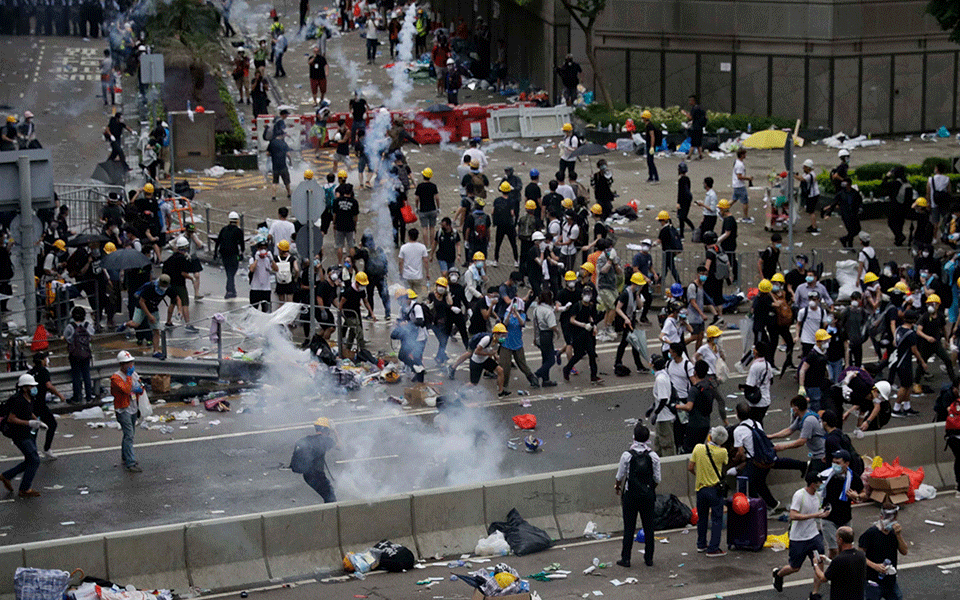
Hong Kong: Violent clashes broke out in Hong Kong on Wednesday as police tried to stop protesters storming the city's parliament, while tens of thousands of people blocked key arteries in a show of strength against government plans to allow extraditions to China.
Police used tear gas, rubber bullets and batons to disperse crowds of black-clad demonstrators -- most of them young people and students -- calling for authorities to scrap the Beijing-backed law.
Clashes broke out shortly after 3:00 pm (0700 GMT) -- the deadline protesters had given for the government to abandon the controversial bill -- and continued throughout the afternoon in the worst political violence the city has seen in years.
Rows of riot police battled protesters -- many wearing face masks, helmets or goggles and using umbrellas as shields -- who had gathered in the centre of the city ahead of a scheduled debate in the city's legislature.
That debate had to be rescheduled "to a later date" after huge crowds seized major roads outside the parliament.
The scenes echoed the pro-democracy "Umbrella Movement" of 2014 where protesters calling for greater democratic rights shut down swathes of the city for two months and battled police but won no concessions from Beijing.
In a repeat of four years ago people flooded major roads and junctions on Wednesday, dragging barricades onto highways and tying them together. Others plucked loose bricks from pavements.
After the deadline expired, protesters broke into the forecourt of the legislature in a bid to breach the building and demonstrators were seen throwing missiles including metal bars at riot police. An injured policeman was carried away unconscious.
Police beat back demonstrators first with batons and pepper spray, then firing rubber bullets and bean bag rounds -- small fabric bags filled with lead pellets -- and dozens of rounds of tear gas as they cleared one side of the surrounded parliament building.
Hong Kong's police chief Stephen Lo defended his officers, saying they had shown restraint until "mobsters" tried to storm parliament.
"These violent protesters kept charging at our line of defence, and used very dangerous weapons, including... throwing metal barricades at us and throwing bricks," he said.
Many Hong Kongers are incensed that the government ignored a massive march on Sunday calling for the bill to be scrapped.
"It's the government who has forced people to escalate their actions, so I think it's inevitable for the fight this time to get heated," said 21-year-old protester Lau Ka-chun.
Organisers said more than a million people turned out on Sunday to oppose the proposed law, which would allow Hong Kong to send suspects to other jurisdictions around the world -- including China.
But the record numbers failed to sway Hong Kong's pro-Beijing leader Carrie Lam, who has rejected calls to withdraw the bill. Matthew Cheung, the city's chief secretary, on Wednesday called on demonstrators to withdraw.
"I also urge citizens who have gathered to show restraint as much as possible, disperse peacefully and do not defy the law," he said in a video message.
Opposition to the bill has united an unusually wide cross-section of the city from influential businesses and lawyers, to religious groups, student unions and workers.
Western nations have criticised the plans while Beijing has voiced support.
Opponents are fearful the law would entangle people in the mainland's opaque courts, leaving them vulnerable to a justice system seen as acting at the behest of the Chinese Communist Party.
Protesters vowed to stay on the streets until the bill is abandoned.
"Stalling is not our ultimate goal. We need them to consider scrapping it," said student Charles Lee, 23. "Clashes are unavoidable if they adopt this attitude towards their citizens."
Lawmakers had been due to debate the bill on Wednesday morning in the city's legislature, which is dominated by Beijing loyalists, with a final vote expected on June 20.
It was not announced when the next meeting on the bill would be held.
"The only responsible thing to do now is for Carrie Lam to withdraw the evil bill, or at least to shelve it in order to solve the crisis," said pro-democracy lawmaker Fernando Cheung.
Hong Kong's leaders say the proposed law is needed to plug loopholes and to stop the city being a sanctuary for fugitives, and that safeguards are in place to ensure that political critics of Beijing will not be targeted.
But many Hong Kongers have little faith in the government's assurances after years of heightened fears that a resurgent Beijing is trying to quash the city's unique freedoms and culture -- despite a 50-year agreement between Hong Kong's former colonial ruler, Britain, and China that means the city is guaranteed freedoms unseen on the Chinese mainland.
Hong Kong's stock market sank nearly 1.8 percent on Wednesday in the city-wide turmoil.
Let the Truth be known. If you read VB and like VB, please be a VB Supporter and Help us deliver the Truth to one and all.
Massive turnout in assembly polls across states, women voters outnumber men: EC data
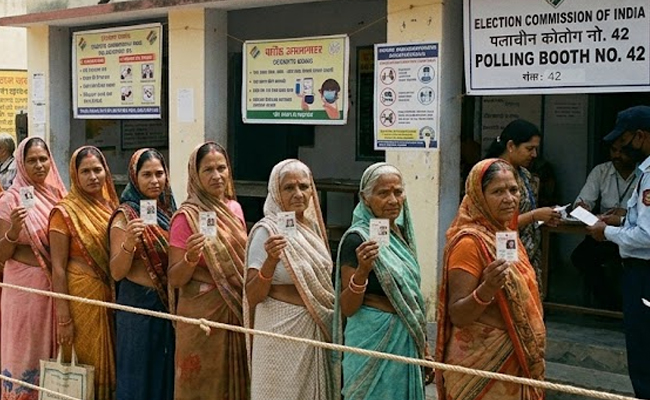
New Delhi (PTI): The recently-concluded assembly elections witnessed exceptionally high voter participation across states, with women voters outnumbering men in turnout percentages, according to Election Commission data.
West Bengal recorded the highest voter turnout among states, with 93.71 per cent polling in 293 constituencies where counting has been completed. The state saw over 6.38 crore votes cast, including postal ballots, against a total of more than 6.81 crore electors.
Women voters recorded a turnout of 93.8 per cent in the West Bengal Assembly polls, slightly higher than the 92.06 per cent participation among men.
The data for West Bengal does not include the figures for the Falta assembly constituency, which is scheduled for repolling.
Tamil Nadu registered an 85.01 per cent turnout, with nearly 4.8 crore votes polled from an electorate of 5.74 crore. Women voters recorded a turnout of 86.2 per cent, higher than the 83.77 per cent among men.
Assam also witnessed robust participation, with the final turnout touching 85.74 per cent. More than 2.15 crore votes were cast in the state, while female turnout at 86.53 per cent marginally exceeded the 84.95 per cent recorded among male voters.
Kerala registered a turnout of 78.11 per cent, with over 2.12 crore votes polled. Female voter participation stood at 81.17 per cent against 74.9 per cent among men.
Puducherry recorded a turnout of 89.82 per cent, with women voters again leading participation at 91.39 per cent. More than 8.5 lakh votes were polled in the Union territory.
Yet, women's representation among elected candidates remained modest.
Tamil Nadu elected 23 women MLAs (9.83 per cent) out of 234 members, West Bengal elected 37 women legislators (12.62 per cent) out of 293, while Kerala returned only 11 women MLAs (7.85 per cent) in the 140-member House.
Only two third-gender candidates contested the elections - one each from Tamil Nadu and Kerala, and both lost, forfeiting their deposits.
The elections also reflected extensive electoral mobilisation infrastructure. West Bengal had the highest number of polling stations at 85,092, followed by Tamil Nadu with 75,064 and Assam with 31,490.
In terms of candidates, Tamil Nadu saw the largest contest with 4,023 candidates in the fray across 234 constituencies, averaging 17 candidates per seat and peaking at 79 contestants in one constituency.
West Bengal pitted 2,920 candidates for 293 constituencies, while Kerala had the fewest contestants among the major states, with 883 candidates for 140 seats.
The data also showed relatively low NOTA votes across states. Tamil Nadu recorded the lowest NOTA share at 0.4 per cent of total votes polled, while Assam recorded the highest at 1.23 per cent. In West Bengal, 0.78 per cent of the total votes polled were NOTA, while it 0.77 per cent and 0.57 per cent of the electorate opted for None of the Above (NOTA) in Puducherry and Kerala, respectively.