I praise India for having assumed leadership for AI Impact Summit: UN chief Guterres
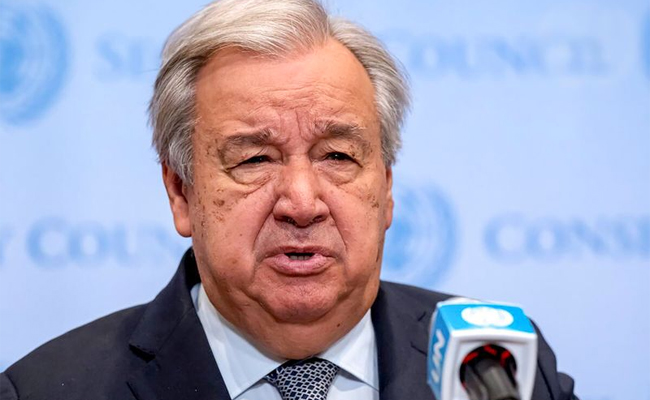
United Nations (PTI): UN chief Antonio Guterres praised India for its leadership for the upcoming global summit on Artificial Intelligence, as he underlined that it is an “absolutely crucial issue” in international relations and one of the biggest challenges of the current times.
Secretary General Guterres will be travelling to India to attend the India–AI Impact Summit 2026 that will be held on February 19-20 in New Delhi.
The Summit, announced by Prime Minister Narendra Modi at the France AI Action Summit, will be the first-ever global AI summit hosted in the Global South and will focus on the principles of 'People, Planet, and Progress'.
“I will be there,” Guterres said at a press conference here Wednesday in response to a question by PTI about the summit.
“Well, I am delighted that I have the chance to participate in this meeting,” Guterres said.
“I do believe that AI today is an absolutely crucial issue in international relations and one of the biggest challenges of our times. So it is very important that countries come together and discuss it, also with civil society, in all kinds of circumstances,” the UN chief said.
“And I praise India for having assumed the leadership in relation to this summit,” he said.
The UN chief underscored that his message to the summit will be directly linked to the conclusions of the Global Digital Compact and to explain to the different Heads of State and entities attending the summit “what exactly will be the role of our international scientific panel, what do we expect from the dialogues and hopefully how can we better mobilize the international community to support capacity building in developing countries.
“And I believe that for India as a developing country, even with remarkable capacity already existing, I believe for India, this objective is the central objective of this summit,” Guterres said.
The India–AI Impact Summit 2026 is anchored in the principles of People, Planet and Progress, and envisions a “future where AI advances humanity, fosters inclusive growth, and safeguards our shared planet.”
The Global Digital Compact, adopted at the 2024 Summit of the Future, had set out a shared vision for an open, safe and inclusive digital future. Among its commitments was the creation of an Independent International Scientific Panel on AI to advance scientific understanding and ensure that international deliberations are informed by the best available evidence, the UN has said.
As part of this, Guterres has recommended 40 distinguished individuals from every region of the world to serve on the Independent International Scientific Panel on Artificial Intelligence.
“The Panel is a direct response to the mandate given by Member States in the Pact for the Future to strengthen multilateral solutions for emerging technologies that are reshaping every aspect of our lives. It will be the first global, fully independent scientific body dedicated to helping close the AI knowledge gap and assess the real impacts of AI across economies and societies,” Guterres said.
Among the 40 individuals whose names the Secretary-General has recommended to the General Assembly for appointment to the panel is Balaraman Ravindran, Head of the Department of Data Science and Artificial Intelligence (DSAI), the Wadhwani School of Data Science and Artificial Intelligence (WSAI) the Robert Bosch Centre for Data Science & Artificial Intelligence (RBCDSAI) and the Centre for Responsible AI (CeRAI) at IIT Madras.
Let the Truth be known. If you read VB and like VB, please be a VB Supporter and Help us deliver the Truth to one and all.
Right to vote under threat, must be made fundamental right: Cong's Jairam Ramesh
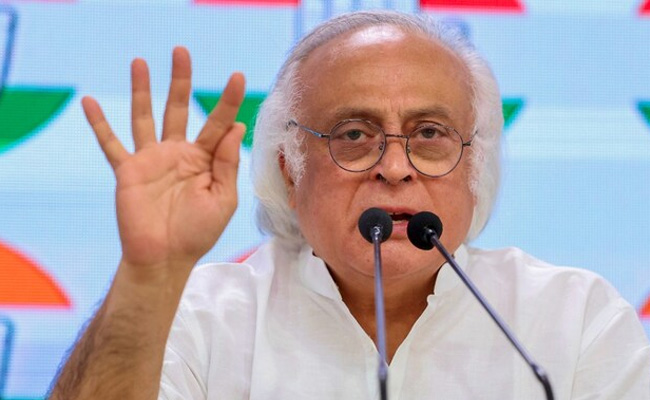
New Delhi (PTI): Congress leader Jairam Ramesh alleged on Thursday that the right to vote is under threat and the time has come when it should be made a fundamental right for citizens.
Speaking with reporters, Ramesh lashed out at Chief Election Commissioner (CEC) Gyanesh Kumar, saying the Election Commission (EC) has never been as compromised as it has been under him.
"The rot started under his predecessor. This man is a player and not a neutral observer," the Congress leader said, slamming Kumar.
Kumar is completely compromised and has become a player in elections, he alleged.
"Home Minister Amit Shah had talked about three Ds -- detect, delete and deport. So we want to know how many non-Indian citizens have been detected, how many have been deleted and how many have been deported," Ramesh said, adding that the right to vote is now under threat.
On opposition parties submitting a fresh notice in the Rajya Sabha, seeking to move a motion for the CEC's removal, the Congress leader said they will continue to make efforts for Kumar's removal as he is "compromised".
Ramesh also batted for the right to vote to be recognised as a fundamental right.
"I believe that the time has come that the right to vote should be made a fundamental right. It is a statutory right, it is not a fundamental right. Fundamental rights are justiciable," he said.
The former Union minister said this was discussed in the Constituent Assembly, but it was eventually decided that it should be made part of the Constitution.
B R Ambedkar and Jagjivan Ram had warned that in the future, governments might try to disenfranchise voters, he added.
"Once and for all, include the right to vote as a fundamental right for Indian citizens," Ramesh asserted.