If elected, will stand with India in confronting threats facing it: Joe Biden
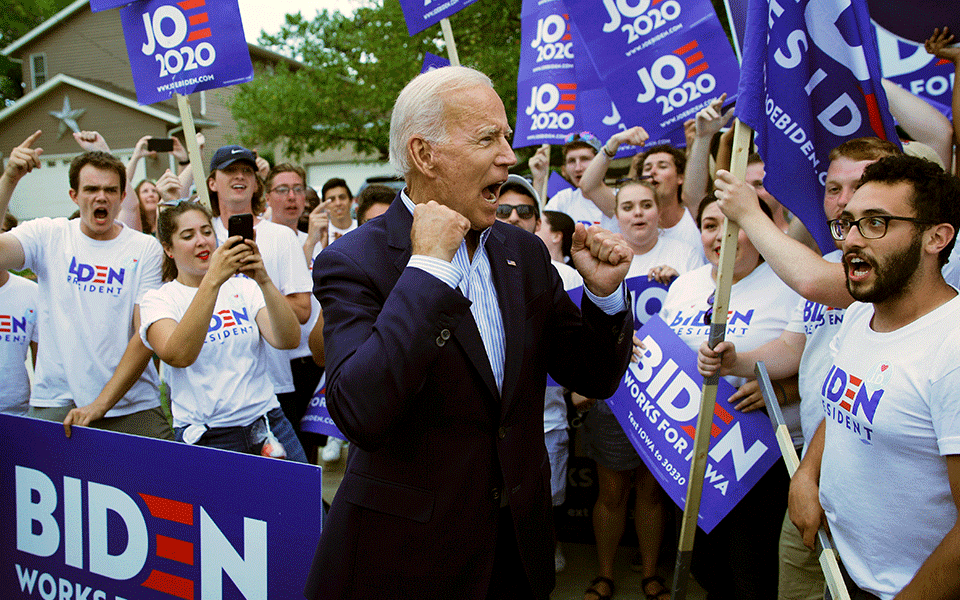
Washington: Democratic presidential nominee Joe Biden asserted that if elected, his administration will stand with New Delhi in confronting the threats it faces and called for strengthening the "bond" between India and the US.
Presidential elections in the US will held on November 3 and the 77-year-old is challenging incumbent Republican President Donald Trump in the polls.
"Fifteen years ago, I was leading the efforts to approve the historic civil nuclear deal with India. I said that if the US and India became closer friends and partners, then the world will be a safer place," Biden, who was vice-president in the Obama administration, said while addressing the Indian-American community on India's Independence Day.
If elected president, Biden said, he will continue to believe this and also continue to stand with India against the threats it faces from its own region and along its borders.
He said that he will work on expanding two-way trade between the two nations and take on big global challenges like climate change and global health security.
If elected, the Democratic candidate said, he will work to strengthen the democracies where diversity is the mutual strength.
On this day, let us "continue to deepen the bond that endures between our nation's and our people, Biden said.
He said that "as President, I'll also continue to rely on the Indian-American diaspora, that keeps our two nations together, as I have throughout my career".
"My constituents in Delaware, my staff in the Senate, the Obama administration that had more Indian-Americans than any other administration in the history of this country, and this campaign with Indian Americans at senior levels, which of course includes the top of the heap, our dear friend (Kamala Harris) who will be the first Indian American vice president in the history of the United States of America, Biden said.
Early this week, Biden scripted history by selecting Indian origin Senator Harris, 55, as his running mate in the US presidential election. Harris, whose father is an African from Jamaica and mother an Indian, is the first-ever Black vice-presidential nominee.
"We all know she's smart, she's tested, she's prepared. But another thing that makes Kamala so inspiring is her mother's immigrant story to the US that started in India, with pure courage that brought her daughters to this moment. I know the pride you feel. It's your story too," Biden said.
"For your sacrifices, and your family's courage, you became pillars of our community and our country. You're patriots and the frontlines of this pandemic. In this reckoning of systemic racism, you're making real real promise that America is a place where people of all races and religions can live together in peace," he said.
"But I know it's hard. I heart goes out to all those of you who have been the targets in a rise in hate crimes, and the crackdown of legal immigration, including a sudden and harmful actions on H-1B visas. That for decades have made America stronger and brought our nation's closer," Biden said.
The H1B visa is a non-immigrant visa that allows US companies to employ foreign workers in speciality occupations that require theoretical or technical expertise.
"While it's sometimes may not feel like the US of your dreams, we will overcome and build back better than ever. Like (former President) Barack Obama had asked to me, I'm asking Kamala Harris, to be the last person in the room to ask the tough questions of me, provide counsel, most of all to always represent the belief in possibilities," the former US vice president said.
Let the Truth be known. If you read VB and like VB, please be a VB Supporter and Help us deliver the Truth to one and all.
India should create strategic buffers to navigate 'most difficult' energy shock: CEA Nageswaran
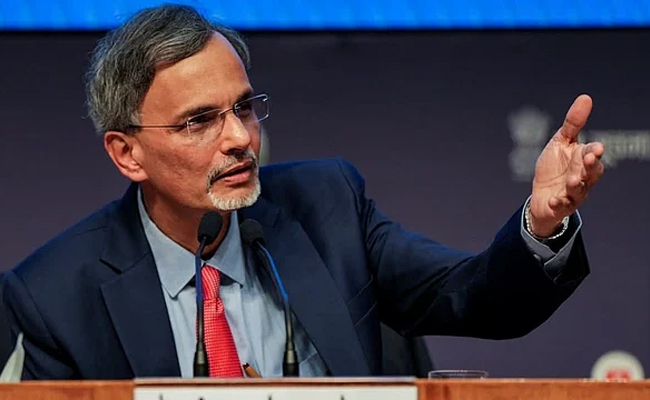
New Delhi (PTI): Chief Economic Advisor V Anantha Nageswaran on Saturday said India needs to create strategic buffers in the face of the "most difficult" energy shock that the country is facing amid the West Asia crisis.
Nageswaran also said the rising prices of fertiliser and petroleum products globally due to the crisis will make it challenging to achieve the 4.3 per cent fiscal deficit target for the current fiscal, while below normal monsoon and pass-through of higher energy prices could lead to "potential inflation spike".
He also said India has employment challenge emanating from AI, and there is a need to ensure that IT sector becomes more competitive and not lose jobs to AI, and instead create jobs that use AI within the IT sector or in other services.
Speaking at the ICPP Growth Conference organised by the Ashoka University, Nageswaran said the current account deficit (CAD) in the current fiscal could rise to over 2 per cent of GDP, from less than 1 per cent in FY'26.
"The ... priority for us is to create strategic buffers. This energy shock is the most difficult one compared to any other previous energy shock in terms of energy lost as a percentage of total global energy supply, not just oil, including gas.
"And we also need to use this occasion to think about other areas where we are vulnerable in terms of import dependence, nickel, tin, and copper. We need to build strategic buffers if we have to make a shot at manufacturing and becoming indispensable," Nageswaran said.
Since the beginning of the war in West Asia on February 28, crude oil prices soared to a four-year high of USD 126 per barrel on Thursday, from about USD 73 level before the war.
Stating that geopolitics will compel policymakers to be nimble and flexible and shed old model of thinking, Nageswaran said India is better prepared than many other countries to deal with the crisis because of the fiscal leeway that the country has due to lowering of fiscal deficit ratio to 4.4 per cent of GDP in FY'26.
Nageswaran said the West Asia conflict is more of a price shock than supply shock for India as the government is managing the supply side deftly.
"This particular conflict, which is going to be on a low simmer or a high flame situation, whatever it is, it is going to be there with us in some form or the other because the military conflict may be over, but the strategic conflict is well and truly alive. It will be so for some time," Nageswaran said.
He said the conflict has four channels of shock: price and supply shock, trade impact, sticky logistics costs and remittance shock.
India imports 60 per cent of its LPG usage and of that, 90 per cent flows through the now closed Strait of Hormuz.
Nageswaran said the pass-through of high global energy prices would have to be a "balancing act". He said some pass-through is already happening in commercial LPG, and the levy of export duty on diesel and ATF.
The government has cut excise duty on petrol and diesel to shield customers from the impact of the rise in petroleum prices. "We are coming around to arriving at a certain modus vivendi with respect to burden-sharing between the fiscal policy side, inflation, households and the oil marketing companies. So it has to be a balancing act," Nageswaran said.