IMF approves USD 1 billion loan for Pak; India abstains from vote, opposes funds to terror-sponsor
New York/Islamabad, May 09 (PTI): The International Monetary Fund has approved the immediate disbursement of about USD 1 billion to Pakistan under the ongoing Extended Fund Facility.
Pointing out that rewarding continued sponsorship of cross-border terrorism sends a dangerous message to the global community, India abstained from voting at the crucial International Monetary Fund (IMF) held on Friday in Washington.
An IMF statement soon after said its Executive Board concluded the initial review of Pakistan's economic reform programme under the Extended Fund Facility (EFF) arrangement.
“This decision allows for an immediate disbursement of around USD 1 billion (SDR 760 million), bringing total disbursements under the arrangement to about USD 2.1 billion (SDR 1.52 billion),” the Washington-based global lender said.
According to the IMF, Special Drawing Rights (SDR) is an international reserve asset created to supplement the official reserves of its member countries.
In addition, the IMF Executive Board approved the authorities' request for an arrangement under the Resilience and Sustainability Facility (RSF), with access of about USD 1.4 billion (SDR 1 billion).
The IMF said in a statement that Pakistan's 37-month EFF was approved on September 25, 2024 and “aims to build resilience and enable sustainable growth”, with priorities including entrenching macroeconomic sustainability.
It said the RSF will support Pakistan's efforts to reduce vulnerabilities to natural disasters and to build economic and climate resilience.
Following the Executive Board discussion, Deputy Managing Director and Chair Nigel Clarke said risks to the outlook remain elevated, “particularly from global economic policy uncertainty, rising geopolitical tensions, and persistent domestic vulnerabilities”.
India earlier raised concerns over the efficacy of IMF programmes in the case of Pakistan, given its poor track record, and also on the possibility of misuse of debt financing funds for state-sponsored cross-border terrorism.
New Delhi also opposed the IMF's proposal to extend fresh loans of USD 2.3 billion to Pakistan, saying they could also be misused for financing state-sponsored cross-border terrorism.
India registered its protest at the board of IMF and abstained from voting at the crucial meeting. The IMF took note of India's statements and its abstention from the vote.
New Delhi's opposition at the IMF comes at a time when the Indian and Pakistani militaries are targetting each other's installations using missiles over the last two days, further escalating the already tense conflict situation triggered by the April 22 terror attack that killed 26 people at Pahalgam in Jammu and Kashmir.
India abstained from the vote because IMF rules do not permit a formal “no” vote, official sources noted and added that the rules allow either any of the 25 directors, who represent member countries or groups of countries, to vote in favour of a proposal or abstain to show their disapproval.
“Unlike in the United Nations, where each country has one vote, they noted that the IMF voting power reflects the economic size of each member. So a country like the United States holds a disproportionately high voting share,” the sources said.
An official said, “By abstaining, India conveyed its strong dissent within the constraints of the IMF’s voting system and used the opportunity to formally record its objections.”
“India’s key objections included the questioning of the effectiveness of the ongoing IMF assistance, noting that Pakistan has received support in 28 of the past 35 years, including four programmes in just the last five years, without any meaningful or lasting reform,” the official added.
“India strongly highlighted the Pakistani military’s continued dominance in economic affairs, which undermines transparency, civilian oversight, and sustainable reform.”
After the IMF meeting, the Indian finance ministry said in a statement in New Delhi that India pointed out that rewarding continued sponsorship of cross-border terrorism sends a dangerous message to the global community, exposes funding agencies and donors to reputational risks and makes a mockery of global values.
“While the concern that fungible inflows from international financial institutions, like the IMF, could be misused for military and state-sponsored cross-border terrorist purposes resonated with several member countries.
“The IMF's response is circumscribed by procedural and technical formalities. This is a serious gap highlighting the urgent need to ensure that moral values are given appropriate consideration in the procedures followed by global financial institutions,” the ministry said.
It further said that the Pakistan military's deeply entrenched interference in economic affairs poses significant risks of policy slippages and reversal of reforms.
Even when a civilian government is in power now, the army continues to play an outsized role in domestic politics and extends its tentacles deep into the economy. A 2021 UN report described military-linked businesses as the “largest conglomerate in Pakistan”, the statement said.
The situation has not changed for the better; rather the Pakistan army now plays a leading role in the Special Investment Facilitation Council of Pakistan, it noted.
Meanwhile, a statement from the Prime Minister's Office in Pakistan said, “Prime Minister Shehbaz Sharif expressed satisfaction over the approval of a USD 1bn dollar instalment for Pakistan by the IMF and the failure of India's high-handed tactics against it.”
“Pakistan's economic situation has improved, and the country is moving towards development. India is plotting a conspiracy to divert attention from our country's development through unilateral aggression”, it said.
“Indian attempts to sabotage the IMF programme have failed,” the statement claimed, adding that the IMF programme would help stabilise Pakistan's economy and put it on the path towards long-term recovery.
“We are working on priority areas such as tax reform, improved energy sector performance and private sector development. The improved economic indicators in the last 14 months are a reflection of the government's positive policies,” it added.
The approval of the IMF's executive board has led to an immediate disbursement of USD 1 billion, bringing total disbursements under the loan programme to about USD 2 billion.
On the successful completion of seven half-yearly reviews, Pakistan is entitled to seven equal instalments of about USD 1 billion under the loan programme.
Pakistan and the IMF had reached a three-year USD 7 billion aid package deal in July last with the new programme set to allow the country to cement macroeconomic stability and create conditions for stronger, more inclusive and resilient growth.
The IMF and Pakistan had reached a staff-level agreement on March 25 this year on the first biannual review of the 39-month USD 7 billion loan programme, agreeing on a series of reforms including the introduction of a carbon levy, timely revisions to electricity tariffs, increased water pricing and liberalisation of the automobile sector.
Let the Truth be known. If you read VB and like VB, please be a VB Supporter and Help us deliver the Truth to one and all.
Chhattisgarh Vedanta power plant blast: Death toll rises to 20; sixteen workers undergoing treatment
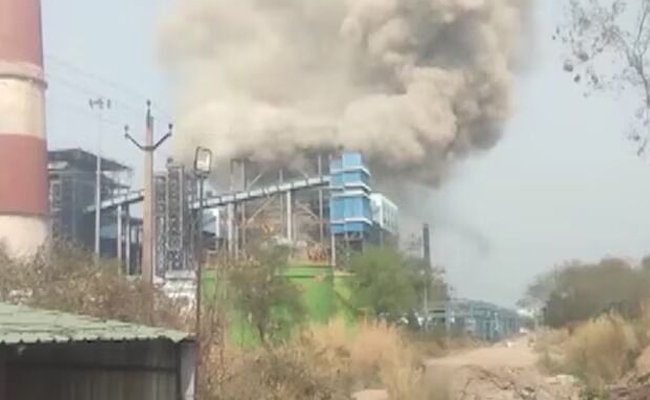
Sakti (Chhattisgarh) (PTI): The death toll in a blast at the Vedanta power plant in Chhattisgarh's Sakti district has mounted to 20 with seven more workers succumbing to injuries, while 16 others are undergoing treatment at different hospitals, officials said on Wednesday.
The deceased include six labourers from West Bengal, five from Chhattisgarh, three each from Jharkhand and Uttar Pradesh, two from Bihar, and one from Madhya Pradesh.
The opposition Congress has demanded registration of an FIR against the plant management and a judicial inquiry into the incident.
The explosion occurred on Tuesday afternoon in a steel tube carrying high-pressure steam from the boiler to the turbine at the Vedanta Ltd power plant located in Singhitarai village, leaving several workers with severe burn injuries.
According to officials, four workers died on the spot, while nine others succumbed to injuries soon after the incident.
Seven more workers have died in hospitals, raising the toll to 20, Sakti Collector Amrit Vikas Topno told PTI on Wednesday.
He said that a total of 36 workers were affected in the blast, and 20 of them died.
"Of the 16 injured workers, five are undergoing treatment in hospitals in Raipur, while 11 others are in hospitals of Raigarh, the neighbouring district of Sakti," he added.
Topno added that every possible effort was being made to provide the best medical treatment to the injured.
The deceased were identified, and their family members are being contacted. Arrangements have been made to transport the mortal remains to their native villages via ambulance following the postmortem examination and to provide immediate financial assistance, he said.
Chief Minister Vishnu Deo Sai has announced a compensation of Rs 5 lakh to the families of each deceased worker and Rs 50,000 for those injured.
Vedanta Power has also announced a Rs 35 lakh compensation for the family of each deceased worker, along with employment support.
The company will also provide Rs 15 lakh to each injured person, ensure salary continuation until recovery, and offer counselling support, a statement from the plant management said.
The chief minister has ordered an inquiry by the Commissioner of the Bilaspur division, assuring strict action against the guilty.
He directed officials to ensure free and proper medical treatment for all injured and emphasised that no negligence in their care would be tolerated.
The district administration has also ordered a separate magisterial probe, while the company has initiated its own internal investigation.
Collector Topno has appointed the Sub-Divisional Magistrate (SDM) of Dabhra to conduct the magisterial inquiry.
The SDM has been asked to submit a report within 30 days covering key aspects, including the cause of the accident, whether it was due to technical or human error, and details of safety inspections carried out at the plant.
Meanwhile, the opposition Congress has demanded registration of an FIR against the plant management and a judicial inquiry into the incident.
State Congress communication wing head Sushil Anand Shukla on Wednesday alleged negligence on the plant management's part and accused the government of attempting to shield those responsible.
He also demanded compensation of Rs 1 crore for the families of the deceased and Rs 50 lakh for the injured.
The construction of a 1,200 MW coal-based thermal power project (two units of 600 MW each) in Singhitarai, originally owned by Athena Chhattisgarh Power Ltd, started in 2009, but remained stalled between 2016 and 2022.
Vedanta acquired the plant in 2022, after which a 600 MW unit was completed and commissioned in August last year, while the second unit is still under construction.
The deceased have been identified as Amrit Lal Patel, Thanda Ram Lahre, Udhab Singh Yadav, Rameshwar Mahilange, and Nadeem Ansari (all from Chhattisgarh); Susanta Jana, Sheikh Saifuddin, Manas Giri, Kailash Mahto, Shibnath Murmu, and Dipankar Singh (West Bengal), Tarun Kumar Ojha, Abdul Karim and Ashok Parhiya (Jharkhand), Raju Ram, Pappu Kumar and Brijesh Kumar (Uttar Pradesh), Aakib Khan and Ritesh Kumar (Bihar), and Chitranjan Dhulai of Madhya Pradesh, officials said.