Effects of global slowdown more pronounced in India: IMF
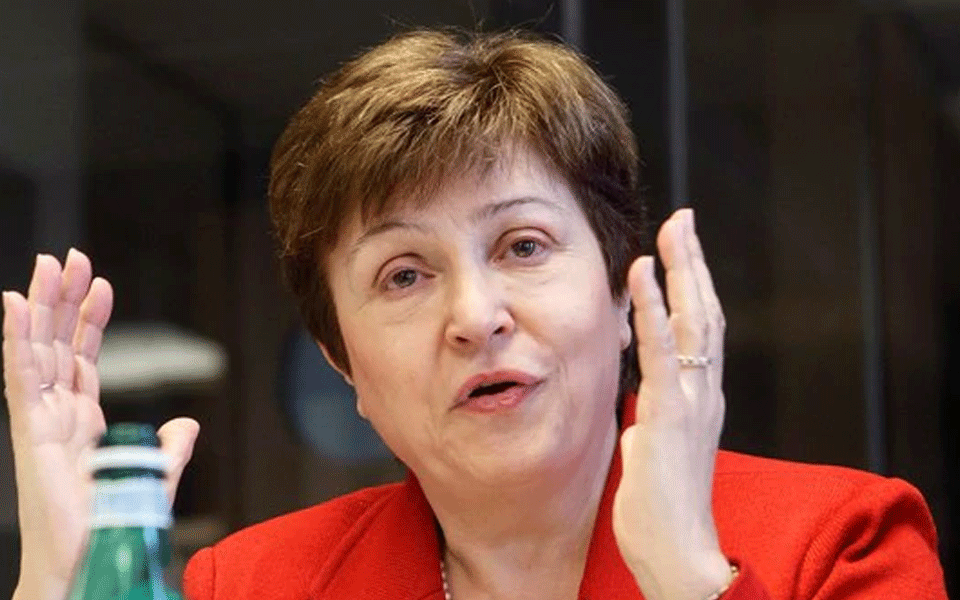
Washington: The global economy is witnessing "synchronized slowdown", which will result in slower growth for 90 per cent of the world this year, and the effect is even "more pronounced" in some of the largest emerging market economies like India, new IMF chief Kristalina Georgieva has warned.
The Managing Director of International Monetary Fund (IMF) pointed out that the widespread deceleration means that growth this year will fall to its lowest rate since the beginning of the decade.
She said the World Economic Outlook to be released next week will show downward revisions for 2019 and 2020.
"In 2019, we expect slower growth in nearly 90 per cent of the world. The global economy is now in a synchronized slowdown," Georgieva said on Tuesday in her curtain raiser speech for the IMF and World Bank's annual meeting here next week.
The headline numbers reflect a complex situation, she said.
Despite this overall deceleration, close to 40 emerging market and developing economies are forecast to have real GDP growth rates above 5 per cent including 19 in sub-Saharan Africa, the IMF chief said.
In the United States and Germany, unemployment is at historic lows. Yet across advanced economies, including in the US, Japan and especially the euro area, there is a softening of economic activity, she said.
"In some of the largest emerging market economies, such as India and Brazil, the slowdown is even more pronounced this year. In China, growth is gradually coming down from the rapid pace it saw for many years," Georgieva said.
The precarious outlook presents challenges for countries already facing difficulties including some of the Fund's programme countries, she noted.
Georgieva called for using monetary policy wisely and enhancing financial stability.
"Now is the time for countries with room in their budgets to deploy or get ready to deploy fiscal firepower. In fact, low interest rates may give some policymakers additional money to spend," she said.
Referring to a new IMF research, which shows how structural reforms can raise productivity and generate enormous economic gains, she said these changes are the key to achieving higher growth over the medium and long-term.
"The right reforms in the right sequence could double the speed at which emerging markets and developing economies reach the living standards of the advanced economies," Georgieva said.
While the need for international cooperation is going up, the will to engage is going down, she rued.
"Trade is a case in point. And yet, we need to work together. From safely adapting to fintech, to fully implementing the financial regulatory reform agenda, to fighting money laundering and the financing of terrorism," Georgieva said.
Describing climate Change as a crisis where no one is immune and everyone has a responsibility to act, she said one of its priorities was to assist countries as they reduce carbon emissions and become more climate resilient.
At the current average carbon price of USD 2 per ton, most people and most companies have little financial incentive to make this transition. Limiting global warming to a safe level requires a significantly higher carbon price, she added.
Let the Truth be known. If you read VB and like VB, please be a VB Supporter and Help us deliver the Truth to one and all.
AIITA welcomes Karnataka’s ban on obscene songs in school events

Bhatkal: The Karnataka unit of the All India Ideal Teachers Association (AIITA) has welcomed the Karnataka government’s decision to strictly ban school children from dancing to obscene songs during educational and cultural programmes in government, aided, and private schools across the state.
AIITA Karnataka State President M. R. Manvi congratulated the government for taking what he termed an important step to preserve the sanctity of education.
“Such decisions to safeguard the dignity of school children and uphold the values of education are the need of the hour. This rule should not be limited to government schools alone but must be strictly implemented in all private educational institutions as well,” he said.
He further urged the government to address other concerns within school programmes.
“The government should not only prohibit obscene dances in the name of school anniversaries, but also ensure that plays and dialogues that incite religious hatred are avoided. Schools should be centres of harmony, not platforms for spreading hatred,” he added.
According to a recent circular issued by the Department of School Education and Literacy, obscene dances are adversely affecting the mental health and moral values of students.
In this regard, schools have been advised to use songs that promote nationalism, positive thinking, the greatness of Kannada culture, and value-based traditions instead of inappropriate content during programmes.
The circular also emphasises that students should be dressed in decent attire.
AIITA also backed the department’s warning that disciplinary action would be taken against head teachers if such guidelines are violated. The association has further demanded that district Deputy Directors of Public Instruction strictly monitor the implementation of these rules.