Impelsys announces leadership expansion; Says, will mark new era of growth for company

New York City: Impelsys, a leading global provider of technology and innovation to customers, has announced the appointments of Anand Ramachandran as its Chief Revenue Officer (CRO) and Barry Bealer as Vice President for Publishing, Information, and Education.
This comes on the back of the strategic appointments of Sripad KB, Venkat Srini, and Vincent Emerald as practice heads for Cloud, Data & Analytics, and Software Testing Services. The expansion signifies a commitment to deliver unparalleled value to its customers and help them forge ahead in their digital transformation journeys. These appointments are also part of a strategic shift to deepen offerings in the Healthcare, Publishing, Information, and Education industries.
The arrival of Anand, Barry, and other practice heads mark a significant milestone in our journey of continuous innovation and growth,” said Sameer Shariff, CEO of Impelsys. “Their expertise and leadership will play a crucial role in further establishing Impelsys as a trusted partner to its customers around the globe. Both Anand and Barry bring a wealth of industry experience and will expand Impelsys capabilities to deliver optimal solutions to its customers; their background in business development will drive Impelsys in its next phase of growth.
Expressing his delight at being a part of the growth story at Impelsys, Anand Ramachandran said, “We are entering a truly exciting phase of convergence where our tech-capabilities, cutting-edge innovation, and our expertise in setting up evolving business models like Global Capability Centers (GCCs) are driving business value to our customers. I also believe that a substantial portion of our business will move towards these modern business models.”
Sharing his excitement, Barry Bealer said, “I’m thrilled to join Impelsys. I’m certain that our mix of people, technology, and processes is a winning combination to drive growth and value. My focus is firmly towards how we can make a difference to customers in Publishing, Information, and Education with our next-gen technology solutions in Cloud, Generative AI, Data Analytics, and AI/ML solutions.”
With this strategic expansion, Impelsys aims to solidify its presence, particularly in Healthcare, Publishing, Information Services, and Education. The company anticipates more growth in the future and actively seeks to broaden its presence across key global markets and verticals.
About Impelsys:
Impelsys is a global provider of technology and innovation that helps organizations transform into digital-first, data-driven intelligent enterprises. Headquartered in New York, NY, with an innovation center in Porto, Portugal, and engineering centers of excellence in Bangalore and Mangalore, India, Impelsys continues to support an ever-growing global client base. With over two decades of expertise in innovation and technology, Impelsys is a trusted partner for organizations seeking end- to-end digital advancement.
Let the Truth be known. If you read VB and like VB, please be a VB Supporter and Help us deliver the Truth to one and all.
Akash Singh says signature celebration fuels motivation, reinforces dominance
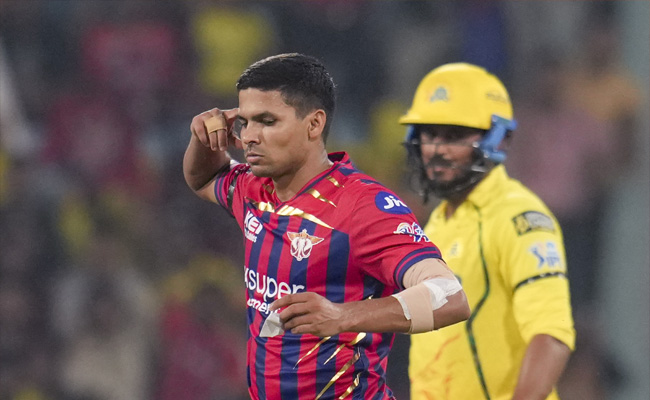
Lucknow (PTI): Pacer Akash Singh caught the eye with his unique celebration during Lucknow Super Giants' win over Chennai Super Kings, pulling out a piece of paper from his pocket after a wicket, a gesture he said was aimed at "motivating" himself and "asserting dominance" over batters.
The left-arm pacer pulled out a scrappy piece of paper after each of the three wickets he took in LSG seven-wicket win over CSK, with the message reading: "Akki on fire -- Akash knows how to take wickets in T20 cricket.
The 24-year-old, who began his IPL journey with Rajasthan Royals and was part of Chennai Super Kings’ title-winning campaign in 2023 before moving to Lucknow Super Giants, registered his best IPL figures with 3 for 26 on Friday.
"'Akki knows how to take wickets in T20 cricket', right?" Akash said when asked about the message on the piece of paper, adding that it serves as a source of motivation and helps him focus on dominating batters and delivering stronger performances for the team.
"Different things motivate different people. Some days I show the paper, some days I don't, but it reflects my mindset on that particular day. When you carry a piece of paper with something written on it, you manifest things and the most important part is when those manifestations actually materialise," he added.
Akash, who hails from Bharatpur in Rajasthan, said the strong backing from the Lucknow Super Giants support staff over the last two years had played a huge role in his growth as a cricketer.
"I've been with LSG for two years and the most important thing has been the backing from the coaches, even when I'm not in the playing XI. This year we have Bharat Arun sir, last year Zaheer sir was there...Tom Moody. The way they guide us, prepare us and keep us ready for opportunities is very important when there are 25 players in the squad," he said.
"When you are not playing, you naturally seek backing and every player wants to make the most of the opportunities he gets. The support from the captain also matters a lot and with Rishabh bhaiya backing you, the confidence grows and you are able to perform better," Akash said, referring to Rishabh Pant.
Akash said Pant had asked him to trust his strengths ahead of the clash against CSK.
"He told me that the new ball is my strength and that I can swing it both ways. So I just tried to make the best use of my skills. The wicket also had good bounce, so I focused on using the bouncer effectively,” added Akash.
On his success against CSK, Akash said his experience of playing in the IPL since 2020, including a stint with CSK, helped him understand the opposition batters better, while backing his own strengths with the ball also played a key role in his impressive spell.
"Obviously, when you play in the IPL and have shared the dressing room with some players, you understand their strengths and weaknesses. My focus was first to back my own strengths, then exploit their weaknesses and also make the best use of what the wicket was offering," Akash said.
Akash said he had sensed over the last two-three games that an opportunity could come his way after being repeatedly told to "be ready", though he admitted he was unfortunate not to get a chance earlier.
"Two days before the match, during practice, I was told to be ready," he said.
Clarifying that he had not been carrying the piece of paper in anticipation, Akash said he often notes down thoughts that could help improve his game..
"Whenever I’m alone or about to sleep, any thought that comes to my mind which can help my cricket, I write it down. The other night I got this thought and jotted it down on paper," he added.