Imran Khan calling Osama bin Laden a 'martyr' was a 'slip of the tongue': Pak info minister
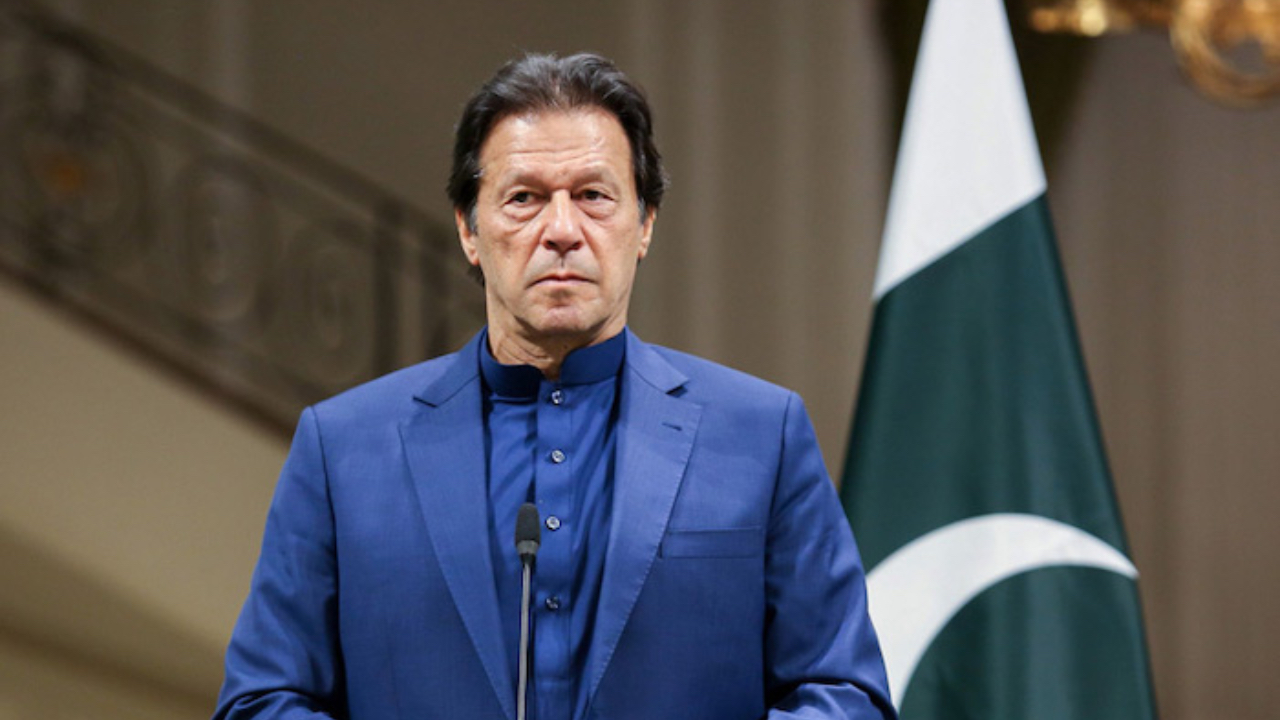
Islamabad, Jun 27: One year after Prime Minister Imran Khan described slain Al Qaeda leader Osama bin Laden as a "shaheed" (martyr), Pakistan's information minister on Sunday clarified that it was a "slip of the tongue" by his boss.
Speaking in Parliament on June 25 last year, Khan said the American forces entered Pakistan and killed bin Laden without informing the government after which everyone started abusing his country.
"I don't think there's a country which supported the war on terror and had to face embarrassment for it. Pakistan was also openly blamed for US' failure in Afghanistan," Khan had said.
"For Pakistanis across the globe, it was an embarrassing moment when the Americans came and killed Osama bin Laden at Abottabad...martyred him. The whole world started abusing us after that. Our ally came inside our country and killed someone without informing us. And, 70,000 Pakistanis died because of US' war on terror," he told lawmakers, drawing criticism from the Opposition as well as from the media.
Bin Laden, then the world's most wanted terrorist, was killed by US Navy Seals in a covert military operation in the Pakistani garrison city of Abbottabad in May, 2011.
Speaking on Geo News programme Jirga, aired on Sunday, Information Minister Fawad Chaudhry said, "It was a slip of the tongue. He had clarified it," the minister said while referring to Khan's controversial remarks.
The controversy surfaced again last week when Foreign Minister Shah Mahmood Qureshi refrained from calling Osama bin Laden a terrorist in an interview with Afghanistan's Tolo News.
When the interviewer quoted Prime Minister Imran as calling bin Laden a martyr , Qureshi said: Well, again. Out of context. He (the PM) was quoted out of context. And, a particular section of the media pair it up.
Asked if he would disagree, the foreign minister paused for a while and then said: I will let it pass, the Dawn newspaper reported.
The leading Pakistani in an editorial noted that Qureshi's refusal to call bin Laden a terrorist in an interview with an Afghan media outlet is perplexing and defies logic.
"There are times to be diplomatic and parry sticky questions. However, this certainly didn't appear to be one of those instances," the Dawn said.
"Mr Qureshi could have used this opportunity to clearly state that Pakistan considers the late Al Qaeda mastermind a terrorist. However, his non-committal comments sent the wrong message to a global audience," it pointed out.
"Pakistan's top leadership needs to be absolutely clear when it comes to describing fighters like bin Laden," the editorial stressed.
When asked about Qureshi's remarks by Tolo News anchor, Information Minister Chaudhry said the foreign minister's refusal to call bin Laden a terrorist might have had to do with his desire to "move forwards, instead of looking at the past".
The information minister said a clarification had been issued last year by Prime Minister Imran's spokesperson after his remarks. He emphasised that Pakistan had rendered the most sacrifices in the war against terrorism.
"Our position is entirely clear," the senior leader of Khan's Pakistan Tehreek-e-Insaf (PTI) said, adding that "when our own media exaggerate things then, of course, the foreign [media] will pick them up from local sources."
Let the Truth be known. If you read VB and like VB, please be a VB Supporter and Help us deliver the Truth to one and all.
Two injuries, one DNF, a DQ as India end messy World Relays campaign
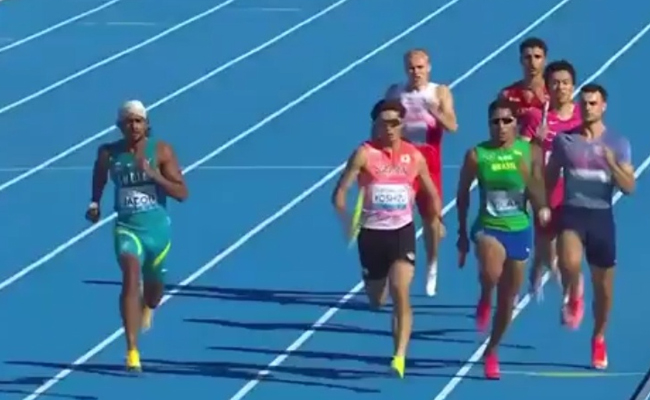
Gaborone (Botswana) (PTI): Amoj Jacob and Ragul Kumar got injured during the men's 4x400m and 4x100 races respectively as India ended their World Athletics Relays campaign in disappointment on the second day of competitions here on Sunday.
The Indian camp had high hopes of making the 2027 World Championships in the men's 4x400m relay but the team did not finish (DNF) the race as Jacob suffered cramps and pulled out of the race after taking the baton from the first leg runner Dharamveer Choudhary. Rajesh Ramesh and Vishal TK were to run in the third and fourth legs.
Those teams which could not qualify for the 2027 Beijing World Championships by reaching the final round of each of the six relay events on Saturday were given another chance in the second qualification round on Sunday.
The top two teams in each of the two heats (in all six relay events) booked the Beijing ticket on Sunday.
India will now have to try and qualify for the World Championships through the Top Lists of the World Athletics, which is a long and tedious process.
In the men's 4x100m race, third leg runner Ragul Kumar fell down the track after failing to hand over the baton inside the exchange zone to fourth leg runner Gurindervir Singh, which clearly showed the lack of coordination among the runners.
Harsh Santosh Raut and Animesh Kujur ran the first two legs.
The Indian quartet was disqualified and Kumar was seen being taken away from the Field of Play with the help of the volunteers.
It was a comedy of errors in the case of the women's 4x100m race, which saw the baton being dropped during an exchange between first leg runner Tamanna and second runner Nithya Gandhe, though the Indians finished the race in 53.09 seconds.
Gandhe started running quite a distance, but after realising that the baton was not in her hand, she turned and ran back to pick it up.
The only silver-lining for the Indian contingent was the national record time in the mixed 4x100m relay race, though the quartet of Ragul Kumar, Nithya Gandhe, Animesh Kujur and Sneha SS finished sixth in heat number two with a time of 41.35 seconds, bettering the previous national mark of 42.30 seconds set in March in Chandigarh.
The mixed 4x400m relay quartet of Theerthesh P Shetty, Kumari Saloni, Nihal William and Rashdeep Kaur ended at fifth in heat number one with a time of 3 minutes and 19.40 seconds.
On Saturday, all the five Indian relay teams had failed to make it to the respective final rounds and thus missed out on the 2027 World Championships berths.