Imran Khan warns of possibility of conventional war with India
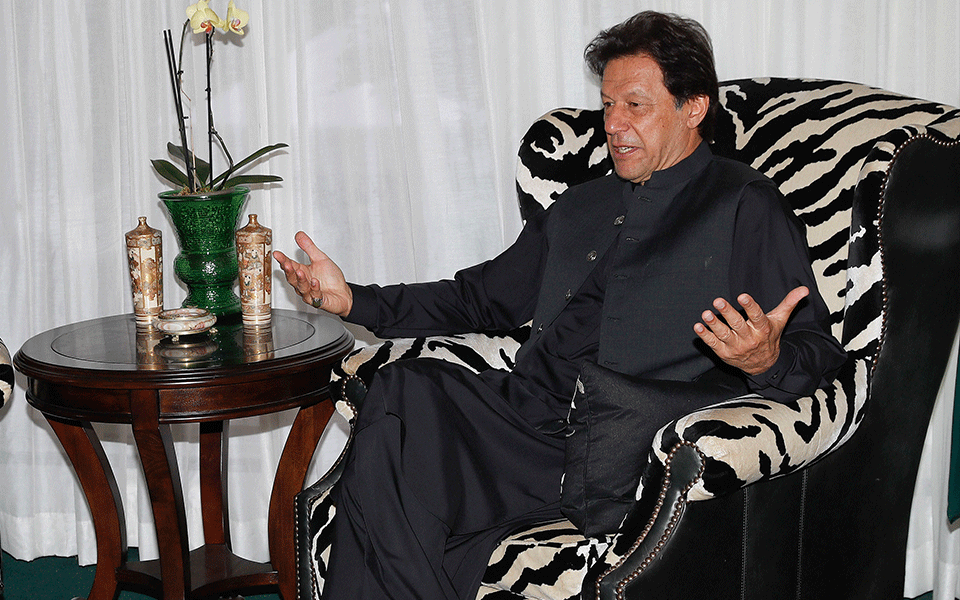
Islamabad: Pakistan Prime Minister Imran Khan has said there was no question of talking to New Delhi after it revoked the special status of Jammu and Kashmir, as he warned about the possibility of a conventional war with India which could go beyond the subcontinent.
"So that's why we have approached the United Nations, we are approaching every international forum, that they must act right now," he said.
Khan said he "absolutely" believes war with India could be a possibility.
"...this is a potential disaster that would go way beyond the Indian subcontinent," Khan said.
He said that Pakistan would never start a war.
"I am a pacifist, I am anti-war, I believe that wars do not solve any problems," he told Al Jazeera.
"When two nuclear-armed countries fight, if they fight a conventional war, there is every possibility that it is going to end up into nuclear war. The unthinkable," he said.
"If say Pakistan, God forbid, we are fighting a conventional war, we are losing, and if a country is stuck between the choice: either you surrender or you fight 'till death for your freedom, I know Pakistanis will fight to death for their freedom," he said.
Tensions between India and Pakistan spiked after New Delhi abrogated provisions of Article 370 of the Constitution to withdraw Jammu and Kashmir's special status and bifurcated it into two Union Territories.
Pakistan downgraded its diplomatic relations with India and expelled the Indian high commissioner following the revocation of Article 370 in Jammu and Kashmir on August 5.
Khan claimed that Pakistan till recently had made attempts to open dialogue with India "to live as civilised neighbours, to resolve our difference [over Kashmir] ... through a political settlement".
He alleged that India tried to blacklist in FATF (Financial Action Task Force).
"If Pakistan is pushed into the blacklist of FATF that means there will be sanctions on Pakistan. So they were trying to bankrupt us economically, so that's when we pulled back. And that's when we realised that this government is on an agenda ... to push Pakistan to disaster," says Khan.
"There is no question of talking to the Indian government right now after they revoked this article 370 of their own constitution and they annexed Kashmir illegally against the UN Security Council resolution," Khan said.
Asserting that abrogation of Article 370 was its internal matter, India has strongly criticised Pakistan for making "irresponsible statements" and provocative anti-India rhetoric over issues internal to it.
Let the Truth be known. If you read VB and like VB, please be a VB Supporter and Help us deliver the Truth to one and all.
AIITA welcomes Karnataka’s ban on obscene songs in school events
Bhatkal: The Karnataka unit of the All India Ideal Teachers Association (AIITA) has welcomed the Karnataka government’s decision to strictly ban school children from dancing to obscene songs during educational and cultural programmes in government, aided, and private schools across the state.
AIITA Karnataka State President M. R. Manvi congratulated the government for taking what he termed an important step to preserve the sanctity of education.
“Such decisions to safeguard the dignity of school children and uphold the values of education are the need of the hour. This rule should not be limited to government schools alone but must be strictly implemented in all private educational institutions as well,” he said.
He further urged the government to address other concerns within school programmes.
“The government should not only prohibit obscene dances in the name of school anniversaries, but also ensure that plays and dialogues that incite religious hatred are avoided. Schools should be centres of harmony, not platforms for spreading hatred,” he added.
According to a recent circular issued by the Department of School Education and Literacy, obscene dances are adversely affecting the mental health and moral values of students.
In this regard, schools have been advised to use songs that promote nationalism, positive thinking, the greatness of Kannada culture, and value-based traditions instead of inappropriate content during programmes.
The circular also emphasises that students should be dressed in decent attire.
AIITA also backed the department’s warning that disciplinary action would be taken against head teachers if such guidelines are violated. The association has further demanded that district Deputy Directors of Public Instruction strictly monitor the implementation of these rules.