In Ethiopian Prime Minister Abiy Ahmed's new cabinet, half the ministers are women
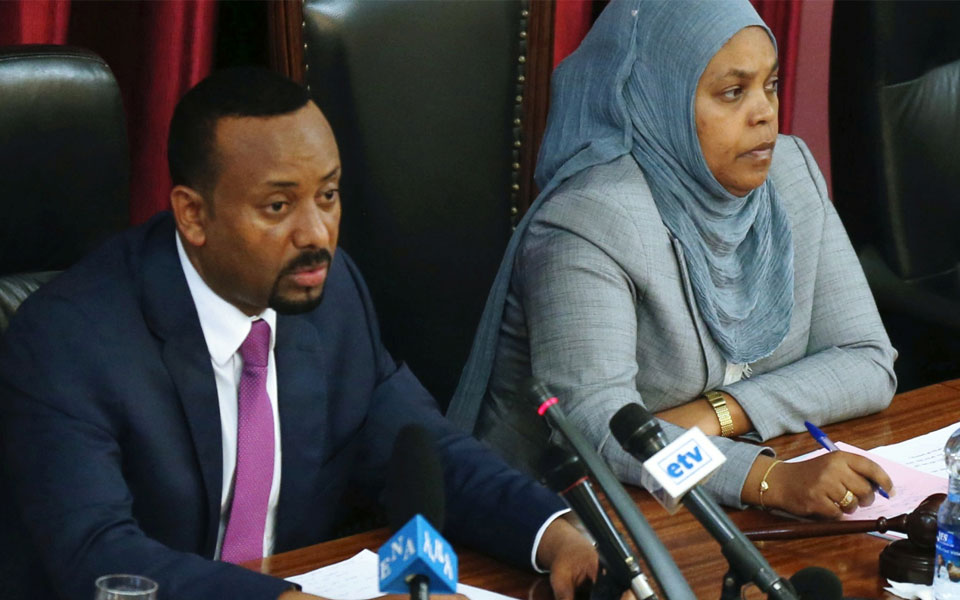
ADDIS ABABA, Ethiopia: Ethiopia’s reformist prime minister announced Tuesday a new cabinet that is half female, in an unprecedented push for gender parity in Africa’s second-most-populous nation.
Prime Minister Abiy Ahmed has marked his nearly seven months in office with staggering reforms for this once authoritarian country, notably releasing thousands of political prisoners, making peace with Ethiopia’s main enemy, Eritrea, and promising to open up the economy.

Ethiopia's newly appointed ministers take their oath of office on Tuesday at the parliament in the capital Addis Ababa. (Stringer/AFP/Getty Images)
The new cabinet, which reduces ministerial positions from 28 to 20, has women in the top security posts for the first time in Ethiopia’s history. Aisha Mohammed will be in charge of defense, and Muferiat Kamil, a former parliamentary speaker, will head the newly formed Ministry of Peace.
In some ways, this could be one of the most important ministries in the government, though its name has garnered a degree of criticism on social media for its Orwellian sound. It oversees the federal police, the intelligence services and the information security agency, and it will take the lead in tackling much of the ethnic unrest that has swept the countryside since Abiy’s reforms.
“Our women ministers will disprove the adage that women can’t lead,” Abiy said in Parliament.
Although women have been in the cabinet before, they often held minor positions. In the new cabinet, in addition to defense and security, women will head the ministries of trade, transport and labor, as well as culture, science and revenue.
Awol Allo, an expert on Ethiopia at Britain’s Keele University, said this was especially important because the lack of gender equality is a persistent problem in the country, which has strong patriarchal traditions.
“It is a very important and progressive move on the part of the prime minister and very consistent with the transformative agendas he’s been pursuing,” Allo said. “I also think it sends a strong message to young Ethiopian women that one day they can take up positions in the government.”

Ethiopia’s newly appointed Minister of National Defence, Aisha Mohammed, arrives to take her oath of office on Tuesday at the parliament in Addis Ababa. (Stringer/AFP/Getty Images)
Also represented in the new cabinet are often marginalized ethnic groups. A diverse nation of about 80 ethnicities, Ethiopia has long been dominated by just a few groups.
Aisha, the new defense minister, comes from the arid and predominantly Muslim Afar region, while Finance Minister Ahmed Shide is from the Somali region.
[Ethiopia’s ethnic divides rock capital as reports of killings prompt angry protests]
Hallelujah Lulie, an analyst based in Addis Ababa, pointed out the presence in the cabinet of two Muslim women who wear headscarves, an important inclusion in a country that is one-third Muslim.
“Muslims were historically underrepresented,” he said. “It is a good move. It projects a good image. It’s inspiring in many ways.”
While much depends on how the new cabinet will tackle the country’s many challenges, including job creation for an overwhelmingly young population and a difficult transition away from an authoritarian system, Hallelujah predicted that the new cabinet would calm tensions and set an important precedent.
Abiy was elected by the ruling party after years of anti-government protests shook the country. He immediately embarked on reforms and has promised free and competitive elections in 2020. The ruling party currently holds all the seats in Parliament.
The transition has not been easy. In the past year alone, ethnic strife has displaced 1.4 million people as old scores were being settled amid a security vacuum.
In many parts of the country, the struggle against the previous regime left government structures weak or nonexistent, making it difficult to enforce the rule of law.
The once repressive police and army, which had operated with impunity, also have been struggling to determine their roles in the new environment.
“The state is still functioning in the hangover of an authoritarian regime,” Hallelujah said. “The army and the federal police are still having a hard time finding that balance and equilibrium between enforcing the law and respecting human rights.”
The country got a scare on Oct. 10 when 240 armed soldiers marched up to the prime minister’s residence demanding pay raises and provoking fears of a coup.
In the end, they were invited inside — without their weapons — and were met by top officials, including Abiy, a former military man, who then did push-ups with the soldiers.
“Democracy is an existential issue for Ethiopia. There is no option but multi-partyism,” Abiy said in an interview published Tuesday.
“Inclusiveness and coexistence is critical in Ethiopia because of differences in terms of tribalism, and religion and the virtually feudal system of land ownership which prevailed in the past,” he said.
Courtesy: www.washingtonpost.com
Let the Truth be known. If you read VB and like VB, please be a VB Supporter and Help us deliver the Truth to one and all.
Three youths bludgeon 40-year-old man to death with brick in Baghpat

Baghpat (UP) (PTI): Police said on Saturday that three youths allegedly bludgeoned a man to death with a brick in Meetli village here following a late-night beer party.
Preliminary investigations suggest the dispute arose from a suspected illicit relationship, said police, adding that the three accused have been detained.
Police received information on Saturday morning that the body of Sonu (40), a resident of Dola village, was lying in the forest near Meetli village.
There were visible signs of severe head injuries on his body, and bottles of liquor and beer were also recovered from the crime scene, leading to the suspicion that a drinking party had taken place there before the incident, police said.
Superintendent of Police Suraj Kumar Rai said police registered a case based on the written complaint submitted by the family members.
Police sent the body for a postmortem.
According to the deceased's family members, two youngsters from the same village took him away at 8:00 pm on Friday, and he never returned home.
They said when they tried to contact him via phone, his mobile number was switched off.
The deceased worked as a street food vendor in the village and is survived by his wife, two sons, and two daughters.