In setback to Turkey's Erdogan, opposition makes huge gains in local election
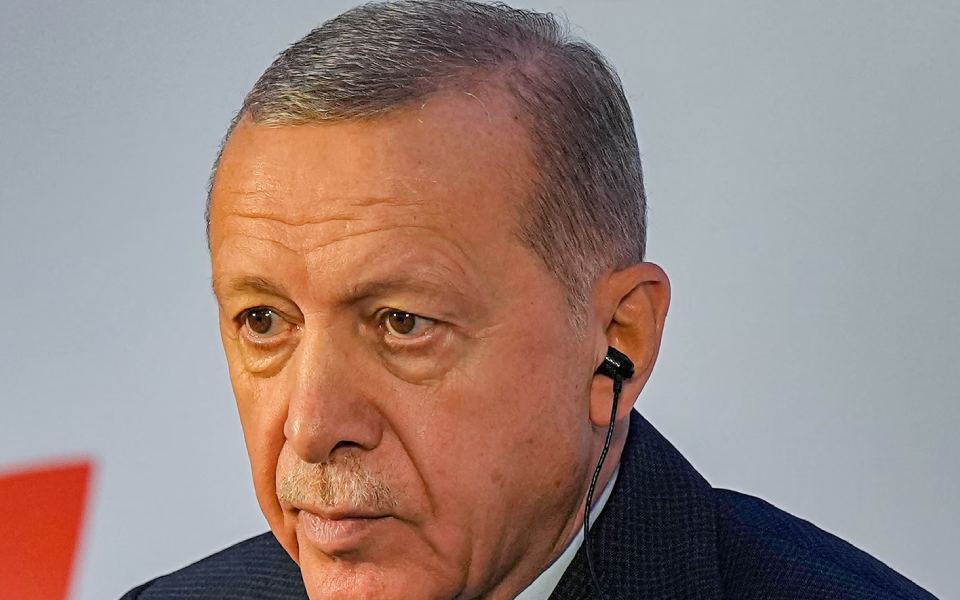
Ankara, Apr 1: Turkiye's main opposition party retained its control over key cities and made huge gains elsewhere in Sunday's local elections, preliminary results showed, in a major upset to President Recep Tayyip Erdogan, who had set his sights on retaking control of those urban areas.
With nearly 60 per cent of the ballot boxes counted, incumbent Mayor Ekrem Imamoglu, of the Republican People's Party, or CHP, was leading in Istanbul, Turkiye's largest city and economic hub, according to state broadcaster TRT. Mansur Yavas, the mayor of the capital Ankara, retained his seat with a large margin, the results indicated.
The CHP was leading in 36 of Turkiye's 81 provinces, according to the results reported by TRT.
The vote was seen as a barometer of President Erdogan's popularity as he sought to win back control of key urban areas he lost to the opposition in elections five years ago. The CHP's victory in Ankara and Istanbul in 2019, had shattered Erdogan's aura of invincibility.
The main battleground for the 70-year-old Turkish president was Istanbul, a city of 16 million people where he was born and raised and where he began his political career as mayor in 1994.
The result came as a boost for the opposition, which was left divided and demoralised after a defeat to Erdogan and his ruling Islamic-oriented Justice and Development Party, or AKP, in last year's presidential and parliamentary elections.
“The voters decided to establish a new political order in Turkiye,” CHP leader Ozgur Ozel told a crowd of jubilant supporters. “Today, the voters decided to change the 22-year-old picture in Turkiye and open the door to a new political climate in our country.”
A large crowd, meanwhile, gathered outside Ankara City Hall to celebrate Yavas' victory. “Ankara is proud of you!” supporters chanted.
Sinan Ulgen, director of the Istanbul-based Edam think tank, said “the surprising outcome" was due to voters wanting to punish the ruling party over the “depth of an economic malaise.” Skyrocketing inflation has left many Turkish households struggling to afford basic goods.
AKP supporters opted to stay away from the ballot stations or voted for other parties, Ulgen said.
“Turnout was relatively low compared to past elections,” he said. “There were cross-party shifts in the vote, which did not happen in the nationals elections because of stronger ideological attachments. This time around the economy prevailed over identity.”
Some 61 million people, including more than a million first-time voters, were eligible to cast ballots for all metropolitan municipalities, town and district mayorships as well as neighborhood administrations.
Turnout was around 76 per cent according to the state-run Anadolu Agency, compared to 87 per cent last year.
Some 5,94,000 security personnel were on duty across the country to ensure the vote goes smoothly. Nevertheless, one person was killed and 11 others hurt in the city of Diyarbakir where a dispute over the election of a neighborhood administrator turned violent, the state-run Anadolu Agency reported. At least six people were also injured in fighting that erupted in the nearby province of Sanliurfa.
“According to the data we have obtained, it seems our citizens' trust in us, their faith in us has paid off,” Imamoglu said.
Imamoglu won some 50 per cent of the votes in Istanbul while AKP's candidate Murat Kurum, a former urbanization and environment minister, received 41 per cent, according to TRT. Polls had pointed to a close race between the two.
Imamoglu — a popular figure touted as a possible future challenger to Erdogan — ran without the support of some of the parties that helped him to victory in 2019. Both the pro-Kurdish Peoples' Equality and Democracy Party and the nationalist IYI Party fielded their own candidates in the race.
A six-party opposition alliance that was led by CHP disintegrated after it failed to oust Erdogan in last year's election, unable to capitalise on the economic crisis and the government's initially poor response to last year's devastating earthquake that killed more than 53,000 people.
Ulgen said the result has thrust Imamoglu into the role of possible leader of the opposition to challenge Erdogan for the presidency in 2028.
“This outcome has certainly been a watershed for Imamoglu,” he said. "He will emerge as the natural candidate of the opposition for the next round of presidential elections.
A new religious-conservative party, the New Welfare Party, or YRP, appeared to have attracted votes from AKP supporters who have been disillusioned with the government's handling of the economy.
In Turkiye's mainly Kurdish-populated southeast, the DEM Party was on course to win many of the municipalities but it's unclear whether it would be allowed to retain them. In previous years, Erdogan's government removed elected pro-Kurdish mayors from office for alleged links to Kurdish militants and replaced them with state-appointed trustees.
Analysts said a strong showing for Erdogan's party would have hardened his resolve to usher in a new constitution — one that would reflect his conservative values and allow him to rule beyond 2028 when his current term ends.
Erdogan, who has presided over Turkiye for more than two decades — as prime minister since 2003 and president since 2014 — has been advocating for a new constitution that would put family values at the forefront.
Let the Truth be known. If you read VB and like VB, please be a VB Supporter and Help us deliver the Truth to one and all.
India, Vietnam elevate ties to enhanced comprehensive strategic partnership; set USD 25 bn
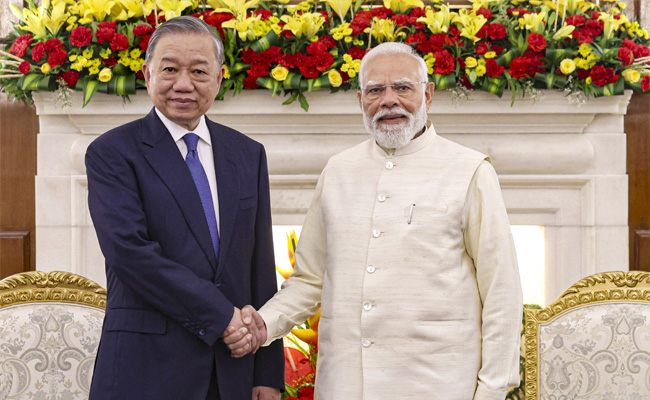
New Delhi (PTI): India and Vietnam on Wednesday elevated their ties to an enhanced comprehensive strategic partnership and set a USD 25 billion annual trade target by 2030 as Prime Minister Narendra Modi and Vietnamese President To Lam held talks focusing on expanding bilateral ties in areas of trade, defence, and critical minerals in the face of increasing geopolitical upheavals.
Following the Modi-Lam meeting, the two sides signed as many as 13 agreements which will provide for deeper two ways engagements in a range of areas including digital payments, rare earth minerals, pharmaceuticals, education, banking and culture.
Modi and Lam also deliberated on the situation in the Indo-Pacific amid China's increasing assertiveness in the region, and agreed to continue to contribute to the rule-of-law, peace, stability, and prosperity.
It is understood that China's growing military muscle-flexing in the South China Sea also figured in the delegation-level talks between the two sides.
Elected as president earlier this month, Lam began his first state visit to India on Tuesday, leading a high-level delegation for a three-day trip.
ALSO READ: Explosives used in blast outside Punjab Frontier BSF HQ in Jalandhar: Punjab Police
"A decade ago, Vietnam became India's first comprehensive strategic partner in ASEAN (Association of Southeast Asian Nations) . Since then, our relations have made rapid and comprehensive progress," Modi said in his media statement.
"Building on this strong foundation, today we are elevating our relations to the level of Enhanced Comprehensive Strategic Partnership. We will now advance our partnership to even higher goals," he said.
"Our cooperation will reach new levels in every area ' culture, connectivity, and capacity building, as well as security, sustainability, and supply chain resilience," Modi added.
He noted that the bilateral trade between India and Vietnam has doubled in the last decade to reach USD 16 billion and that the target now is to increase it to USD 25 billion by 2030.
Modi also cited a plethora of agreements signed between the two countries to emphasis that the economic engagement is expected to witness a significant upswing going forward.
"The MoU between our drug authorities will now increase access to Indian medicines in Vietnam. Exports of Indian agricultural, fisheries, and animal products to Vietnam are also set to become easier. Very soon, Vietnam will taste India's grapes and pomegranates," he said.
The two sides also agreed to update the India-ASEAN trade agreement by the end of this year.
"This will provide a new impetus to trade and investment between India and all ASEAN countries. New initiatives in critical minerals, rare earths, and energy cooperation will ensure the economic security and supply chain resilience of both countries," Modi said.
"To boost financial connectivity, we have today decided to enhance cooperation between our central banks. India's UPI and Vietnam's fast payment systems will soon be linked. Furthermore, we are strengthening state-to-state and city-to-city cooperation between the two countries," he noted.
Modi said India is grateful to Vietnam for its strong condemnation of the Pahalgam terrorist attack and standing with India in its fight against terrorism.
"In this era of global turmoil and economic challenges, thanks to their talent, good governance, and economic reforms, India and Vietnam are emerging as the world's fastest-growing economies," he said.
"Now, through our enhanced strategic partnership, we will support each other's rapid growth. As the Buddha's teachings say, 'If you light a lamp for someone else, it also illuminates your own path'," Modi said.
He also described Vietnam a a key pillar of India's Act East Policy and Vision Ocean.
"In the Indo-Pacific region as well, we share a common outlook. Through our strengthening defence and security cooperation, we will continue to contribute to the rule-of-law, peace, stability, and prosperity," he said.
The prime minister said India will broaden its relations with ASEAN with Vietnam's cooperation.
In his remarks, Lam said both sides agreed to deepen political trust and elevate security cooperation.
Last year, the two sides inked a pact to set up a framework for submarine search, rescue and support mechanism. They also signed a letter of intent (LoI) to strengthen bilateral defence industry collaboration.