India abstains in UNGA on Pak resolution on Islamophobia
Says religiophobia against Hinduism, Sikhism must also be acknowledged
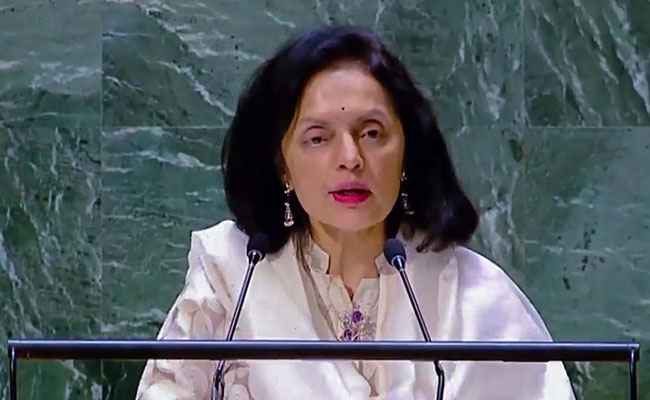
United Nations (PTI): India abstained in the UN General Assembly on a draft resolution introduced by Pakistan and co-sponsored by China on Islamophobia, asserting that the prevalence of "religiophobia" against Hinduism, Buddhism, Sikhism and other faiths facing violence and discrimination must also be acknowledged rather than singling out just one religion.
The 193-member General Assembly adopted the resolution Measures to combat Islamophobia', introduced by Pakistan on Friday, with 115 nations voting in favour, none against and 44 abstentions, including India, Brazil, France, Germany, Italy, Ukraine and the UK.
India's Permanent Representative to the UN Ambassador Ruchira Kamboj voiced condemnation of all acts motivated by anti-Semitism, Christianophobia and Islamophobia but asserted that it is crucial to acknowledge that such phobias extend beyond Abrahamic religions.
"Clear evidence shows that over decades, followers of non-Abrahamic religions have also been affected by religiophobia. This has led to the emergence of contemporary forms of religiophobia, particularly anti-Hindu, anti-Buddhist and anti-Sikh sentiments," she said, in an explanation of India's position on the resolution.
India stressed that the adoption of the resolution should not establish a precedent that could result in numerous resolutions centred on phobias tied to specific religions, "potentially dividing the United Nations into religious camps."
"It is crucial for the UN to maintain its stance above such religious concerns, which have the potential to fragment us rather than unite us under the banner of peace and harmony, embracing the world as one global family," Kamboj said.
India called on all member states to consider the broader scope of religious discrimination that persists globally.
"While the issue of Islamophobia is undoubtedly significant, we must acknowledge that other religions are also facing discrimination and violence. Allocating resources solely to combat Islamophobia, while neglecting similar challenges faced by other faiths, might inadvertently perpetuate a sense of exclusion and inequality," she said.
Kamboj told the UN General Assembly that "it is crucial to recognise" that Hinduism, with over 1.2 billion followers, Buddhism with more than 535 million and Sikhism with over 30 million followers worldwide, are all subject to religiophobia.
"It is time that we acknowledge the prevalence of religiophobia, rather than single out just one," she said.
Kamboj said the contemporary forms of religiophobia are evident in the increasing attacks on religious places of worship such as gurudwaras, monasteries and temples, as well as the spreading of hatred and disinformation against non-Abrahamic religions in many countries.
"The destruction of the Bamiyan Buddhas, violations of gurudwara premises, massacres of Sikh pilgrims in gurudwaras, attacks on temples, and the glorification of breaking idols in temples all contribute to the rise of contemporary forms of religiophobia against non-Abrahamic religions," she said.
The destruction of the giant Buddha statues of Bamiyan in Afghanistan by the Taliban in March 2001 led to global condemnation.
Kamboj underlined that India stands against all forms of religiophobia, be it antisemitism, Christianophobia, or Islamophobia, as "we stand against all anti-Hindu, anti-Buddhist, and anti-Sikh sentiments."
The resolution condemned the incitement to discrimination, hostility or violence against Muslims as manifested in the increasing number of incidents of desecration of their holy book, attacks on mosques, sites and shrines and other acts of religious intolerance, negative stereotyping, hatred and violence against Muslims.
It also requested UN Secretary-General Antonio Guterres to appoint a United Nations Special Envoy to combat Islamophobia.
India said it "in principle" is opposed to the creation of the post of a Special Envoy on the basis of a single religion, she said.
Kamboj pointed out that the substantial budgetary implications of establishing such a position "prompt us to pause and reflect on whether this is the most effective use of resources. Could we not achieve greater impact through a more inclusive approach that addresses religious discrimination in its entirety?"
She underscored that India's rich history as a pluralistic and democratic nation, embracing diverse religions, has long served as a refuge for those persecuted for their faith.
"Whether Zoroastrians, Buddhists, Jews, or adherents of any other belief, they have consistently found in India a sanctuary free from persecution or discrimination," she said.
Prior to adopting the resolution, the Assembly rejected two amendments to the draft introduced by Belgium on behalf of the EU. India voted in favour of both the amendments.
One amendment proposed changes in the resolution's language to remove references to the desecration of the Quran.
The other amendment would have called for the appointment of a "United Nations focal point, within existing structures and resources, to combat anti-Muslim discrimination" instead of a UN special envoy.
The General Assembly adopted a resolution in 2022 proclaiming March 15 as the International Day to Combat Islamophobia in the wake of the 2019 mass shootings in two mosques in Christchurch, New Zealand that had killed over 50 people.
In his remarks to mark the day, Guterres said that around the world, there is a rising tide of anti-Muslim hate and bigotry in many forms such as structural and systemic discrimination, unequal immigration policies, unwarranted surveillance and profiling and restrictions in accessing citizenship, education, employment and justice.
The UN chief also voiced concern over "supremacist ideologies and attacks" against Jews, minority Christian communities and many others. "Hatred of one group fuels hatred of another. Hate normalises hate. Hate destroys the fabric of our societies," he said.
Let the Truth be known. If you read VB and like VB, please be a VB Supporter and Help us deliver the Truth to one and all.
Telangana rains: Four farmers dead, three injured as sheds collapse in Mancherial

Karimnagar (Telangana) (PTI): Four farmers died, and three others were injured after tin-roofed sheds and dilapidated structures collapsed in two separate incidents in Mancherial district of Telangana, officials said on Wednesday.
The incidents occurred in two villages of Luxettipet mandal late on Tuesday night, when the farmers were taking shelter in the structures following heavy rain and strong winds.
According to officials, two people died when a shed caved in at Kothuru village.
In a separate incident in Gampalapalli village, two more persons died after another structure collapsed, police and district authorities said.
The three injured were shifted to a hospital in Karimnagar for treatment, police said.
Preliminary reports indicate that unseasonal rains accompanied by strong winds weakened the structures, leading to the collapses.
Authorities are assessing the situation, and further investigation is underway.