India an important manufacturer of vaccines for world: White House
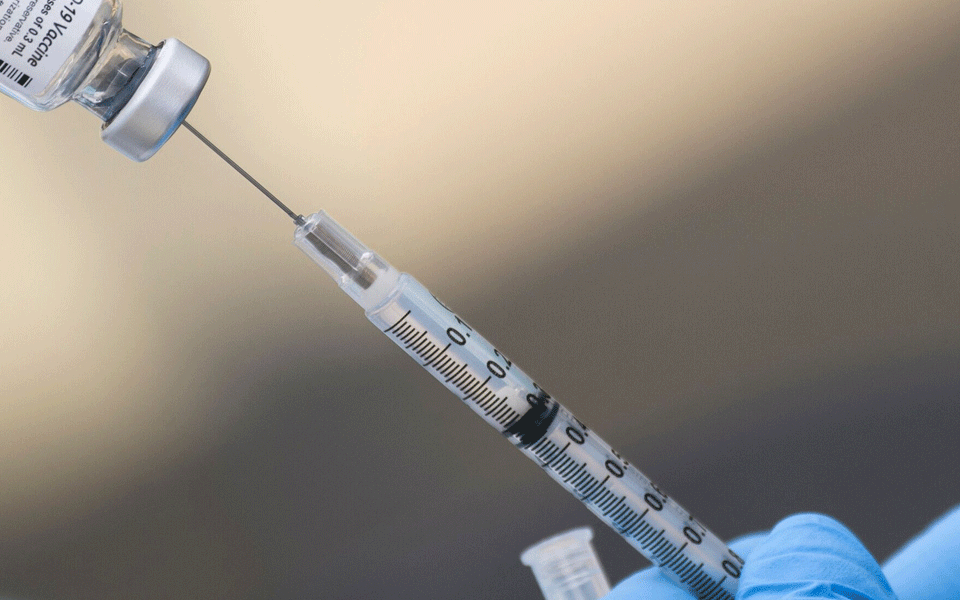
Washington (PTI): India is an important manufacturer of vaccines for the world, the White House said, acknowledging the crucial role the country played in supplying vaccines against COVID-19 globally.
Because of its incredible manufacturing capacity, (India) has been a major exporter of vaccines, Dr. Ashish Jha, White House Coronavirus Response Coordinator, told reporters at a news conference here on Tuesday.
Responding to a question, Dr. Jha said the QUAD partnership a strategic security dialogue between Australia, India, Japan, and the US -- on coronavirus was important to the Joe Biden administration.
I think India is an important manufacturer of vaccines for the world. I mean not just for India itself, this is a really important thing, he said at the White House news conference.
Defending the Biden administration's decision to supply vaccines to the world, Dr. Jha said the US will continue making them available for every low and several low- and middle-income countries.
There are about 100 countries that are eligible to get free vaccines through COVAX -- where we donate the vaccines still available for donation, he said. According to Dr. Jha, every major variant that hit the US originated from outside the country. So, the notion that we can somehow wall ourselves off and not be affected by what's happening in the rest of the world is just naive, he said.
It's just not how transmissible viruses like this work. So even if you think about it from a very narrow self-interest, it's very important that we get much of the world vaccinated, that we help build out the kind of vaccination program. But beyond self-interest, you know, America is a country that has deeply engaged in the world, he added.
Dr. Jha claimed that Biden had restored American leadership on global health in a way which is very different from the previous President .
So, for a whole set of reasons, it's very, very important that America continues to lead, 4.02 billion is a small investment to make to better protect Americans and better protect the world, he said.
Let the Truth be known. If you read VB and like VB, please be a VB Supporter and Help us deliver the Truth to one and all.
Man kills woman lecturer, sets car ablaze; dies by suicide in Karnataka

Bengaluru (PTI): A 46-year-old man allegedly killed a woman lecturer by setting fire to the car with her inside, before dying by suicide; his severed body was found by railway police the next day, police said on Tuesday.
The deceased, identified as Ramanjinappa, a resident of Doddaballapura, was a contract worker in the tahsildar’s office, they said.
Police said the man, who was married and had apparently separated from his wife, was in an illicit relationship with a woman identified as Saroja, whose charred body was found inside a gutted car in an isolated area near the Bashetty Industrial Area in Doddaballapura taluk on the outskirts of Bengaluru.
Saroja was also married and had a son, police said.
According to police, on Saturday, the man allegedly borrowed a car from an acquaintance, claiming he had a medical emergency and needed to visit a hospital.
Citing preliminary investigations, a senior police officer said the man picked up the lecturer from a bus stop in Devanahalli. The two spent a couple of hours driving around Nandi Hills and nearby areas.
Later, they reached a secluded spot in Doddaballapura, where it is suspected that an argument ensued inside the car, following which he allegedly hit her on the head with a hammer, the officer said.
He then set the car on fire, reportedly using petrol, and is believed to have died by suicide thereafter, police said.
Locals who saw the burning car alerted the police and fire department, who rushed to the spot, extinguished the fire, and found the woman’s body completely charred inside the vehicle, the officer added.
His severed body was found near railway tracks in Bidadi by the railway police on Sunday, he said.
The motive and whether the crime was premeditated or impulsive are under investigation, he said.
Saroja’s husband filed a complaint accusing Ramanjinappa of killing her, police said, adding that a detailed investigation is underway to establish the exact sequence of events.