India, Australia ink 5 pacts as Kovind meets PM Morrison
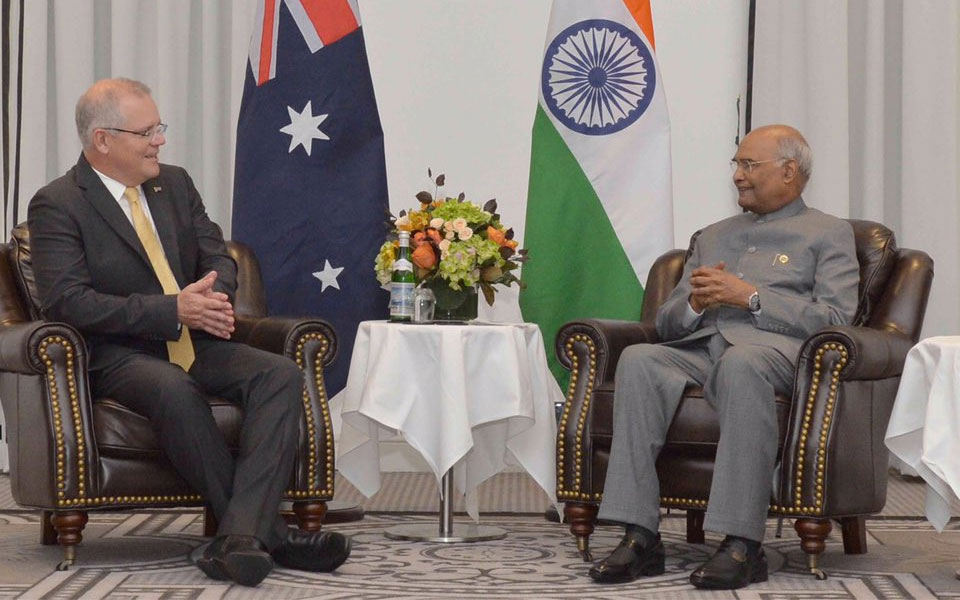
Melbourne, Nov 22 : India and Australia signed five agreements on Thursday to boost investments and enhance cooperation in key sectors like disability, agricultural research and education as President Ram Nath Kovind met Australian Prime minister Scott Morrison in Sydney.
Kovind, the first-ever Indian head of state to visit Australia, arrived in Sydney on Wednesday on the second leg of his two nation trip.
External Affairs Ministry Spokesperson Raveesh Kumar said that during the state visit of President Kovind to Australia, five agreements were exchanged in the presence of Marise Payne, Foreign Minister of Australia and Anantkumar Hegde, Minister of State for Skill Development and Entrepreneurship, by High Commissioners of both countries.
The first agreement was for cooperation in the area of disability and to deliver services to the differently-abled. The second one was between Invest India and Austrade to facilitate bilateral investment.
The third agreement was signed between the Central Mine Planning and Design Institute, Ranchi, and the Commonwealth Scientific and Research Organisation, Canberra, to foster scientific collaboration and innovation.
The fourth one between the Acharya N G Ranga Agricultural University, Guntur, and the University of Western Australia, Perth, for cooperation in agricultural research and education while the last one was between the Indraprashta Institute of Information Technology, New Delhi, and the Queensland University of Technology, Brisbane for a joint Ph.D agreement.
Following the meeting with President Kovind, Prime Minister Morrison announced the release of Australia's response to the India Economic Strategy, a blueprint to transform the economic engagement.
"This report provides a roadmap for our economic future with India," Morrison said.
India is the world's fastest growing major economy and offers more opportunity for Australian business over the next 20 years than any other single market, he said.
The Australian government said it endorsed the report and provides in-principle support to its 20 priority recommendations.
"Our work will focus on greater economic engagement targeting 10 Indian states and 10 key sectors, while providing practical support for Australian businesses entering or expanding operations in India," Trade Minister Simon Birmingham said.
Australia also pinpointed the initial implementation plan with key actions for next one year which will include agreements forged between Austrade and Invest India, the establishment of an Australia-India Food Partnership, opening up new opportunities for agri-tech and service companies and Australia-India Strategic Research Fund grants of up to Australian dollar 500,000.
The fund is designed to help researchers solve challenges shared by both nations, including energy storage, marine science and plant genomics.
Other actions include the expansion of the Australia-India Mining Partnership at the Indian School of Mines, connecting Australian companies to India's mineral-rich northeastern states, supported by the new Consulate-General in Kolkata, engagement with airlines to increase direct flights through the Australia-India air services agreement.
Ministers across education, agribusiness, resources and tourism will oversee progress of the government's response and ongoing implementation of the India Economic Strategy.
Morrison along with the ministers for trade and resources will join President Kovind at the launch of the Australian chapter of the Confederation of Indian Industry India Business Forum, which will serve as a platform for networking and policy advocacy for Indian businesses in Australia.
"I look forward to continue discussing the opportunities presented in the India Economic Strategy with President Kovind, and how we can continue to work together to develop enhanced economic ties," Morrison said.
"Today's steps are only the first on a long journey that will see Australia and India grow together," he said.
Kovind, who was accorded a ceremonial Guard of Honour by Governor General Peter Cosgrove in Sydney, will be visiting Melbourne on Friday to address university students.
Let the Truth be known. If you read VB and like VB, please be a VB Supporter and Help us deliver the Truth to one and all.
Brothers awaiting board exam results drown in canal

Erode (Tamil Nadu) (PTI): Minor brothers who were awaiting their board exam results have drowned in a canal in this district while spending their Summer holidays at their aunt's place, police said.
According to Arachalure Police, Santhosh, aged 17, and his younger brother Sanjai, aged 15, natives of Musiri village in Tiruchirapalli district, came to Gopaliparai hamlet near Arachalure to their Aunt's house a couple of days ago after writing their annual 12th and 10th examinations, respectively.
The police said on Friday that both boys went to the nearby Lower Bhavani Project canal to take a bath. It was alleged that while taking a bath, both boys went to a deeper area of the canal and went missing.
As they didn't return home, even two hours after they left, their aunt grew suspicious and informed the Fire and Rescue Services, Chennimalai. A rescue team from the department rushed to the spot. After a few minutes of searching, they located the dead bodies of the brothers and sent them to the hospital. Arachalure police registered a case of death due to drowning and are investigating.