India clearly a big market: Paris-based shoemaker
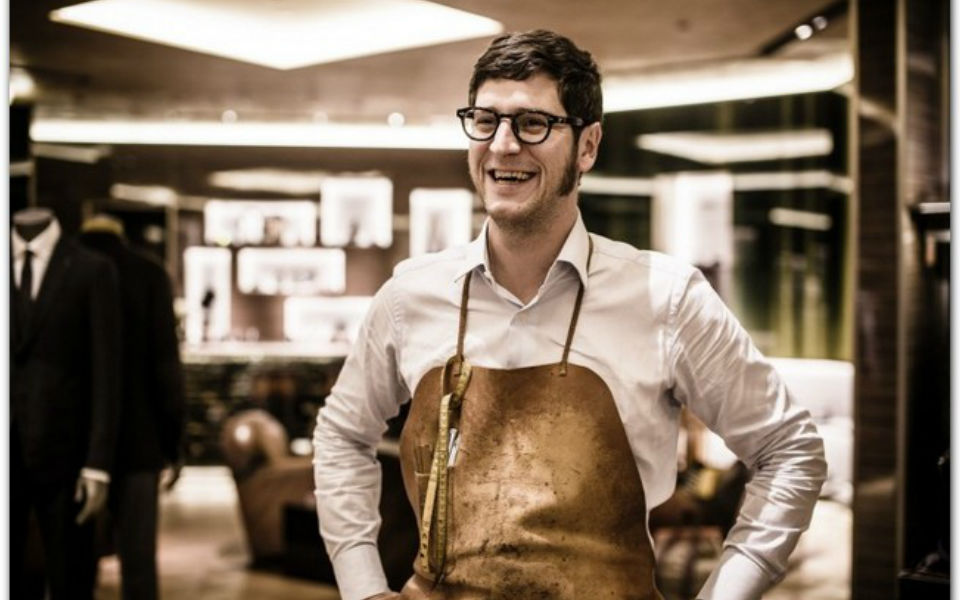
New Delhi, May 11: Master shoemaker Jean Michel Casalonga of the brand Berluti Paris, which has made its India debut, says the country is a big market for them as the consumers have become more playful in terms of dressing up and they are looking for something that is not just comfortable but also light.
"Berluti, with is long presence in Britain and Singapore, has very loyal Indian customers, who are all of them very exciting for us about this new adventure. They all agree to say that we arrived at the right time, ready to bring our products. India is clearly a big market," Casalonga said.
"The consumers are looking for more and more comfort, softness and lightness. Our customers are travelling a lot and want to be comfortable in their shoes. In the same time, people dress less formally and became playful," he added.
Casalonga, a self-proclaimed 'shoe addict' with over 50 pairs in his closet, joined Berluti as an intern at age 23. Before walking away with the prized apprenticeship at Berluti, Casalonga was studying for an Advanced Degree in Physics when he decided to switch career paths and become a shoemaker.
He dropped out of school and spent five years learning approximately 250 precise steps needed to make a single pair of the finest shoes at Berluti, eventually becoming the house's youngest maître bottier or Master Shoemaker in 2008 when he was only 30 years old.
On the evolution of shoe fetish, he said: "When I started 16 years ago, there were only a few shoemakers in the world. Since a couple of years, we can see daily new independent and talented shoemakers who launch new models. This is extremely encouraging and stimulating. That pushes us to be up to date and stay on the top."
So what all offerings does the brand have for the Indian market ?
"We are offering a selection of ready to walk, ready to wear, small leather goods and leather goods, but we are not ready yet for bespoke which requires the presence of the shoemaker in India. The staff is too small today to be ready for this challenge, but we offer the special order with which we can satisfy most of the demand," he said.
Let the Truth be known. If you read VB and like VB, please be a VB Supporter and Help us deliver the Truth to one and all.
India, Italy to boost defence industrial framework for co-production of military hardware
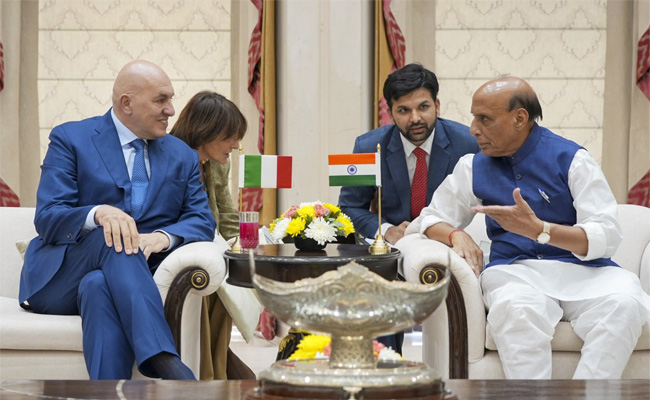
New Delhi (PTI): India and Italy on Thursday resolved to develop a defence industrial framework for co-production of military hardware, a move that came as both nations navigate an evolving security landscape, including the ongoing crisis in West Asia.
The decision to bolster bilateral defence and strategic ties was reached during talks between Defence Minister Rajnath Singh and his Italian counterpart Guido Crosetto in New Delhi.
Following the meeting, the two sides unveiled a bilateral military cooperation plan (MCP) 2026-27 regarding military engagements between the armed forces of both the countries.
"We discussed a wide range of regional and global issues including the current situation in West Asia," Singh said on social media.
"We also discussed the avenues to further develop mutually beneficial defence industrial cooperation under India's Atmanirbhar Bharat programme and Italy's defence cooperation initiative," he added.
The defence ministry said Singh and Crosetto reiterated that the India-Italy strategic partnership is based on shared values of peace, stability, freedom, and mutual respect.
"Convergence between both the ancient seafaring nations on various key maritime issues was also highlighted including information exchange through Information Fusion Center-Indian Ocean Region, Gurugram," it said.
Prior to the meeting, the Italian defence minister laid a wreath at the National War Memorial, and paid homage to the bravehearts who made the supreme sacrifice in the service of the nation.
Crosetto also inspected the tri-service Guard of Honour.
Under the broader framework of defence ties, both sides have been looking at boosting cooperation in the Indo-Pacific region with an aim to increase interoperability and cooperation.
The two sides have been exploring avenues for enhanced partnerships and dialogue among public and private stakeholders, focusing on technology collaboration, co-production and co-development of defence platforms and equipment.