India, Gulf Cooperation Council sign MoU to facilitate consultations

Riyadh (PTI): External Affairs Minister S Jaishankar has held a "productive" meeting with the Gulf Cooperation Council (GCC) Secretary-General Nayef Falah Mubarak Al-Hajraf during which the two leaders signed an MoU on the mechanism of consultations between India and the six-nation regional bloc.
Jaishankar arrived here on Saturday on a three-day visit to Saudi Arabia to discuss ways to further strengthen relations between the two countries. It is his first visit to Saudi Arabia as External Affairs Minister.
On the first day of his visit on Saturday, Jaishankar met GCC Secretary-General and exchanged views on current regional and global issues.
"Productive meeting with @GCC Secretary-General Dr Nayef Falah Mubarak Al-Hajraf. Signed the MoU on the mechanism of consultations between India and GCC. Exchanged views on the current regional and global situation and the relevance of India-GCC cooperation in that context," Jaishankar tweeted after the meeting.
The GCC is a regional, intergovernmental, political, and economic union comprising Bahrain, Kuwait, Oman, Qatar, Saudi Arabia, and the United Arab Emirates.
India enjoys traditionally cordial relations and cooperation with the GCC.
India's old, historical ties with the GCC states, coupled with increasing imports of oil and gas, growing trade and investment, and the presence of approximately 6.5 million Indian workers in the region, are of vital interest to India, according to the Indian Embassy in Riyadh.
India's economic linkage with the GCC has increased steadily, especially due to the growth in oil imports.
During 2020-21, India's exports to GCC were USD 28.06 billion. The bilateral two-way trade during the period was USD 87.36 billion.
Earlier this year, there was an unease in India's ties with some Muslim-majority countries, including Gulf nations, over the controversial remarks of two former BJP leaders on the Prophet Mohammad.
All six GCC nations had condemned the remarks.
Let the Truth be known. If you read VB and like VB, please be a VB Supporter and Help us deliver the Truth to one and all.
Bengaluru airport introduces AI-based system to enhance safety at vehicle-aircraft intersections
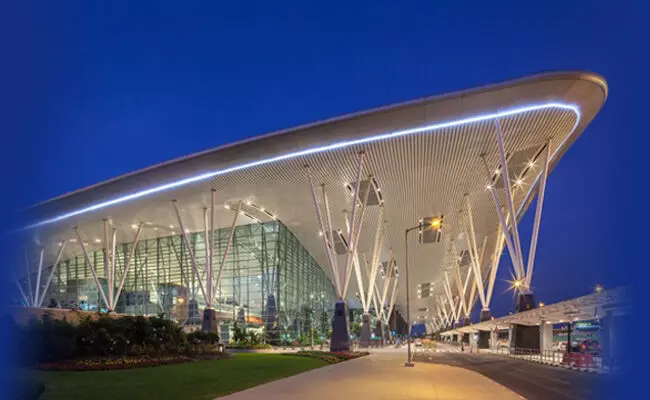
Bengaluru: Bangalore International Airport Limited (BIAL) has introduced an integrated smart airside safety system at Kempegowda International Airport to improve operational safety at key intersection zones.
According to The Hindu, the system has been designed to enhance safety at Cross Service Roads (CSRs), where aircraft and ground vehicle movements intersect.
According to BIAL, the system integrates AI-based computer vision, automation, and centralised monitoring to manage right-of-way movements and reduce the risk of human error.
“CRSs are among the most sensitive areas within airport operations, requiring precise and seamless coordination between aircraft and ground vehicles. Traditionally, right of way protection at these intersections relied on manual or semi-manual inset light activation, creating dependencies on human intervention, increasing the risk of delays and limiting operational visibility,” TH quoted BIAL as saying.
The new system uses real-time detection of vehicle movement, risk assessment, and automated signalling. AI-enabled cameras identify potential conflicts and trigger automated inset light signals to ensure aircraft priority. Normal operations resume once the area is confirmed clear.
“Based on these detections, the system triggers automated inset light activation to protect aircraft right‑of‑way and restores normal signalling once the intersection is confirmed clear. A centralised monitoring and analytics platform digitally logs all events, strengthening governance, compliance, and operational control,” BIAL said.
By embedding technology into operations, the system creates a data-driven separation layer between aircraft and ground vehicles, significantly reducing human error, especially during night and low-visibility conditions.
“Precision-led signal activation improves traffic flow, minimises unnecessary stoppage and enhances turnaround efficiency. It also establishes a scalable foundation for predictive safety analytics, enabling trend analysis, peak-hour optimisation, compliance mapping and risk forecasting to support continuous improvement and stronger airside governance,” BIAL said.