
India hits out at Pak over Ahmadiyyas persecusion, air-bombings against Afghan in UNGA
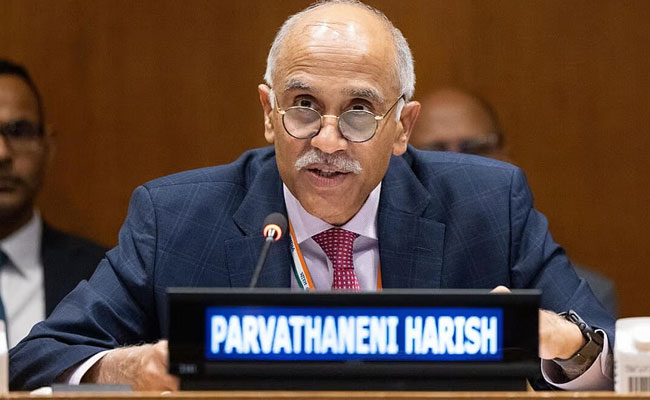
United Nations (PTI): India called out Pakistan for its habit of “fabricating imaginative” tales of Islamophobia in neighbouring countries, questioning how Islamabad’s own brutal repression of Ahmadiyyas or air-bombing campaigns during Ramzan against Afghanistan can be characterised as.
"India's western neighbour is an excellent example of fabricating imaginative tales of Islamophobia in their neighbourhood," India’s Permanent Representative to the UN Ambassador Parvathaneni Harish said.
"One wonders what would brutal repression of Ahmadiyyas in this country be termed, or the large-scale refoulement of the helpless Afghans or air-bombing campaigns in this Holy Month of Ramadan?” Harish said.
Harish was addressing the UN General Assembly commemoration of the International Day to Combat Islamophobia on Monday.
In a strong retort, he also said that the Organisation of Islamic Cooperation, which "our western neighbour has systematically attempted to weaponise against India”, has repeatedly made false and baseless allegations against my country.
He stressed that it is important for the UN to take note of the rising trend and dangers of weaponising religious identity and instrumentalising it to serve narrow political ends by state and non-state actors alike.
Underlining that India is home to more than 200 million Muslims, one of the largest populations of the community in the world, he said Muslims in India, including those in Jammu and Kashmir, elect their own representatives to speak for them.
“The only ‘phobia’ evident here appears to be directed against the multicultural and peaceful coexistence that all communities in India enjoy, including Muslim communities," he said.
"Such narratives run counter to India’s fundamental ethos and reflect instead the sectarianism and terrorist mentality that this country has perpetuated since its inception. That is the real issue at hand,” he said.
Harish said that history bears repeated witness to how the politicisation of religion does not solve and resolve grievances; however well-intentioned, they risk lending legitimacy to precisely this kind of selective, polarising narratives that breed further division.
“The United Nations was conceived as an institution that transcends religion, culture, and politics. Its credibility rests on universality and impartiality. We, therefore, urge caution against frameworks that exclusively focus on one faith, without addressing the broader phenomenon of religiophobia in all its manifestations,” he said.
India noted that the 1981 Declaration on the Elimination of All Forms of Intolerance and of Discrimination Based on Religion or Belief remains a very balanced and enduring instrument that enshrines the rights of all religious followers without privileging any.
India also strongly condemned violence and hatred in the name of religion, regardless of the religion in question. As a nation where followers of virtually every major world religion coexist peacefully and a nation that has given birth to four major world religions, namely Hinduism, Buddhism, Jainism and Sikhism, India, more than any other country, is acutely aware of the need for a world free from religious discrimination.
“The philosophy of 'Sarva Dharma Sambhava' implying equal respect for all religions has been the civilizational way of life for India and one that inspired the secular ethos of the Indian Constitution,” he said.
Harish noted that the United Nations' greatest contribution to peace and human dignity lies in its efforts to maintain international peace and security, bringing everlasting peace in conflict situations, its development work and humanitarian action, and its promotion of universal human rights - work that is conducted without regard to the faith of those it serves.
"Global public goods, like sunshine, should be available to one and all, irrespective of affiliations. The UN has built its credibility through tireless work on conflict resolution, poverty alleviation, and protection of civilians. We urge the UN to remain anchored to this founding spirit,” he said.
India reaffirmed its commitment to a world free from religious hatred and violence in all its forms. “We urge the UN to channel its time and limited resources towards building inclusive societies grounded in equality, dignity, and the rule of law - for every individual of every faith,” Harish said.
Let the Truth be known. If you read VB and like VB, please be a VB Supporter and Help us deliver the Truth to one and all.
Karnataka issues nutrition advisory for govt events; recommends millets, healthier options
_vb_61.jpeg)
Bengaluru (PTI): The Karnataka government on Monday issued a nutrition advisory recommending healthier food and beverage options at meetings, functions, and other official gatherings held in the state.
The advisory has been issued by the Department of Karnataka Health and Family Welfare Services to promote healthy dietary and nutritional habits among officials and staff, noting that food, refreshments and beverages served in government offices and official programmes are "often not aligned with nutrition standards."
The advisory recommends serving snacks such as millet-based, low-fat and low-sugar foods, fresh fruits, vegetable salads, sprouts, roasted nuts and seeds during in-house office meetings and breaks.
Beverages such as green tea, low-fat buttermilk, and locally filtered or boiled water served in glass bottles or steel flasks have also been suggested.
According to the advisory, for larger government events, conferences and exhibitions, departments have been advised to include at least one millet-based item during snacks and a minimum of two millet dishes in meals, along with local cuisine and at least one regional recipe.
It also recommends the use of brown rice instead of white rice, freshly prepared vegetable salads, and fresh fruits or low-sugar fruit juices.
If non-vegetarian food is served, it should consist of well-cooked lean or white meat, the advisory stated.
In eateries operating within government office campuses, the department has recommended millet-based foods, fresh vegetable salads, boiled pulses such as horse gram or chickpeas, and low-fat beverages.
It suggests serving food using reusable metal plates and glasses.
The advisory also recommends avoiding microwave-heated food, industrially processed food, fried snacks, high-fat or heavily spiced dishes, carbonated drinks, high-sugar fruit juices, and alcoholic beverages.
It further discourages serving milk-based tea or coffee and plastic-bottled water during official events.
“Overall, hygiene and cleanliness should be maintained while serving food and water. Local cottage industries, self-help groups, prison kitchens, nutri-gardens and others should be preferred for placing food and beverage orders,” the advisory added.
_vb_54.jpeg)
_vb_07.jpeg)
_vb_34.jpeg)