India, Kuwait sign MoU for cooperation on recruitment of domestic workers
Kuwait City: India and Kuwait have signed an MoU that brings Indian domestic workers in the Gulf nation within the ambit of a legal framework that streamlines their recruitment and provides them with the protection of the law.
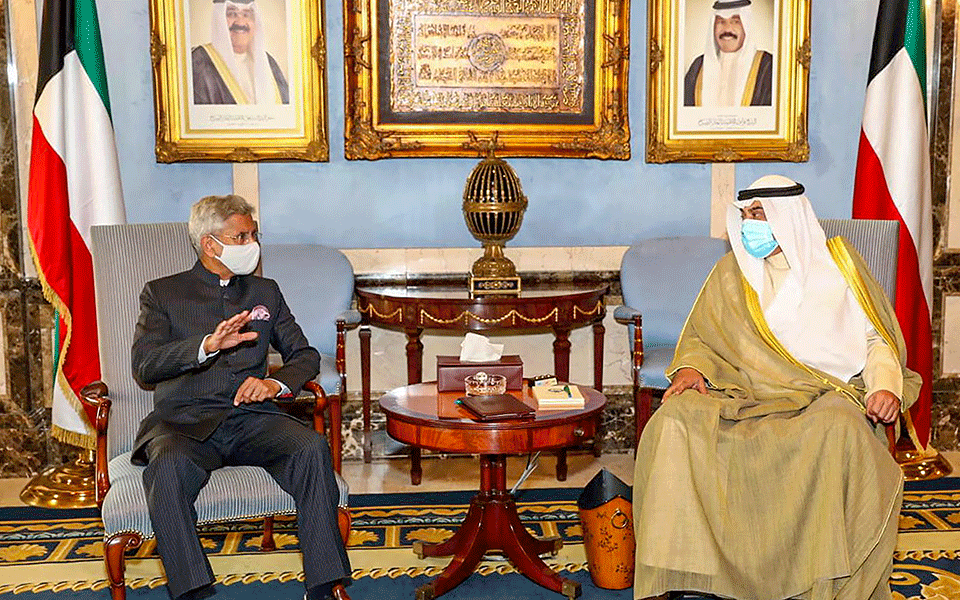
The MoU was signed on Thursday by Indian Ambassador Sibi George and Deputy Minister for Foreign Affairs of Kuwait Majdi Ahmad Al-Dhafiri in the presence of visiting External Affairs Minister S Jaishankar and his Kuwaiti counterpart Sheikh Ahmad Nasser Al-Mohammad Al-Sabah.
Jaishankar arrived here on his first bilateral visit to the oil-rich Gulf nation early on Thursday, according to a press release issued by the Indian Embassy here.
The MoU brings the Indian domestic workers in Kuwait within the ambit of a legal framework that streamlines their recruitment and provides them with the protection of the law.
Both ministers welcomed the signing of the MoU which will introduce an employment contract ensuring the rights and obligations of both the employer and the domestic workers.
The MoU seeks to establish a mechanism for 24-hour assistance to domestic workers. It provides for the establishment of a joint committee for periodic review and assessment and to follow up the implementation of the MoU which will conduct annual meetings.
Around one million (ten lakh) Indians reside in Kuwait. India is amongst the largest trading partners of Kuwait and the Gulf nation is a major supplier of oil to India.
Jaishankar on Thursday called on Prime Minister Sheikh Sabah Al-Khaled Al-Hamad Al-Sabah.
He handed over to him a letter from Prime Minister Narendra Modi addressed to Al-Hamad Al-Sabah.
The visiting minister thanked the leadership for Kuwait's prompt supply of liquid medical oxygen and other oxygen-related supplies to India to fight the second wave of the COVID-19 pandemic in the country. Both sides discussed the state of bilateral relations and also the developments in the region.
Jaishankar's visit comes at the invitation of his Kuwaiti counterpart and is part of the enhanced high-level political exchanges in the context of the 60th anniversary of the establishment of diplomatic relations between India and Kuwait.
The visiting minister held talks with his counterpart Sheikh Ahmad Nasser Al-Sabah.
Both sides reviewed the entire gamut of bilateral relations and exchanged views on regional developments and global issues.
They also discussed the challenges posed by the devastating COVID-19 pandemic, the distress it caused to humanity and reiterated their commitment to jointly fight the pandemic and address the myriad of issues that their citizens face such as travel restrictions and issues related to vaccination.
The topics covered also included food security, cybersecurity, cooperation in the energy sector and issues related to the Indian workforce in Kuwait.
Both sides agreed to hold the first India-Kuwait Joint Commission meeting later this year and also to set dates for early meetings of the Joint Working Groups on health, hydrocarbon and manpower. The two sides also agreed to set up new joint working groups in other areas of cooperation.
The joint celebrations of the 60th anniversary of the establishment of diplomatic relations between India and Kuwait were launched at the meeting.
The year-long celebrations will continue through 2021-2022. In the evening, Jaishankar chaired a round-table conference of Indian ambassadors in the Gulf Cooperation Council countries and Iran.
The GCC is a political and economic alliance of six countries Saudi Arabia, Kuwait, the United Arab Emirates, Qatar, Bahrain, and Oman.
Let the Truth be known. If you read VB and like VB, please be a VB Supporter and Help us deliver the Truth to one and all.
Two injuries, one DNF, a DQ as India end messy World Relays campaign
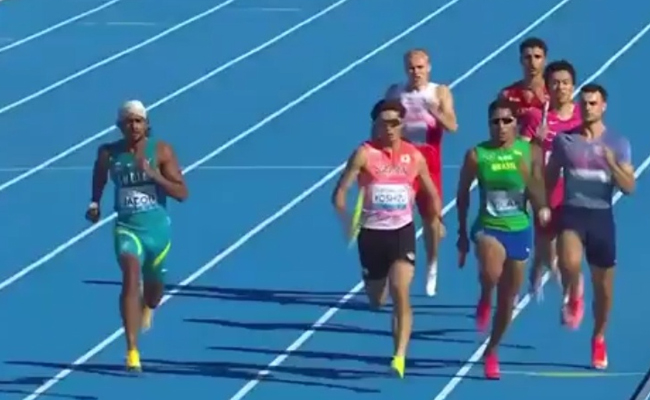
Gaborone (Botswana) (PTI): Amoj Jacob and Ragul Kumar got injured during the men's 4x400m and 4x100 races respectively as India ended their World Athletics Relays campaign in disappointment on the second day of competitions here on Sunday.
The Indian camp had high hopes of making the 2027 World Championships in the men's 4x400m relay but the team did not finish (DNF) the race as Jacob suffered cramps and pulled out of the race after taking the baton from the first leg runner Dharamveer Choudhary. Rajesh Ramesh and Vishal TK were to run in the third and fourth legs.
Those teams which could not qualify for the 2027 Beijing World Championships by reaching the final round of each of the six relay events on Saturday were given another chance in the second qualification round on Sunday.
The top two teams in each of the two heats (in all six relay events) booked the Beijing ticket on Sunday.
India will now have to try and qualify for the World Championships through the Top Lists of the World Athletics, which is a long and tedious process.
In the men's 4x100m race, third leg runner Ragul Kumar fell down the track after failing to hand over the baton inside the exchange zone to fourth leg runner Gurindervir Singh, which clearly showed the lack of coordination among the runners.
Harsh Santosh Raut and Animesh Kujur ran the first two legs.
The Indian quartet was disqualified and Kumar was seen being taken away from the Field of Play with the help of the volunteers.
It was a comedy of errors in the case of the women's 4x100m race, which saw the baton being dropped during an exchange between first leg runner Tamanna and second runner Nithya Gandhe, though the Indians finished the race in 53.09 seconds.
Gandhe started running quite a distance, but after realising that the baton was not in her hand, she turned and ran back to pick it up.
The only silver-lining for the Indian contingent was the national record time in the mixed 4x100m relay race, though the quartet of Ragul Kumar, Nithya Gandhe, Animesh Kujur and Sneha SS finished sixth in heat number two with a time of 41.35 seconds, bettering the previous national mark of 42.30 seconds set in March in Chandigarh.
The mixed 4x400m relay quartet of Theerthesh P Shetty, Kumari Saloni, Nihal William and Rashdeep Kaur ended at fifth in heat number one with a time of 3 minutes and 19.40 seconds.
On Saturday, all the five Indian relay teams had failed to make it to the respective final rounds and thus missed out on the 2027 World Championships berths.