India, Pakistan exchange list of nuclear installations

New Delhi, Jan 1: Continuing with an over three-decade practice, India and Pakistan on Monday exchanged a list of their nuclear installations under a bilateral pact that prohibits the two sides from attacking each other's atomic facilities.
The exchange of the list took place under the provisions of an agreement on the prohibition of attack against nuclear installations and facilities, the Ministry of External Affairs (MEA) said.
It was done simultaneously through diplomatic channels in New Delhi and Islamabad.
"India and Pakistan today exchanged, through diplomatic channels simultaneously at New Delhi and Islamabad, the list of nuclear installations and facilities, covered under the agreement on the prohibition of attack against nuclear installations and facilities between India and Pakistan," the MEA said.
The agreement was signed on December 31, 1988 and entered into force on January 27, 1991. It mandates the two countries to inform each other of nuclear installations and facilities to be covered under the agreement on the first of January of every calendar year.
The exchange of the list came amid frosty ties between the two countries over the Kashmir issue as well as cross-border terrorism.
"This is the 33rd consecutive exchange of such lists between the two countries, the first one having taken place on January 1, 1992," the MEA said in a statement.
Let the Truth be known. If you read VB and like VB, please be a VB Supporter and Help us deliver the Truth to one and all.
AAP hit by exit of 7 MPs, faces test ahead of 2027 poll battles
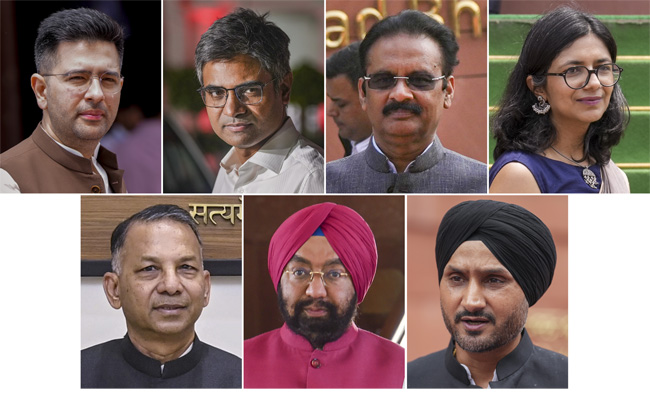
New Delhi (PTI): With Seven MPs, including prominent faces such as Raghav Chadha, Sandeep Pathak, Ashok Mittal, Harbhajan Singh and Swati Maliwal, quitting the AAP on Friday, the party has not only lost numerical strength in Parliament but its preparedness for upcoming elections has also been hampered.
The development comes against the backdrop of a turbulent phase for the Aam Aadmi Party (AAP) over the last two years, when several of its top leaders, including former Delhi chief minister Arvind Kejriwal and Manish Sisodia, were arrested in connection with the alleged excise-policy scam, leaving the party grappling with a leadership vacuum and testing its ability to function under pressure.
During that period, the party had sought to project resilience, with second-rung leaders, including Chadha, stepping in to keep both the government and organisation running.
Many among the seven MPs were seen as key pillars in shaping the AAP's outreach -- whether in policy articulation, organisational strategy, finances or public messaging -- making their collective departure more than a routine political shift and more of an organisational rupture.
Their move, meeting the two-thirds threshold under the anti-defection law, showcases both the scale and the severity of the split.
Chadha said on Friday that all seven MPs have merged with the BJP, asserting that the AAP has strayed from its principles, values and core morals. Besides Chadha, Pathak, Mittal, Singh and Maliwal, Rajinder Gupta and Vikram Sawhney have also quit the Kejriwal-led party.
For the AAP, the timing of the seven MPs' exit is particularly crucial. The party is gearing up for next year's electoral battles in Gujarat, Goa and Punjab, where it hopes to consolidate and expand its presence beyond Delhi, where it has formed the government thrice and enjoys a strong base.
AAP leaders have sought to project confidence, maintaining that the party’s grassroots connect and governance plank remain intact despite the departures.
On the ground, the party continues to hold power in Punjab and retains a presence in Delhi, along with a limited reach in Gujarat and Jammu and Kashmir.
In Parliament, however, its reduced strength in the Rajya Sabha -- down from 13 to six now -- could limit its ability to assert itself in legislative debates.
For a party that built its identity on the anti-corruption plank, a collective leadership and a steady stream of new faces rising through the ranks, the current departure revives an old pattern of prominent colleagues parting ways, including former IPS officer Kiran Bedi and poet Kumar Vishwas.
In 2015, former AAP spokesperson Shazia Ilmi quit the party and later, joined the BJP, followed by senior leader Kapil Mishra in 2017 after a bitter public fallout over allegations of corruption within the party. In 2018, founding member Ashish Khetan stepped away from active politics altogether, citing personal reasons. Each of these departures came at a time when the AAP was attempting to stabilise or expand.
With the Gujarat, Goa and Punjab polls on the horizon, the immediate challenge before the Kejriwal-led party is to steady its organisation, rebuild its leadership bench and reassure workers that the political project it launched more than 10 years ago remains intact.
For the AAP, after weathering the arrests of its top leaders and with the exit of influential parliamentarians now, the current situation may well determine whether it can sustain its expansion ambitions or will be forced to consolidate around its existing strongholds.