India ranks 126th out of 143 nations on global happiness index
New York, Mar 20: India was ranked 126th out of 143 nations in a global happiness index released on Wednesday which noted that older age is associated with higher life satisfaction in the world's most populous country.
Finland emerged as the happiest country in the world, topping the World Happiness Report 2024, the seventh successive year that the country has occupied the top spot on the list.
The other of the top 10 countries are Denmark, Iceland, Sweden, Israel, Netherlands, Norway, Luxembourg, Switzerland and Australia.
India is ranked 126th on the list, behind countries such as Libya, Iraq, Palestine and Niger, according to the findings announced on Wednesday to mark the UN's International Day of Happiness.
The World Happiness Report is a partnership of Gallup, the Oxford Wellbeing Research Centre, the UN Sustainable Development Solutions Network, and the WHR's Editorial Board.
The young in India are the "happiest" while those in "lower middle" rung are the least happy.
The US (23rd) has fallen out of the top 20 for the first time since the World Happiness Report was first published in 2012, driven by a large drop in the well-being of Americans under 30.
Afghanistan remains bottom of the overall rankings as the world's unhappiest' nation. Pakistan is ranked 108th on the list.
The report said that older age is associated with higher life satisfaction in India, "refuting some claims that the positive association between age and life satisfaction only exists in high-income nations."
On average, older men in India are more satisfied with life than older women "but when taking all other measures into account, older women report higher life satisfaction than their male counterparts," it said.
In India, older adults with secondary or higher education and those of higher social castes report higher life satisfaction than counterparts without formal education and those from scheduled castes and scheduled tribes.
"India's older population is the second largest worldwide, with 140 million Indians aged 60 and over, second only to its 250 million Chinese counterparts. Additionally, the average growth rate for Indians aged 60 and above is three times higher than the overall population growth rate of the country," the report said.
Satisfaction with living arrangements, perceived discrimination, and self-rated health emerge as the top three predictors of life satisfaction for India in this study, the report said.
"We found that older men, those in the higher age groups, currently married, and those who were educated, report higher life satisfaction compared to their respective peers. Lower satisfaction with living arrangements, perceived discrimination, and poor self-rated health were important factors associated with low life satisfaction among older Indians," it said.
The findings of this study indicate that strengthening family networks to ensure a comfortable living arrangement for older adults, men, widowed, and those without formal education in particular, and bolstering social networks to reduce discrimination may enhance well-being in older age, it noted.
The report added that Serbia (37th) and Bulgaria (81st) have had the biggest increases in average life evaluation scores since they were first measured by the Gallup World Poll in 2013.
The next two countries showing the largest increases in life evaluations are Latvia (46th) and Congo (Brazzaville) (89th), with rank increases of 44 and 40 places, respectively, between 2013 and 2024.
For the first time, the report gives separate rankings by age group, in many cases varying widely from the overall rankings. Lithuania tops the list for children and young people under 30, while Denmark is the world's happiest nation for those 60 and older.
Let the Truth be known. If you read VB and like VB, please be a VB Supporter and Help us deliver the Truth to one and all.
India, Vietnam elevate ties to enhanced comprehensive strategic partnership; set USD 25 bn
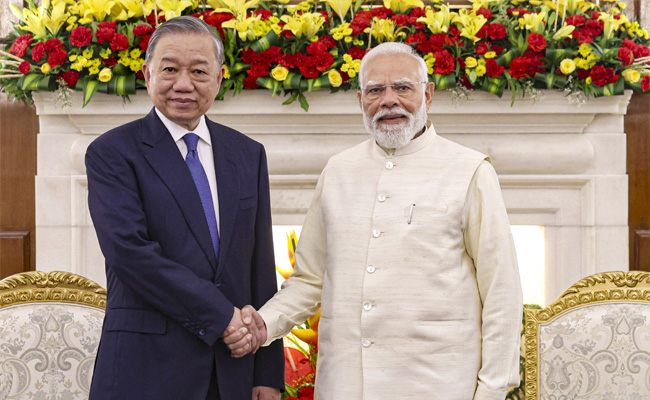
New Delhi (PTI): India and Vietnam on Wednesday elevated their ties to an enhanced comprehensive strategic partnership and set a USD 25 billion annual trade target by 2030 as Prime Minister Narendra Modi and Vietnamese President To Lam held talks focusing on expanding bilateral ties in areas of trade, defence, and critical minerals in the face of increasing geopolitical upheavals.
Following the Modi-Lam meeting, the two sides signed as many as 13 agreements which will provide for deeper two ways engagements in a range of areas including digital payments, rare earth minerals, pharmaceuticals, education, banking and culture.
Modi and Lam also deliberated on the situation in the Indo-Pacific amid China's increasing assertiveness in the region, and agreed to continue to contribute to the rule-of-law, peace, stability, and prosperity.
It is understood that China's growing military muscle-flexing in the South China Sea also figured in the delegation-level talks between the two sides.
Elected as president earlier this month, Lam began his first state visit to India on Tuesday, leading a high-level delegation for a three-day trip.
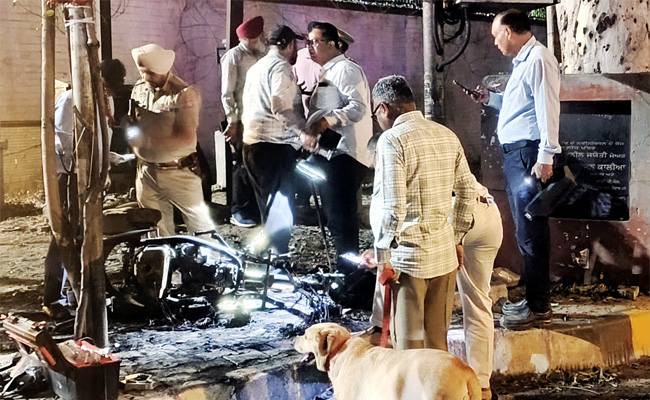
ALSO READ: Explosives used in blast outside Punjab Frontier BSF HQ in Jalandhar: Punjab Police
"A decade ago, Vietnam became India's first comprehensive strategic partner in ASEAN (Association of Southeast Asian Nations) . Since then, our relations have made rapid and comprehensive progress," Modi said in his media statement.
"Building on this strong foundation, today we are elevating our relations to the level of Enhanced Comprehensive Strategic Partnership. We will now advance our partnership to even higher goals," he said.
"Our cooperation will reach new levels in every area ' culture, connectivity, and capacity building, as well as security, sustainability, and supply chain resilience," Modi added.
He noted that the bilateral trade between India and Vietnam has doubled in the last decade to reach USD 16 billion and that the target now is to increase it to USD 25 billion by 2030.
Modi also cited a plethora of agreements signed between the two countries to emphasis that the economic engagement is expected to witness a significant upswing going forward.
"The MoU between our drug authorities will now increase access to Indian medicines in Vietnam. Exports of Indian agricultural, fisheries, and animal products to Vietnam are also set to become easier. Very soon, Vietnam will taste India's grapes and pomegranates," he said.
The two sides also agreed to update the India-ASEAN trade agreement by the end of this year.
"This will provide a new impetus to trade and investment between India and all ASEAN countries. New initiatives in critical minerals, rare earths, and energy cooperation will ensure the economic security and supply chain resilience of both countries," Modi said.
"To boost financial connectivity, we have today decided to enhance cooperation between our central banks. India's UPI and Vietnam's fast payment systems will soon be linked. Furthermore, we are strengthening state-to-state and city-to-city cooperation between the two countries," he noted.
Modi said India is grateful to Vietnam for its strong condemnation of the Pahalgam terrorist attack and standing with India in its fight against terrorism.
"In this era of global turmoil and economic challenges, thanks to their talent, good governance, and economic reforms, India and Vietnam are emerging as the world's fastest-growing economies," he said.
"Now, through our enhanced strategic partnership, we will support each other's rapid growth. As the Buddha's teachings say, 'If you light a lamp for someone else, it also illuminates your own path'," Modi said.
He also described Vietnam a a key pillar of India's Act East Policy and Vision Ocean.
"In the Indo-Pacific region as well, we share a common outlook. Through our strengthening defence and security cooperation, we will continue to contribute to the rule-of-law, peace, stability, and prosperity," he said.
The prime minister said India will broaden its relations with ASEAN with Vietnam's cooperation.
In his remarks, Lam said both sides agreed to deepen political trust and elevate security cooperation.
Last year, the two sides inked a pact to set up a framework for submarine search, rescue and support mechanism. They also signed a letter of intent (LoI) to strengthen bilateral defence industry collaboration.