India urges Australia to address students' difficulties due to travel restrictions
New Delhi, Sep 11: India on Saturday urged Australia to sympathetically address as soon as possible the difficulties being faced by Indian students due to the travel restrictions put in place by that country in view of the COVID-19 pandemic.
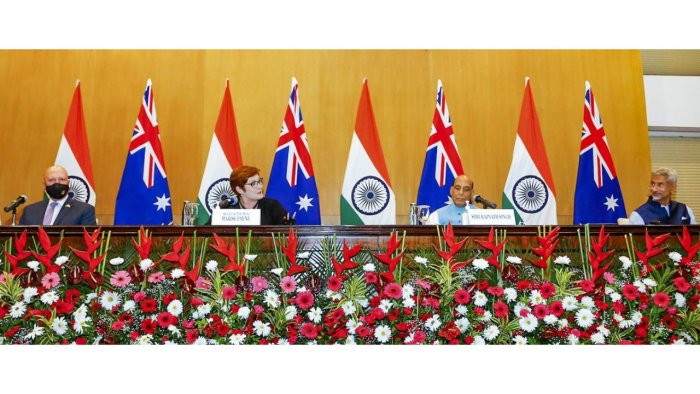
The issue was taken up during deliberations when External Affairs Minister S Jaishankar and Defence Minister Rajnath Singh held the inaugural 'two-plus-two' dialogue here with their Australian counterparts Marise Payne and Peter Dutton.
"I specifically took up with Minister Payne the problems faced by Indian students in Australia and those wishing to go to Australia as well as the Indian origin community that is resident there," Jaishankar said at a press event after the talks.
Jaishankar said during the talks he urged that the difficulties faced by students due to travel restrictions be sympathetically addressed as soon as possible.
"I think their (students') frustrations, their feelings are completely understandable. Many of them would like to be at the institutions that they are already studying or want to study. So we discussed it in some detail today. Minister Payne shared with me what is Australia's thinking about when students will be able to come," he said.
Jaishankar said that the Indian government has taken up the issue of problems being faced by students due to travel restrictions not just with Australia but with other countries like the US and Canada.
"So I do want the students of the country and the parents of the students to know that it is something we take as very high priority and take up very vigorously with our foreign partners," he said.
Australian Foreign Minister Payne said she understands the desire of students and their families that are not able to be in Australia for education and their desire for on campus experience.
The COVID-19 restrictions have impacted travel to and from Australia, not just for students, but for Australians themselves and even for ministers, she said.
"We (ministers) are required to comply with the same sort of quarantine restrictions and health requirements as all incoming travellers as you would expect. So our approach in Australia has been based on research and modelling commissioned by the government from the eminent Doherty institute and that gives us a four-phase pathway in terms of our response to COVID-19 and our progression through and out of the restrictions that have been in place," Payne said.
She said her country is on the way to vaccinating Australians to a level which will give Australia the confidence to begin the sort of reopening that will enable students to return in phase three and then in phase four, a much more opened environment for international travel.
"There is shared desire on both sides to see that travel resume between our countries as soon as it is safe to do so. I look forward to being one of the people at the airport to welcome the first arrivals of Indian students coming back to Australia," she said.
Earlier, Jaishankar said he and the other ministers came together for the first time and also discussed their experiences and further collaboration in responding to the COVID-19 challenges.
Decentralised globalisation, strategic autonomy and sharper sense of national security are some of the relevant outcomes, he noted.
"We also underlined our commitments to creating secure and resilient global supply chains. We welcomed the renewed vigour with which both sides are now engaging on trade issues to fully expedite the complementarities between us," Jaishankar said.
Let the Truth be known. If you read VB and like VB, please be a VB Supporter and Help us deliver the Truth to one and all.
Allahabad HC orders probe into 'reinstatement' of teacher in UP's Barabanki
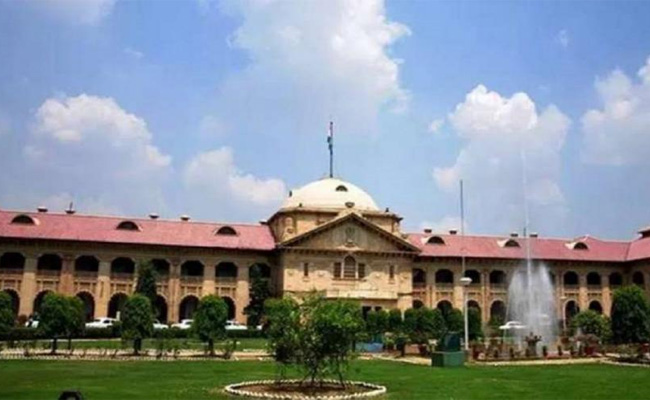
Lucknow (PTI): The Lucknow Bench of the Allahabad High Court on Friday ordered a probe by the special task force (STF) into alleged irregularities in the rejoining of a teacher at City Intermediate College in Barabanki, observing that the reinstatement appeared to be prima facie illegal.
The court also directed the recovery of the salary paid to the teacher during the disputed period.
A bench of Justice Rajeev Singh passed the order on a petition filed by the college management committee. The court expressed doubts over the roles of the District Inspector of Schools (DIOS), Barabanki, the college principal and the teacher concerned and hence, directed a detailed inquiry into the matter.
Taking note of alleged manipulation of records and misleading submissions, the court ordered the immediate transfer of the Barabanki DIOS to ensure a fair probe. It also directed the initiation of disciplinary proceedings against the then joint director of education of the Ayodhya division.
In its order, the court found that the teacher, Abhay Kumar, was initially appointed as an assistant teacher in 2018 but joined an Eklavya Model Residential School in Chhattisgarh as a lecturer in June 2024 without obtaining permission from the management. His subsequent request to retain the lien was rejected.
Despite this, he was allowed to rejoin the Barabanki College in September 2025 on the directions of the joint director of education and the DIOS, and was even paid the salary for October 2025. The court termed the rejoining "wholly illegal" and lacking any legal basis.
The bench also expressed concern over lapses in communication within the education department and directed the Uttar Pradesh chief secretary to ensure that official orders are communicated through email and WhatsApp as well, to prevent disputes.
The matter is next listed for hearing on May 28 when a compliance report is sought.