India very close to China in purchasing Russian oil, you are going to see more sanctions: Trump
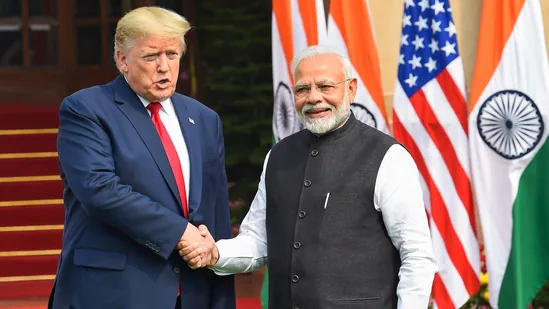
New York/Washington (PTI): US President Donald Trump has said India is "very close" to China in terms of its purchases of Russian oil and will pay tariffs of 50 per cent as he indicated that "you are going to see so much secondary sanctions".
".... As you know, we put a 50-per cent tariff on India on oil. They are the second largest, they are very close to China in terms of the purchase of oil from Russia," Trump said in the Oval Office on Wednesday.
Trump signed an executive order "Addressing Threats to the US by the Government of the Russian Federation" early on Wednesday, slapping an additional 25-per cent tariff on India for New Delhi's purchases of oil from Russia. This took the total levies imposed on India to 50 per cent, among the highest that Washington has imposed on any country, after the Trump administration had announced 25-per cent tariffs on India last week that come into effect from August 7. The additional 25-per cent duty will come into effect after 21 days or August 27.
At the White House event, Trump was flanked by Apple CEO Tim Cook, Vice President J D Vance, Secretary of the Treasury Scott Besant and Secretary of Commerce Howard Lutnick as the technology giant announced that it will invest USD 600 billion in the United States over the next four years. Trump was asked several questions about his decision to impose an additional tariff on India.
To a question that if he reaches a deal with Ukraine and Russia, would he drop the additional tariffs on India, Trump said, "We will determine that later but right now, they are paying a 50-per cent tariff."
Trump was then told that Indian officials have said there are other countries like China that are buying Russian oil, to which he said, "It is okay." On why was he singling India out for these additional tariffs, the US president said "it has only been eight hours, so let us see what happens over the next.... You are going to see a lot more. You are going to see so much secondary sanctions."
The United States has imposed this additional tariff or penalty for Russian imports only on India, while other buyers, such as China and Turkiye, have so far escaped such measures. The 30-per cent tariff on China and 15 per cent on Turkiye is lower than India's 50 per cent.
Asked about the additional penalties on India and whether he has any similar plans to enact more tariffs on China for its purchases, Trump said, "Could happen, could happen. Depends on how we do. Could happen."
On another question on possible tariffs on China for its purchases of Russian oil, he said, "It may happen, I do not know, I cannot tell you yet. We did it with India. We are doing it probably with a couple of others. One of them could be China."
Reacting to Trump's additional tariffs, the Ministry of External Affairs (MEA) said in a statement that it is "extremely unfortunate" that the US should choose to impose additional tariffs on India for actions that several other countries are also taking in their own national interest.
"We have already made clear our position on these issues, including the fact that our imports are based on market factors and done with the overall objective of ensuring the energy security of 1.4 billion people of India," the MEA statement said, adding that the US has in recent days targeted India's oil imports from Russia.
"We reiterate that these actions are unfair, unjustified and unreasonable. India will take all actions necessary to protect its national interests," it said.
In the executive order, Trump said he has determined that "it is necessary and appropriate to impose an additional ad valorem duty on imports of articles of India, which is directly or indirectly importing Russian Federation oil".
"I find that the Government of India is currently directly or indirectly importing Russian Federation oil. Accordingly, and as consistent with applicable law, articles of India imported into the customs territory of the United States shall be subject to an additional ad valorem rate of duty of 25 per cent," Trump said in the executive order.
He also announced that the US will be putting a tariff of approximately 100 per cent on chips and semiconductors coming into the country. "But if you are building in the United States of America, there is no charge.... If you have made a commitment to build, or if you are in the process of building, as many are, there is no tariff."
India buys about 88 per cent of its crude oil, which is converted into fuels like petrol and diesel, from overseas. Russian oil made up for hardly 0.2 per cent of all crude oil that India imported till 2021. After Moscow invaded Ukraine, Russian oil was available at a discount to international benchmarks due to western sanctions, and was quickly lapped up by Indian refiners. Russia is now India's largest oil supplier.
In July, India imported about five million (50 lakh) barrels of oil a day, of which 1.6 million (16 lakh) came from Russia.
After the new levy, India will attract the highest tariff of 50 per cent along with Brazil. After this, India's competitors will be much better placed in the US market as their duty is lower -- Myanmar (40 per cent), Thailand and Cambodia (both 36 per cent), Bangladesh (35 per cent), Indonesia (32 per cent), China and Sri Lanka (both 30 per cent), Malaysia (25 per cent), the Philippines and Vietnam (both 20 per cent).
The announcement comes at a time when a team from Washington is scheduled to visit India from August 25 for the sixth round of negotiations for the proposed bilateral trade agreement (BTA).
Let the Truth be known. If you read VB and like VB, please be a VB Supporter and Help us deliver the Truth to one and all.
Mangaluru: Man sentenced to 20 years rigorous imprisonment in POCSO case

Mangaluru: A court in Mangaluru has sentenced a 44-year-old man to 20 years of rigorous imprisonment in connection with a case under the Protection of Children from Sexual Offences (POCSO) Act.
According to Deccan Herald, the Additional District and Sessions Judge, FTSC-II (POCSO), Maanu K S, delivered the judgment.
The convict has been identified as Dayanand Moolya (44).
According to Special Public Prosecutor Sahana Devi Boloor, the incident occurred on November 16, 2025, when a seven-year-old girl was studying alone at home and the accused illegally entered the house and raped her. He threatened to kill her and throw her into a well if she revealed it to anyone.
The survivor later informed her mother, following which a complaint was registered at Mulki Police Station on November 22. Police Inspector Manjunath B S investigated the case and submitted the charge sheet to the court.
For the rape, under POCSO Section 6, along with Bharatiya Nyaya Sanhita (BNS) Act 65(2) and POCSO 4(2), the man has been sentenced to 20 years of rigorous imprisonment and a fine of Rs 30,000. For illegal entry into the house, under BNS Section 332(B), the convict has been sentenced to three years of simple imprisonment and a fine of Rs 5,000. For issuing death threats, under BNS Section 351(3), he has been sentenced to two years of simple imprisonment and a fine of Rs 5,000.
The court also directed payment of Rs 4 lakh as compensation to the survivor, including Rs 40,000 from the fine amount, and instructed the District Legal Services Authority to provide the remaining Rs 3.60 lakh.