India votes in favour of UNGA resolution on Palestine endorsing two-state solution
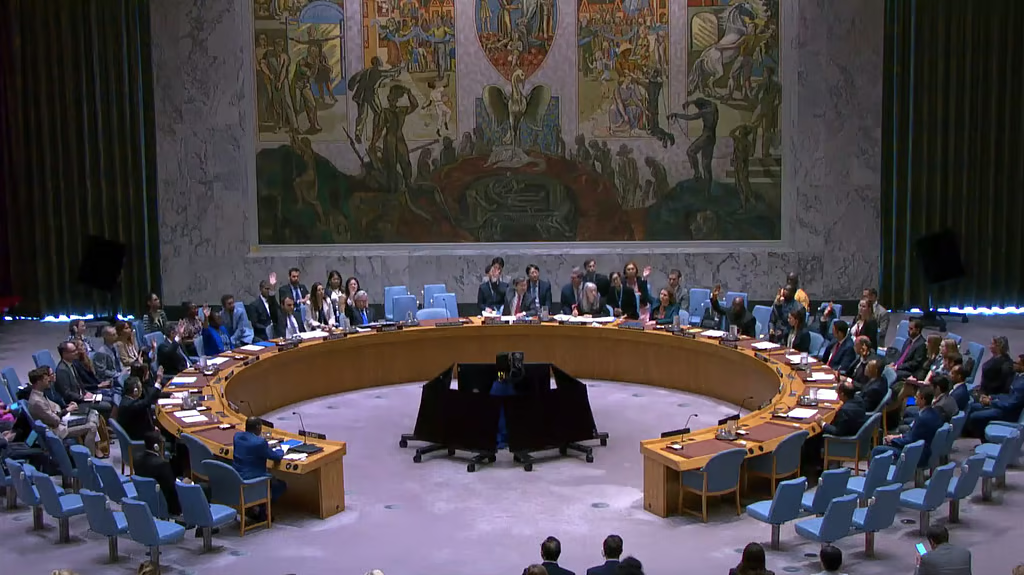
United Nations (PTI): India on Friday voted in favour of a resolution in the UN General Assembly that endorses the ‘New York Declaration' on peaceful settlement of the Palestine issue and implementation of the two-state solution.
The resolution, introduced by France, was adopted with an overwhelming 142 nations voting in favour, 10 against and 12 abstentions. Those voting against included Argentina, Hungary, Israel and the US.
India was among the 142 nations that voted in favour of the resolution titled ‘Endorsement of the New York Declaration on the Peaceful Settlement of the Question of Palestine and the Implementation of the Two-State Solution’.
The declaration was circulated at a high-level international conference held in July at the UN headquarters and co-chaired by France and Saudi Arabia.
In the declaration, the leaders “agreed to take collective action to end the war in Gaza, to achieve a just, peaceful and lasting settlement of the Israeli-Palestinian conflict based on the effective implementation of the two-state solution, and to build a better future for Palestinians, Israelis and all peoples of the region”.
The declaration called on the Israeli leadership to issue a clear public commitment to the two-state solution, including a sovereign, and viable Palestinian State.
It also called on Israel to "immediately end violence and incitement against Palestinians, to immediately halt all settlement, land grabs and annexation activities in the Occupied Palestinian Territory, including East Jerusalem, publicly renounce any annexation project or settlement policy, and put an end to settlers’ violence".
It also reaffirmed "support for the right of the Palestinian people to self-determination".
“Recent developments have highlighted, once again, and more than ever, the terrifying human toll and the grave implications for regional and international peace and security of the persistence of the Middle East conflict,” the declaration said.
“Absent decisive measures towards the two-state solution and robust international guarantees, the conflict will deepen and regional peace will remain elusive,” it added.
Asserting that “the war in Gaza must end now”, the declaration further said that, “Gaza is an integral part of a Palestinian State and must be unified with the West Bank. There must be no occupation, siege, territorial reduction, or forced displacement.”
Let the Truth be known. If you read VB and like VB, please be a VB Supporter and Help us deliver the Truth to one and all.
NCW chief condemns rape-murder of 4-year-old girl in Pune, calls for swift action
New Delhi (PTI): National Commission for Women (NCW) Chairperson Vijaya Rahatkar has condemned the alleged rape and murder of a four-year-old girl in Maharashtra's Pune, calling it "deeply distressing" and a "blot on humanity".
The girl was allegedly raped and killed by a 65-year-old labourer, who has a criminal record, in Bhor tehsil of Pune on Friday. The accused allegedly lured the child to a cattle enclosure on the pretext of giving her food. After raping her, he killed her by hitting her with a stone, according to police.
The accused has been arrested.
In a post on X on Saturday, Rahatkar said the incident in the Nasrapur area in Pune was heartbreaking and has shaken society.
"The brutal torture and murder of a four-year-old innocent girl in Nasrapur (Bhor, Pune) is deeply painful, heartbreaking, and shocking. It is a blot on humanity," she said.
She said Pune Rural police has arrested the accused and noted that Maharashtra Chief Minister Devendra Fadnavis and Deputy Chief Minister Sunetra Pawar have assured strict action in the case.
Rahatkar said the NCW has taken cognisance of the matter and written to the National Commission for Protection of Child Rights (NCPCR), requesting the body to ensure necessary and prompt action.
It has also been recommended that the case be pursued under stringent provisions of the Protection of Children from Sexual Offences (POCSO) Act and be closely monitored from the filing of the chargesheet to proceedings in a fast-track special court to ensure time-bound justice, she added.
Ensuring justice for the victim and stringent punishment for the accused is a collective responsibility, the NCW chairperson underlined.
In a post on X, the NCW said it has taken suo motu cognisance of the extremely "heinous" incident.
"This heinous crime causes profound pain and outrage, and it highlights serious concerns regarding the safety of young girls," it said.
Strongly condemning this grave "inhuman act", the NCW said such crimes constitute a serious violation of children's rights and raise questions about society's security system.