India will not join RCEP deal: PM Modi

Bangkok, Nov 4: Prime Minister Narendra Modi said on Monday that India will not join the mega Regional Comprehensive Economic Partnership (RCEP) deal as negotiations failed to address New Delhi's "outstanding issues and concerns".
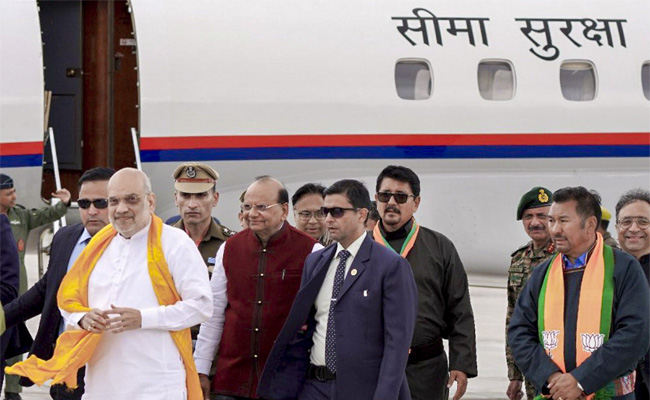
Prime Minister Modi made the announcement during his speech at the RCEP Summit here, which was attended by several world leaders.
"The present form of the RCEP Agreement does not fully reflect the basic spirit and the agreed guiding principles of the RCEP. It also does not address satisfactorily India's outstanding issues and concerns. In such a situation, it is not possible for India to join RCEP Agreement," Modi said.
The RCEP comprises 10 ASEAN nations and six of its FTA (free trade agreement) partners - China, India, Japan, South Korea, India, Australia and New Zealand. However, India opted out of the RCEP.
The original RCEP was aiming to facilitate the creation of the biggest free-trade region in the world as the 16-nation grouping is home to 3.6 billion people, or nearly half the world's population.
India has been forcefully raising the issue of market access as well as protected lists of goods mainly to shield its domestic market as there have been fears that the country may be flooded with cheap Chinese agricultural and industrial products once it signs the deal.
"India stands for greater regional integration as well as for freer trade and adherence to a rule-based international order. India has been proactively, constructively and meaningfully engaged in the RCEP negotiations since inception. India has worked for the cherished objective of striking balance, in the spirit of give and take," the prime minister said.
"Today, when we look around we see during seven years of RCEP negotiations, many things, including the global economic and trade scenarios have changed. We cannot overlook these changes," he added.
The RCEP negotiations were launched by ASEAN leaders and six other countries during the 21st ASEAN Summit in Phnom Penh in November 2012. The objective of launching RCEP negotiations was to achieve a modern, comprehensive, high-quality, and mutually beneficial economic partnership agreement among the ASEAN member States and its FTA partners.
"When I measure the RCEP Agreement with respect to the interests of all Indians, I do not get a positive answer. Therefore, neither the Talisman of Gandhiji nor my own conscience permit me to join RCEP," Modi said.
This is not the first time that the Indian government under Prime Minister Modi has demonstrated a strong resolve in matters of international trade and related negotiations. US President Donald Trump who is known for his negotiation skills has himself called Modi a tough negotiator, sources said.
"Gone are the days when Indian negotiators caved-in to pressures from the global powers on trade issues. This time, India played on the front foot, stressing on the need to address India's concerns over trade deficits and the need for other countries to open their markets to Indian services and investments," government sources said.
The sources said except India, all 15 RCEP member countries were on board in finalising the deal at Monday's summit.
On Saturday, the trade ministers from 16 RCEP countries failed to resolve the outstanding issues identified by India, though back-channel talks continued on the sidelines of the ASEAN summit to resolve the sticky issues.
Let the Truth be known. If you read VB and like VB, please be a VB Supporter and Help us deliver the Truth to one and all.
AIITA welcomes Karnataka’s ban on obscene songs in school events
Bhatkal: The Karnataka unit of the All India Ideal Teachers Association (AIITA) has welcomed the Karnataka government’s decision to strictly ban school children from dancing to obscene songs during educational and cultural programmes in government, aided, and private schools across the state.
AIITA Karnataka State President M. R. Manvi congratulated the government for taking what he termed an important step to preserve the sanctity of education.
“Such decisions to safeguard the dignity of school children and uphold the values of education are the need of the hour. This rule should not be limited to government schools alone but must be strictly implemented in all private educational institutions as well,” he said.
He further urged the government to address other concerns within school programmes.
“The government should not only prohibit obscene dances in the name of school anniversaries, but also ensure that plays and dialogues that incite religious hatred are avoided. Schools should be centres of harmony, not platforms for spreading hatred,” he added.
According to a recent circular issued by the Department of School Education and Literacy, obscene dances are adversely affecting the mental health and moral values of students.
In this regard, schools have been advised to use songs that promote nationalism, positive thinking, the greatness of Kannada culture, and value-based traditions instead of inappropriate content during programmes.
The circular also emphasises that students should be dressed in decent attire.
AIITA also backed the department’s warning that disciplinary action would be taken against head teachers if such guidelines are violated. The association has further demanded that district Deputy Directors of Public Instruction strictly monitor the implementation of these rules.