Indian-American mathematician among three selected for inaugural Ciprian Foias Prize

Washington, Dec 4: Eminent Indian-American mathematician Nikhil Srivastava, who teaches at the University of California, Berkeley, has been jointly selected for the inaugural Ciprian Foias Prize in Operator Theory by American Mathematical Society (AMS).
Along with Srivastava, the two other awardees are Adam Marcus and Daniel Spielman. Adam Marcus holds the Chair of Combinatorial Analysis at the cole Polytechnique F d rale de Lausanne (EPFL) in Switzerland. Spielman is Sterling Professor of Computer Science, a professor of statistics and data science, and a professor of mathematics.
The award recognises their highly original work that introduced and developed methods for understanding the characteristic polynomial of matrices, namely the iterative sparsification method (also in collaboration with Batson) and the method of interlacing polynomials, a media release said.
"Together, these ideas provided a powerful toolkit with many applications, notably in the trio's breakthrough paper Interlacing families II: mixed characteristic polynomials and the Kadison Singer problem (Annals of Mathematics, 2015), which solves the famous paving problem'' in operator theory, formulated by Richard Kadison and Isadore Singer in 1959, AMS said.
In a joint statement, the three awardees said they wish to accept it on behalf of the many people whose work contributed to the resolution of the Kadison Singer problem.
"Our involvement was the final chapter of an amazing story we hope will inspire similar solutions to difficult problems in the future, they said.
The prize will be presented to Professor Srivastava and his colleagues on January 5 next year at the 2022 Joint Mathematics Meeting in Seattle, described as "the largest mathematics gathering in the world."
The Ciprian Foias Prize is the third major prize won by Srivastava, who earlier jointly won the George Polya Prize in 2014, and the Held prize in 2021.
Let the Truth be known. If you read VB and like VB, please be a VB Supporter and Help us deliver the Truth to one and all.
Sengottaiyan secures historic 10th victory in Gobichettipalayam assembly constituency
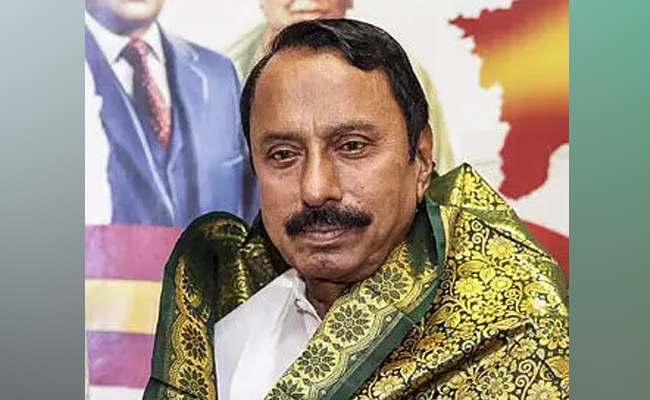
Gobichettipalayam (Tamil Nadu) (PTI): In a historic 10th win, veteran leader K A Sengottaiyan clinched the Gobichettipalayam seat in the 2026 Assembly elections.
Contesting for the first time under actor Vijay’s TVK, the 78-year-old secured approximately 71,380 votes, defeating DMK’s N Nallasivam by a margin of nearly 13,000 votes.
This win marks Sengottaiyan’s 10th consecutive victory in the constituency, cementing his status as an immovable force in the region despite his high-profile exit from the AIADMK in late 2025.
His success was a cornerstone for the TVK, which emerged as a formidable force across the state. Supporters celebrated the win as a testament to Sengottaiyan’s personal influence, which successfully transitioned from his former Dravidian home to the newly formed TVK.