Indian-American MIT Prof Abhijit Banerjee and wife win Nobel in Economics
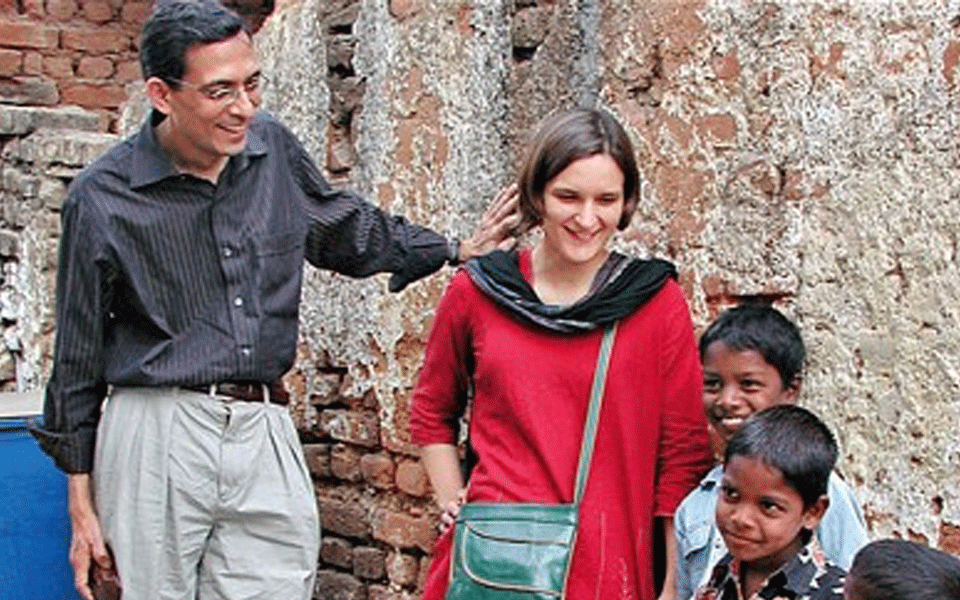
Stockholm: Indian-American Abhijit Banerjee, who won the 2019 Nobel Prize for Economics jointly with his wife Esther Duflo and another economist Michael Kremer on Monday, is currently the Ford Foundation International Professor of Economics at the US-based Massachusetts Institute of Technology (MIT).
Banerjee, born in 1961 in Mumbai, bagged the award for his "experimental approach to alleviating global poverty". The 58-year-old economist received his PhD in 1988 from Harvard University. He also studied at the University of Calcutta and Delhi's Jawaharlal Nehru University.
In 2003, he founded the Abdul Latif Jameel Poverty Action Lab (J-PAL), along with his French-American wife Duflo, who is also a MIT professor, and Sendhil Mullainathan..
He remains one of the lab's directors, according to the MIT website.
Banerjee is a past president of the Bureau for the Research in the Economic Analysis of Development, a Research Associate of the NBER, a CEPR research fellow, International Research Fellow of the Kiel Institute, a fellow of the American Academy of Arts and Sciences and the Econometric Society, and has been a Guggenheim Fellow and an Alfred P Sloan Fellow and a winner of the Infosys prize.
He is the author of a large number of articles and four books, including 'Poor Economics', which won the Goldman Sachs Business Book of the Year Award in 2011.
The 'Poor Economics' has been translated into more than 17 languages.
"Why would a man in Morocco who doesn't have enough to eat buy a television? Why is it so hard for children in poor areas to learn, even when they attend school? Does having lots of children actually make you poorer? Answering questions like these is critical if we want to have a chance to really make a dent against global poverty," Banerjee wrote in the book 'Poor Economics'.
He is the editor of three more books and has directed two documentary films.
He also served on the UN Secretary-General's High-level Panel of Eminent Persons on the Post-2015 Development Agenda, the website said.
Duflo, born 1972 in Paris, received her PhD in 1999 from MIT. In her research, she seeks to understand the economic lives of the poor, with the aim to help design and evaluate social policies. Duflo is the Abdul Latif Jameel Professor of Poverty Alleviation and Development Economics in the Department of Economics at the MIT.
She has worked on health, education, financial inclusion, environment and governance. Duflo's first degrees were in history and economics from Ecole Normale Superieure in Paris.
She has received numerous academic honors and prizes including the Princess of Asturias Award for Social Sciences (2015), the A.SK Social Science Award (2015), Infosys Prize (2014), the David N Kershaw Award (2011), a John Bates Clark Medal (2010), and a MacArthur "Genius Grant" Fellowship (2009).
With Banerjee, she co-authored the book, 'Poor Economics'.
Duflo is the Editor of the American Economic Review. She is also a member of the National Academy of Sciences and a Corresponding Fellow of the British Academy.
Let the Truth be known. If you read VB and like VB, please be a VB Supporter and Help us deliver the Truth to one and all.
AIITA welcomes Karnataka’s ban on obscene songs in school events

Bhatkal: The Karnataka unit of the All India Ideal Teachers Association (AIITA) has welcomed the Karnataka government’s decision to strictly ban school children from dancing to obscene songs during educational and cultural programmes in government, aided, and private schools across the state.
AIITA Karnataka State President M. R. Manvi congratulated the government for taking what he termed an important step to preserve the sanctity of education.
“Such decisions to safeguard the dignity of school children and uphold the values of education are the need of the hour. This rule should not be limited to government schools alone but must be strictly implemented in all private educational institutions as well,” he said.
He further urged the government to address other concerns within school programmes.
“The government should not only prohibit obscene dances in the name of school anniversaries, but also ensure that plays and dialogues that incite religious hatred are avoided. Schools should be centres of harmony, not platforms for spreading hatred,” he added.
According to a recent circular issued by the Department of School Education and Literacy, obscene dances are adversely affecting the mental health and moral values of students.
In this regard, schools have been advised to use songs that promote nationalism, positive thinking, the greatness of Kannada culture, and value-based traditions instead of inappropriate content during programmes.
The circular also emphasises that students should be dressed in decent attire.
AIITA also backed the department’s warning that disciplinary action would be taken against head teachers if such guidelines are violated. The association has further demanded that district Deputy Directors of Public Instruction strictly monitor the implementation of these rules.