Indian-American population grew by 38 percent between 2010-2017: report
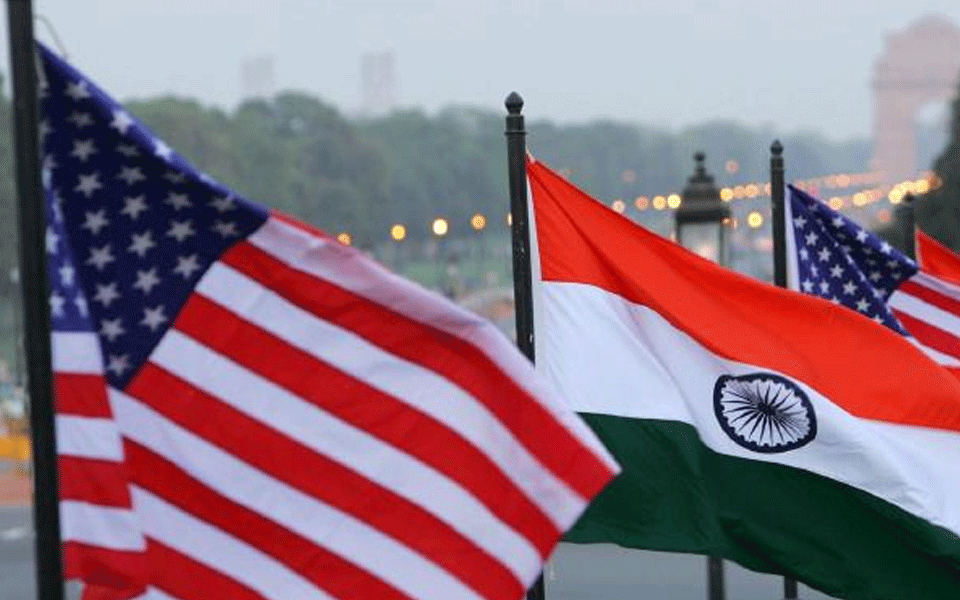
Washington, Jun 18: The population of Indian-origin people in America grew by 38 per cent in seven years between 2010 and 2017, a South Asian advocacy group has said in its latest demographic report.
There are at least 630,000 Indians who are undocumented, a 72 per cent increase since 2010, the South Asian Americans Leading Together (SAALT) said in its snapshot.
The increase in illegal Indian-Americans can be attributed to Indian immigrants overstaying visas, it said.
Nearly 250,000 Indians overstayed their visa in 2016 therefore becoming undocumented, it said.
In general, the population of American residents tracing their roots to South Asia grew by 40 per cent. In real terms, it increased from 3.5 million in 2010 to 5.4 million in 2017, SAALT said.
The Nepali community grew by 206.6 per cent since 2010, followed by Indian (38 per cent), Bhutanese (38 per cent), Pakistani (33 per cent), Bangladeshi (26 per cent) and Sri Lankan populations (15 per cent).
There are currently at least 4,300 active South Asian Deferred Action for Childhood Arrivals (DACA) recipients. As of August 2018, there are approximately 2,550 active Indian DACA recipients. Only 13 per cent of the overall 20,000 DACA eligible Indians have applied and received DACA.
SAALT said that as far as DACA recipients from other countries are concerned, there are 1,300 from Pakistan, 470 from Bangladesh, 120 from Sri Lanka and 60 from Nepal.
The immigrant population density of the country shows that undocumented Bangladeshi immigrants live in New York (19,000); Michigan (4,000); Virginia (3,000); and California (2,000).
The demographic snapshot is based primarily on Census 2010 and the 2017 American Community Survey.
According to the report, income inequality has been reported to be the greatest among Asian Americans.
Nearly one percent of the approximately five million South Asians in the US live in poverty.
SAALT said there has been a rise in the number of South Asians seeking asylum in the US over the last 10 years.
The US Immigration and Customs Enforcement (ICE) has detained 3,013 South Asians since 2017. US Customs and Border Patrol arrested 17,119 South Asians between October 2014 and April 2018 through border and interior enforcement, it said.
According to SAALT, since 1997, more than 1.7 million dependent spouses of H-1B visa holders have received H-4 visas.
In 2017, 136,000 individuals received H-4 status. Nearly 86 per cent of H-4 visa holders are from South Asian countries.
In 2015, DHS granted work authorisation to certain H-4 visa holders. As of December 2017, approximately 127,000 visa holders were approved for H-4 EAD, the report said.
Nearly 472,000 or 10 per cent of the approximately five million South Asians in the US live in poverty, the report said.
Among South Asian Americans, Pakistanis (15.8 per cent), Nepalis (23.9 per cent), Bangladeshis (24.2 per cent), and Bhutanese (33.3 per cent) had the highest poverty rates, it said.
Bangladeshi and Nepali communities have the lowest median household incomes out of all Asian American groups, earning USD 49,800 and USD 43,500 respectively, it said.
Nearly 61 per cent of non-citizen Bangladeshi American families receive public benefits for at least one of the four federal programmes including TANF, SSI, SNAP and Medicaid/CHIP, 48 per cent of non-citizen Pakistani families and 11 per cent of non-citizen Indian families also receive public benefits, the report said.
In the lead up to the 2020 elections, South Asians are becoming an increasingly powerful segment of the American electorate, SAALT said.
According to the Current Population Survey (CPS), 49.9 per cent of voting-age, Asian American citizens cast a ballot in 2016. The number of Asian American voters in the last decade has nearly doubled from about two million voters in 2001 to 5 million voters in 2016.
Of these, Indians account for more than 1.5 million, followed by Pakistanis (2,22,252) and Bangladeshi (69,825), SAALT added.
Let the Truth be known. If you read VB and like VB, please be a VB Supporter and Help us deliver the Truth to one and all.
Hospital wall collapse: CM orders suspension of executive engineer; kin of victims get solatium
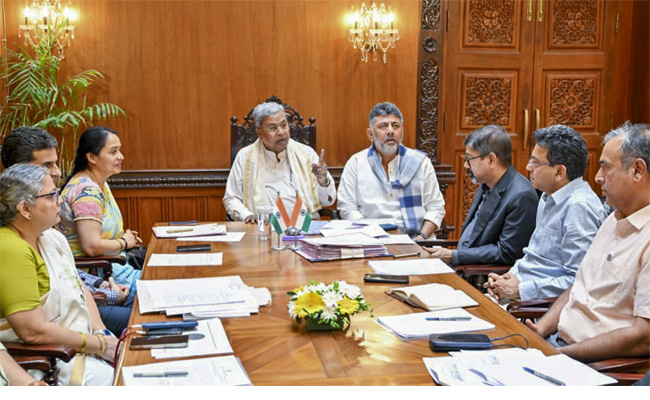
Bengaluru (PTI): Karnataka Chief Minister Siddaramaiah on Thursday ordered the immediate suspension of an executive engineer for the Bowring and Lady Curzon Hospital wall collapse that claimed the lives of seven people, during a high-level review meeting at Vidhana Soudha.
A compensation of Rs 5 lakh, as announced by the CM Siddaramaiah, was distributed to the families of seven victims who lost their lives in the tragedy on Wednesday evening, which occurred due to heavy downpour with gusty winds and hailstorm.
The meeting of municipal commissioners of the five corporations, chaired by the chief minister and attended by Deputy Chief Minister D K Shivakumar, focused on fixing accountability and examining lapses that led to the tragedy.
"Why was soil dumped in a way that damaged the wall? Why did you not monitor this?" Siddaramaiah asked, pulling up hospital authorities during the meeting.
A statement from the chief minister's office said that the CM ordered the immediate suspension of the executive engineer of the Karnataka Health Systems Development Project (KHSDP).
ALSO READ: Three arrested for running fake Aadhaar racket in UP's Badaun
He also questioned the hospital authorities, asking why they failed to monitor the dumping of soil that weakened the structure.
The chief minister directed that a notice be issued to the head of the Hospital.
During the meeting, Siddaramaiah said the rains had caused extensive damage in the city, with over 250 trees uprooted.
The Chief Minister instructed officials to take necessary measures before the onset of the monsoon to avoid untoward incidents.
Commissioners of all five municipal zones in Bengaluru have been asked to take precautionary steps, including trimming dry and dangerous tree branches, the CMO said.
Siddaramaiah also directed them to get the silt cleared from stormwater drains to prevent flooding, and that immediate action be taken to remove debris and fallen branches from roads.
Further, he instructed that barricades be placed at underpasses where water stagnates and restricts public movement.
The Greater Bengaluru Authority (GBA) Chief Commissioner M Maheshwar Rao said in a statement that Shivajinagar MLA Rizwan Arshad distributed compensation cheques of Rs 5 lakh each to the families of the deceased on Thursday.
Seven people, including a six-year-old girl, were killed and seven others injured when the compound wall collapsed amid heavy rain, strong winds and a hailstorm on Wednesday evening.
Police said the victims, comprising three from Bengaluru, two from Kerala on a study tour and one each from Uttar Pradesh and Assam, had taken shelter near the wall when it suddenly gave way, trapping them under the debris.
The chief minister questioned officials over the dumping of soil near the wall despite knowing it could weaken the structure, and directed that a notice be issued to the head of Bowring Hospital.
Siddaramaiah, who had visited the spot soon after the incident along with senior officials, reviewed the situation and ordered a detailed probe into the collapse.