Indian-American presidential aspirant Vivek Ramaswamy attacked by rivals over Ukraine
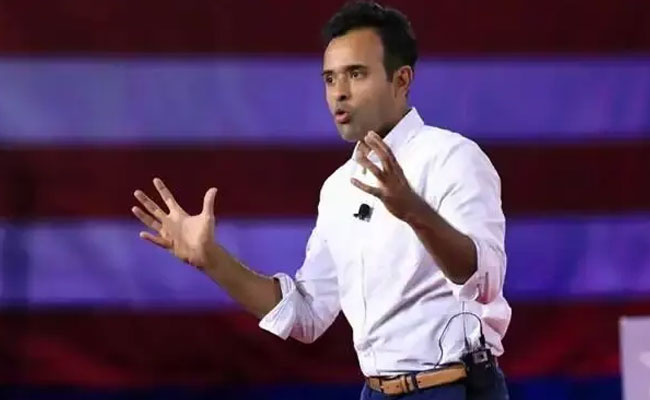
Washington (PTI): Indian-American Republican presidential aspirant Vivek Ramaswamy has infuriated his Republican primary rivals when he said that he will not back Ukraine in its war against Russia, aligning himself with former president Donald Trump who wants to abandon critical support of Kyiv.
"We have to level with the American people on this issue," the 38-year-old multimillionaire biotech entrepreneur said.
"Just because (Russian President Vladimir) Putin is an evil dictator does not mean that Ukraine is good. This is a country that has banned 11 opposition parties, that has actually...," Ramaswamy said during the second Republican presidential primary at the Reagan Library in Simi Valley, California, on Wednesday.
Ramaswamy's isolationist tilt drew major blowback from former vice president Mike Pence, former governor of New Jersey Chris Christie and former South Carolina governor Nikki Haley.
Haley, who is also of Indian origin, was the first to jump in and oppose such a move by Ramaswamy.
"A win for Russia is a win for China," she said.
Ramaswamy disagreed.
"China is the real enemy. We are driving Russia further into China's arms. We need a reasonable peace plan to end this, this is a country whose president just last week was hailing a Nazi in his own ranks," he said.
Pence joined Haley in slamming Ramaswamy for his comments.
"Vivek, if you let Putin have Ukraine, that's a green light to China to take Taiwan. Peace comes through strength," he said. "We need a reasonable plan to peace. We need a reasonable plan to peace," Ramaswamy responded.
Christie too slammed Ramaswamy.
"The Chinese are paying for the Russian war in Ukraine. The Iranians are supplying more sophisticated weapons, and so are the North Koreans now as well, with the encouragement of the Chinese," he said.
"The naivete on this stage from some of these folks is extraordinary," Christie said.
"Look, I understand people want to go and talk to Putin. Guess what? So did George W. Bush. So did Barack Obama. So did Donald Trump. And so did Joe Biden, when he said a small invasion wouldn't be so bad. Every one of them has been wrong," he said.
"The fact of the matter is, we need to say right now that the Chinese-Russian alliance is something we have to fight against. And we are not going to solve it by going over and cuddling up to Vladimir Putin. Look, Donald Trump said Vladimir Putin was brilliant and a great leader. This is the person who is murdering people in his own country. And now, not having enough blood, he's now going to Ukraine to murder innocent civilians and kidnap 20,000 children," he said.
"And let me tell you, if you think that's where it's going to stop, if we give him any of Ukraine, next will be Poland," Christie said.
In an email to his supporters after the debate, Ramaswamy said that he was once again the number one target of his fellow Republican candidates.
"Nikki Haley said she felt "dumber" when I spoke. Tim Scott came after my business record. Ron DeSantis' Super PAC wouldn't stop tweeting about me. While they launched their attacks on my platform last night, I focused on the Truth," he said.
Let the Truth be known. If you read VB and like VB, please be a VB Supporter and Help us deliver the Truth to one and all.
Man arrested with Rs 2.54-crore heroin in Mumbai

Mumbai (PTI): Police have arrested a man and seized over 500 grams of heroin worth Rs 2.54 crore in the illicit market from him in Mumbai, officials said on Friday.
The police's Anti-Narcotics Cell (ANC) made the drug seizure in Santacruz in the western suburbs. The operation was conducted by the Kandivali unit of the ANC on Thursday as part of a special crackdown against drug trafficking in the area, they said.
Acting on specific inputs, an ANC team conducted a raid in Santacruz (East) and intercepted a man. During a search, the team recovered 508 grams of high-grade heroin from his possession, an official said.
The seized contraband, a highly addictive, opioid drug derived from morphine, is estimated to be worth Rs 2.54 crore in the international market, he informed.
Following the seizure, a case was registered against the man under relevant sections of the Narcotic Drugs and Psychotropic Substances (NDPS) Act, 1985, and he was formally placed under arrest in the early hours of Friday.
The police are currently investigating the source of the drug and trying to identify the intended recipients of the consignment, he said.