Indian-American teacher hailed for saving students during Florida shooting
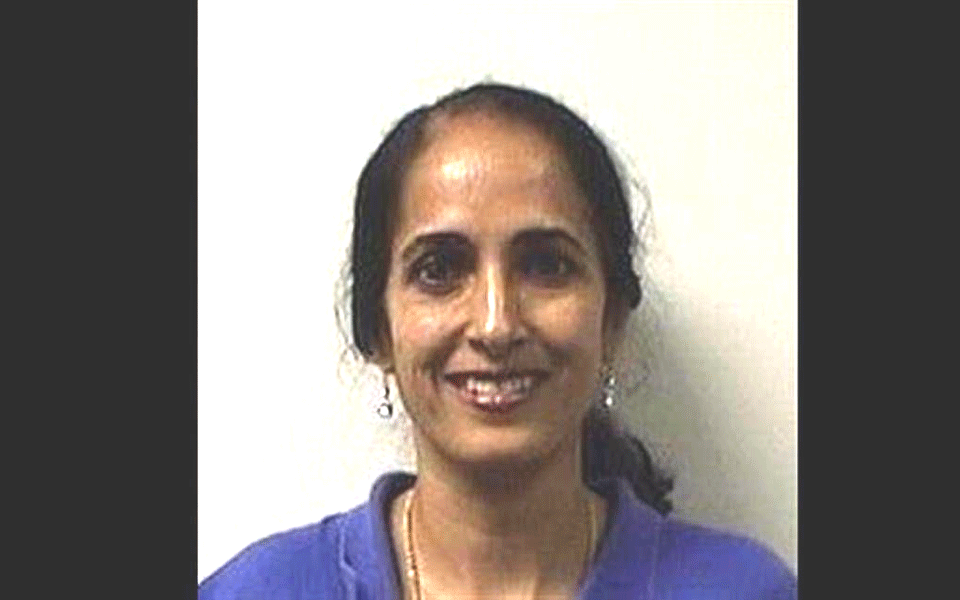
New York: An Indian-American maths teacher is being hailed for saving the lives of her students during the shooting rampage at a Florida, high school that left 17 dead.
When an alarm sounded for the second time on Wednesday afternoon, Shanthi Viswanathan shut the doors to her algebra classroom, made the students crouch on the floor and covered the windows, keeping them out of the reach and sight of the gunman, the Sun-Sentinel reported.
"She was quick on her feet. She used her knowledge. She saved a lot of kids," Dawn Jarboe, the mother of one of Viswanathan's students, told the newspaper.
When an elite police SWAT team came and knocked on the door asking her to open it, "Viswanathan took no chance that it wasn't a trick by the gunman to get in" the newspaper said.
"She said, 'knock it down or open it with a key. I'm not opening the door," Jarboe quoted her as telling the police.
"Some SWAT guy took out the window and cleared our room," Jarboe's son, Brian, texted his mother.
It may be recalled that a former student of the school, Nikolas Cruz, barged into Stoneman Douglas High School in Parkland on Valentine's Day and killed 15 students and two staff members with an AR-15 automatic rifle.
However, he was reported to have had a troubled childhood and had threatened in a YouTube post to shoot up schools.
Although it was reported to the Federal Bureau of Investigation, the agency closed the investigation without locating him, according to media reports.
The shooter abandoned his gun and during the ensuing chaos mixed in with the students to escape. He was captured about 40 minutes later in a neighboring town, authorities said.
In the entire Broward County, where Parkland is located, the Indian population is 22,600, according to statisticalatlas.com. But none of those killed are of Indian descent.
Let the Truth be known. If you read VB and like VB, please be a VB Supporter and Help us deliver the Truth to one and all.
Karnataka Lokayukta to register case, probe Bowring wall collapse
Bengaluru (PTI): Karnataka Lokayukta Justice B S Patil on Thursday took serious note of the compound wall collapse at Bowring and Lady Curzon Hospital in the city that killed seven people, and announced registration of a case on its own while warning of action against officials found responsible.
The Lokayukta, who visited the site and conducted an inspection, expressed strong displeasure over the incident and questioned the inaction of authorities, even as police and emergency teams had earlier rushed to the spot to rescue victims trapped under the debris following heavy rain, strong winds and a hailstorm on Wednesday evening.
“I will now register a suo motu case. This is not just about this one incident — such incidents must not occur anywhere in the state or the city in the future,” Justice Patil told reporters.
Seven people, including a six-year-old girl, were killed and seven others injured when the compound wall collapsed as rain-battered victims had taken shelter near it, according to police. The victims included people from Kerala who were in the city on a study tour.
Calling for systemic accountability, the Lokayukta said, “Dilapidated buildings and weakened compound walls, especially in areas with public access, must first be identified. They must either be repaired, demolished, or rebuilt.”
He added that responsibility would be fixed on officials of the BBMP and the concerned departments.
Justice Patil said that hearings would be conducted and preventive action initiated, while also probing those responsible for it, how the incident could have been prevented, and why it was not prevented.
A Scene of Crime Officers (SOCO) team and a Forensic Science Laboratory (FSL) team also inspected the site, while police cordoned off Kovil Street to facilitate the probe.
Deputy Chief Minister D K Shivakumar said the government had initiated measures following the rain-related incidents and stressed preparedness.
“Since last night we have initiated measures regarding the rains. When it rains heavily, we must be prepared, and we are working towards that,” he told reporters here.
On the wall collapse, Shivakumar said, “I will not directly blame any officials. It was an old wall, and trees had grown alongside it. Due to that pressure, it collapsed.”
The Deputy CM said instructions had been issued to identify such vulnerable structures and clear areas around them, including relocating street vendors.
Karnataka Medical Education Minister Sharan Prakash Patil said a technical assessment had been ordered.
“This is a very serious matter. Innocent people have been affected. We are issuing directions to the engineers to find out why this compound wall collapsed and to assess its structural strength,” he told reporters after inspecting the spot.
The Minister noted that the wall was ‘very old’ and required thorough examination to prevent recurrence.
Speaking to reporters, Congress president Mallikarjun Kharge asked the Karnataka government to take precautions to ensure that incidents like the collapse of the Bengaluru government hospital compound wall, which caused loss of life, should not repeat.
Meanwhile, addressing a press conference, Shivajinagar MLA Rizwan Arshad said the collapse raised questions about construction and maintenance practices.
“If a wall collapses within 25 years of its construction, it needs to be examined -- whether there was any technical issue, or if anything was altered inside, weakening it. All this can only come out through a technical investigation,” he said.
The Congress MLA also called for wider structural audits across the city, stating that all such structures, whether private or government, must be audited.
He urged citizens to support victims, saying it was a collective responsibility in times of crisis.