Indian diplomats ignore handshake by Pak officials :India snubs Pakistan at ICJ
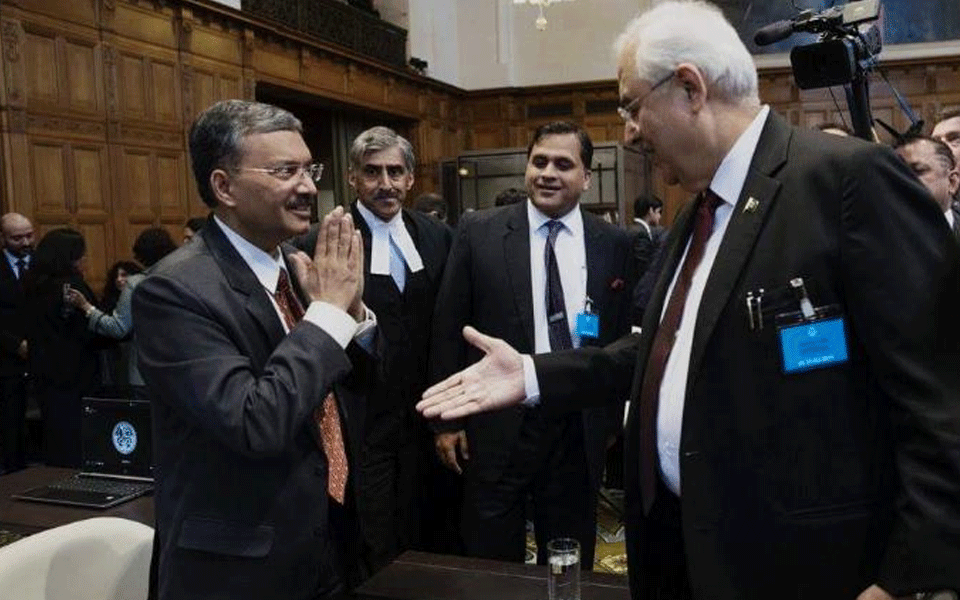
The Hague, Feb 18: Indian diplomats on Monday ignored the handshake gesture by senior Pakistani officials and instead greeted them with a 'namaste' on the first day of the hearing in the Kulbhushan Jadhav case at the International Court of Justice (ICJ) here.
The four-day hearing in the Jadhav case opened Monday at the ICJ headquarters amidst heightened tensions between India and Pakistan following one of the worst terror attacks in Jammu and Kashmir by Pakistan-based Jaish-e-Mohammad terror group that killed at least 41 CRPF soldiers.
Ahead of the hearing this morning, Pakistan's Attorney General Anwar Mansoor Khan reached out to Deepak Mittal, Joint Secretary, the Ministry of External Affairs, to shake hand but he responded with a namaste.
Khan then extended his hand to Venu Rajamony, the Indian ambassador to the Netherlands, who was sitting next to Mittal. Rajamony too greeted him with a namaste.
The Pakistani official then moved to Harish Salve, the former attorney general who is representing India and Jadhav at the ICJ, who shook hands.
Mittal also greeted Mohammad Faisal, Pakistan's Foreign Office spokesman and the Director General for South Asia and SAARC, with a 'namaste.
Jadhav, a retired Indian Navy officer, was sentenced to death by the military court on charges of "espionage and terrorism" after a closed trial in April 2017. His sentencing evoked a sharp reaction in India.
India moved the ICJ in May the same year for the "egregious violation" of the provisions of the Vienna Convention by Pakistan by repeatedly denying New Delhi consular access to the 48-year-old Indian national.
Let the Truth be known. If you read VB and like VB, please be a VB Supporter and Help us deliver the Truth to one and all.
Online fraud: Hotel chef from Udupi cheated of over Rs 1 lakh by WhatsApp contact

Udupi: Udupi City Police have registered a case of online fraud after a 62-year-old hotel chef was allegedly cheated of Rs 1.13 lakh by a woman who befriended him on WhatsApp, claiming to be based in London.
The victim, identified as Pandu Kariappa Poojary, a resident of Kuthpadi in Udupi, was working at a hotel in Mangaluru.
He reportedly came into contact with a woman identifying herself as Emilda William on WhatsApp. During their interactions, she told Poojary that she planned to start a cosmetics and hotel business in India and would meet him during a visit to Mangaluru.
On April 7, Emilda sent Poojary a flight ticket from London to Delhi via WhatsApp. The following day, Poojary received a phone call from a woman who informed him that Emilda had arrived at Delhi airport carrying a demand draft worth Rs 5 crore along with other items. The caller allegedly asked him to pay Rs 70,000.
Subsequently, Poojary also received a call from Emilda, who was reportedly crying and spoke about the situation. Believing the claims, he transferred a total of Rs 1,13,300 in phases using a scanner. He later realised that he had been cheated.