Indian economist Kalpana Kochhar joining Bill and Melinda Gates Foundation
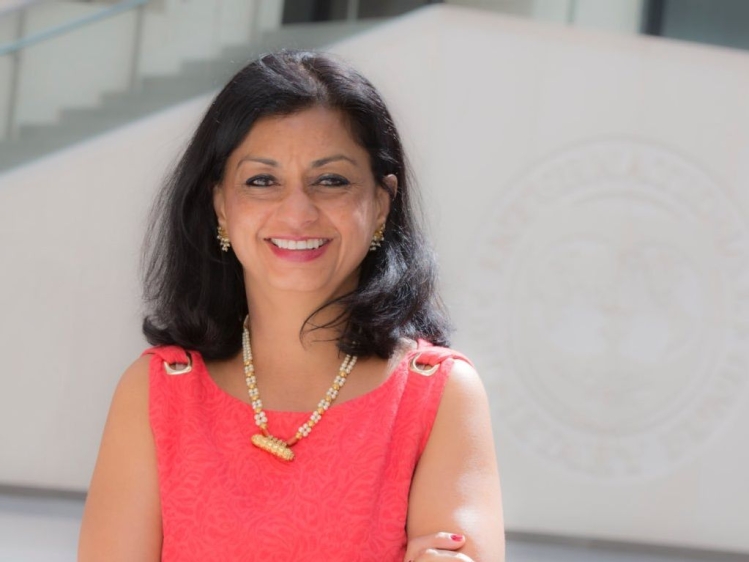
Washington, Jun 3: Noted Indian economist Kalpana Kochhar, who heads the Human Resources Department of the IMF, is retiring next month after serving for over three decades with the organisation to join the Bill and Melinda Gates Foundation.
Kochhar, who served in various senior positions during her three decades at the International Monetary Fund, will retire on July 30, and will join as Director of Development Policy and Finance, at the Bill and Melinda Gates Foundation, the IMF announced on Wednesday.
In her 33 years at the Fund, Kalpana provided a shining example of strong leadership and dedication to the Fund's mission. She brought a keen intellect and remarkable passion to her work and always focused her efforts on helping those we serve. Her work helped to shape the Fund and, while we wish her the very best in her new role, she will be sorely missed, IMF Managing Director Kristalina Georgieva said.
As Director of Human Resources, Kochhar oversaw the IMF's HR policies and the recruitment and retention of more than 4,000 IMF employees from nearly 150 countries based in Washington, DC, and in overseas offices.
In the past five years, she led the successful review and modernisation of the IMF's compensation and benefits programme, as well as the successful implementation of a large and complex human capital management IT system which helped to simplify, streamline and modernise HR at the Fund.
From start to finish, Kalpana provided the management team and the Executive Board with sound advice and displayed excellent judgment in all HR-related matters, Georgieva said.
Throughout her career, Kalpana has pioneered change in the institution, particularly on gender and emerging market issues, while always exhibiting a positive and caring management style, she added.
Georgieva said Kochar's caring spirit was especially evident during the current health crisis.
This caring spirit was especially evident during the current health crisis when, spurred on by her compassion, HRD worked hard to effect policy and other interventions to ensure that staff continued to feel a sense of belonging and connectedness. She leaves a distinguished legacy, and opened an admirable pathway for others to follow, Georgieva said.
As Deputy Director in the Asia and Pacific Department (APD), she was responsible for setting up and executing the IMF's strategy for Asia, including guiding analytical work and policy advice to a number of Asian countries to help promote economic growth, financial stability, and gender equality.
As Deputy Director in the Strategy, Policy, and Review Department (SPR), she led research and policy formulation on gender equity, income inequality, jobs and growth, and structural reforms.
In SPR, she also oversaw a comprehensive review of the IMF's surveillance policy and practices aimed at enhancing engagement with the member countries.
Before these roles, Kochhar was Assistant Director and Senior Personnel Manager in the Research Department. In between her Fund positions, Kochhar was seconded to the World Bank on a two-year stint as Chief Economist for the South Asia Region, lending her vast knowledge and experience on Asia to the Bank's work in the region.
There, she pioneered work on trade and financial integration in South Asia, and established a high-level advisory group of economists and foreign policy specialists from the region to assist the Bank in these areas, a media release said.
Kochhar started at the IMF as an Economist in 1988. Over the years, she built on her expertise in Asian regional matters with desk economist positions on Sri Lanka and the Philippines, and by leading work on Korea and Malaysia during the Asian financial crisis of the late 1990s.
Prior to joining the Fund, she was an Assistant Professor at George Washington University in Washington DC.
Kochhar is also an accomplished author, and her research on Asia, gender, and a variety of development issues has appeared in numerous IMF working papers, Staff Discussion Notes, books, blogs, and publications including the widely circulated Finance and Development magazine, IMF said in a media release.
Let the Truth be known. If you read VB and like VB, please be a VB Supporter and Help us deliver the Truth to one and all.
Two injuries, one DNF, a DQ as India end messy World Relays campaign
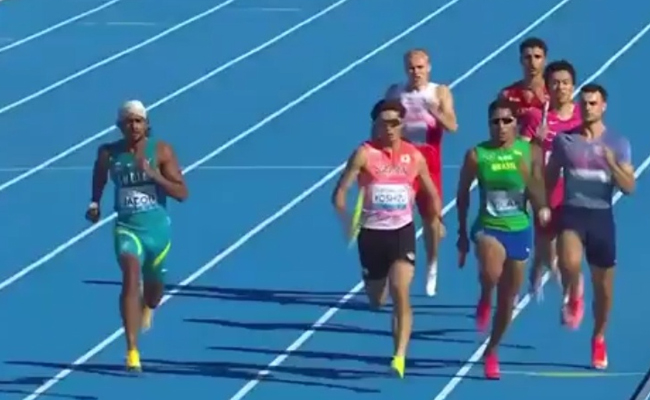
Gaborone (Botswana) (PTI): Amoj Jacob and Ragul Kumar got injured during the men's 4x400m and 4x100 races respectively as India ended their World Athletics Relays campaign in disappointment on the second day of competitions here on Sunday.
The Indian camp had high hopes of making the 2027 World Championships in the men's 4x400m relay but the team did not finish (DNF) the race as Jacob suffered cramps and pulled out of the race after taking the baton from the first leg runner Dharamveer Choudhary. Rajesh Ramesh and Vishal TK were to run in the third and fourth legs.
Those teams which could not qualify for the 2027 Beijing World Championships by reaching the final round of each of the six relay events on Saturday were given another chance in the second qualification round on Sunday.
The top two teams in each of the two heats (in all six relay events) booked the Beijing ticket on Sunday.
India will now have to try and qualify for the World Championships through the Top Lists of the World Athletics, which is a long and tedious process.
In the men's 4x100m race, third leg runner Ragul Kumar fell down the track after failing to hand over the baton inside the exchange zone to fourth leg runner Gurindervir Singh, which clearly showed the lack of coordination among the runners.
Harsh Santosh Raut and Animesh Kujur ran the first two legs.
The Indian quartet was disqualified and Kumar was seen being taken away from the Field of Play with the help of the volunteers.
It was a comedy of errors in the case of the women's 4x100m race, which saw the baton being dropped during an exchange between first leg runner Tamanna and second runner Nithya Gandhe, though the Indians finished the race in 53.09 seconds.
Gandhe started running quite a distance, but after realising that the baton was not in her hand, she turned and ran back to pick it up.
The only silver-lining for the Indian contingent was the national record time in the mixed 4x100m relay race, though the quartet of Ragul Kumar, Nithya Gandhe, Animesh Kujur and Sneha SS finished sixth in heat number two with a time of 41.35 seconds, bettering the previous national mark of 42.30 seconds set in March in Chandigarh.
The mixed 4x400m relay quartet of Theerthesh P Shetty, Kumari Saloni, Nihal William and Rashdeep Kaur ended at fifth in heat number one with a time of 3 minutes and 19.40 seconds.
On Saturday, all the five Indian relay teams had failed to make it to the respective final rounds and thus missed out on the 2027 World Championships berths.