Indian economy likely to be 'a little weaker' in 2025: IMF MD
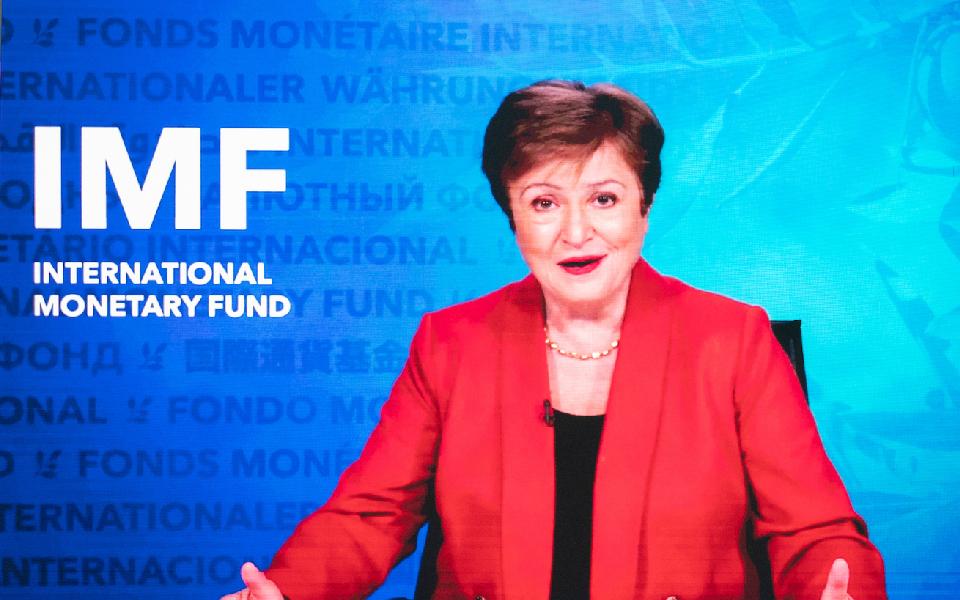
Washington, Jan 11: The Indian economy is expected to be "a little weaker" in 2025 despite steady global growth, IMF Managing Director Kristalina Georgieva has said.
Georgieva also said she expects quite a lot of uncertainty in the world this year mainly around the trade policy of the US.
In her annual media roundtable with a group of reporters on Friday, she said global growth is expected to be steady in 2025, but with regional divergence.
Georgieva said she expects the Indian economy to be a little weaker in 2025. However, she did not explain it any further. The World Economy Outlook update week will have more details about it.
“The US is doing quite a bit better than we expected before, the EU is somewhat stalling, (and) India a little weaker," she said.
Brazil was facing somewhat higher inflation, she said.
In China, the world’s second-largest economy, the International Monetary Fund (IMF) was seeing deflationary pressure and ongoing challenges with domestic demand, she said.
"Low-income countries, despite all the efforts they are making, are in a position when any new shock can affect them quite negatively,” Georgieva said.
“What we expect in 2025 is to have quite a lot of uncertainty, especially in terms of economic policies. Not surprisingly, given the size and role of the US economy, there is keen interest globally in the policy directions of the incoming administration, in particular on tariffs, taxes, deregulation and government efficiency,” Georgieva said.
“This uncertainty is particularly high around the path for trade policy going forward, adding to the headwinds facing the global economy, especially for countries and regions that are more integrated in global supply chains, medium-sized economies, (and) Asia as a region," she said.
That uncertainty is actually expressed globally through higher long-term interest rates, even though short-term interest rates have gone down, the IMF Managing Director said.
Donald Trump will be sworn in as the 47th President of the United States on January 20, replacing Joe Biden at the White House.
Trump, 78, has announced plans to impose additional tariffs on countries like China, Canada and Mexico. He has publicly announced the use of tariffs as a key policy tool.
On inflation, the IMF expects global disinflation to continue, Georgieva said.
"As we all recognise, the higher interest rates that were necessary to fight inflation did not push the world economy into recession. They have delivered the desired results. Headline inflation is converging back to target sooner in advanced economies than in emerging markets,” she said.
Let the Truth be known. If you read VB and like VB, please be a VB Supporter and Help us deliver the Truth to one and all.
Put petty politics aside; it's not about one party, but India: Rahul on TMC's loss in polls
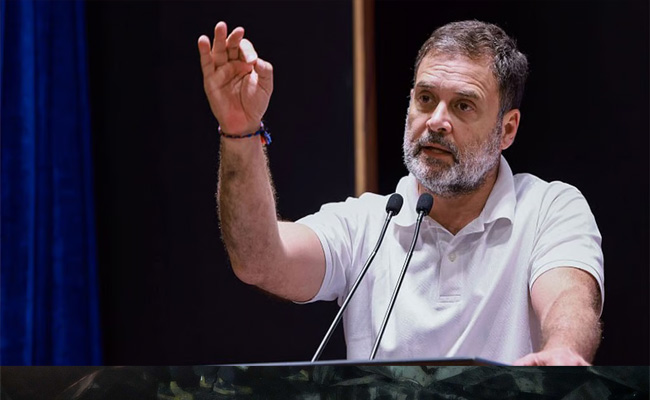
New Delhi (PTI): Congress leader Rahul Gandhi on Tuesday termed the BJP's victory in Bengal and Assam assembly polls a "theft" of the mandate, and a big step forward in the saffron party's mission to "destroy" Indian democracy.
Gandhi also came out in support of the TMC, which has been trounced by the BJP in the polls, and urged those gloating over the loss of Mamata Banerjee's party to put petty politics aside.
"Some in the Congress, and others, are gloating about TMC's loss.They need to understand this clearly - the theft of Assam and Bengal's mandate is a big step forward by the BJP in its mission to destroy Indian democracy," Gandhi said in a post on X.
"Put petty politics aside. This is not about one party or another. This is about India," he said in his post.
The BJP ousted Trinamool Congress from power in Bengal and captured power for the third time in a row in Assam in results of assembly polls declared on Monday.