Indian-origin Anita Anand is Canada's new Defence Minister as PM Trudeau reshuffles Cabinet
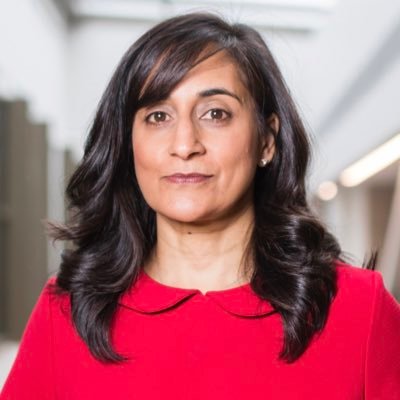
Toronto, Oct 26: Indian-origin Canadian politician Anita Anand was on Tuesday appointed as the country's new Defence Minister in a Cabinet reshuffle by Prime Minister Justin Trudeau, over a month after his Liberal Party returned power in the snap polls and amid calls for major military reforms.
Anand, 54, will replace long-time defence minister Indian-origin Harjit Sajjan, whose handling of the military sexual misconduct crisis has been under criticism.
Sajjan has been appointed as Minister of International Development Agency, a report in the National Post newspaper said.
The new Cabinet maintains gender balance and has 38 members, up one person from before the election, it said.
According to a report in Global News, Anand has been touted as a strong contender for weeks among defence industry experts who said that moving her into the role would send a powerful signal to survivors and victims of military sexual misconduct that the government is serious about implementing major reforms.
The Canadian military is facing intense public and political pressure to change its culture and create better systems for both preventing and handling sexual misconduct allegations, it said.
Anand has a deep background as a corporate lawyer and has worked extensively on corporate governance, which refers specifically to the laws and rules in place to manage the operations of businesses, the report said.
Anand, along with Sajjan and Bardish Chagger were the three Indo-Canadian ministers in the dissolved Cabinet who emerged victorious in the parliamentary polls last month.
Anand was declared the winner in Oakville with a nearly 46 per cent vote share; a significant development for Canada's vaccine minister.
She was first elected as a rookie Member of Parliament in 2019 representing Oakville in Ontario province and served as procurement minister throughout the COVID-19 pandemic.
She quickly became in charge of the country's efforts to secure COVID-19 vaccines and was often on the campaign trail with Trudeau.
In her role as former Minister of Public Services and Procurement, she played a very public role in the Liberal response to the health crisis.
"I'm just ecstatic, she had said after her win, thanking the volunteers who had worked extremely hard as a team for five weeks straight, she was quoted as saying by the Oakville News.
Let the Truth be known. If you read VB and like VB, please be a VB Supporter and Help us deliver the Truth to one and all.
Focus on Vijay's poll promises; TVK assured 8 gm gold for women
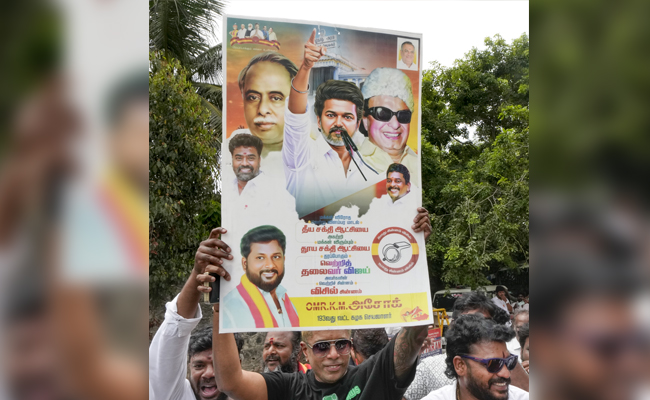
Chennai (PTI): As the new-entrant TVK appears likely to emerge as the single largest party and form the government, the focus has now turned into actor-politician Vijay's poll promises, including 8 gm gold for marriage, which is worth about Rs 14,000 per gram (22 carat).
Vijay's assurances in the party manifesto include Rs 2,500 monthly assistance for women below 60 years, 8 gm gold for marriage and six free cooking gas cylinders a year, per family.
By 3 PM, as per EC data, Vijay's party is leading in 105 constituencies and it falls short of a simple majority (118) in the Assembly.
The actor-turned-politician also assured a quality silk saree in addition to gold for indigent brides and interest-free loans up to Rs 5 lakh for women-run SHGs. He assured corruption-free good governance if voted to power in his maiden electoral fight.
The manifesto also laid importance on education. To prevent school dropouts, mothers or guardians of children studying in government and state-aided schools will receive Rs 15,000 annually.
Vijay promised 100 special residential schools named after iconic leader K Kamaraj, credited with revolutionising education in the state, and higher education loans of up to Rs 20 lakh. The TVK founder also assured AI Ministry, AI University and AI City.
The manifesto placed a strong emphasis on agrarian welfare, too.
The party promised a full waiver of agricultural cooperative crop loans for farmers owning less than five acres of land, while those holding more than five acres will receive a 50 per cent waiver. Additionally, the party promised a Minimum Support Price (MSP) of Rs 3,500 per quintal for paddy and Rs 4,500 per tonne for sugarcane.
Addressing youth unemployment, Vijay pledged to create five lakh new government jobs and offer as many stipendiary internships. Unemployed graduates will be provided a monthly aid of up to Rs 4,000. For government employees, the party assured consideration of the Old Pension Scheme and the regularisation of contract workers, including nurses.
On the health front, he promised a drug-free Tamil Nadu. Vijay also committed to modernising hospitals, providing free annual health checkups, and introducing a Rs 25 lakh family health insurance scheme.
The manifesto also included a Rs 3,000 monthly pension for the elderly and the differently-abled, 200 units of free power, patta (land deed) regularisation, and 100 per cent piped drinking water supply for all households.
Some of the policy intereventions promised by TVK include a legal guarantee to provide essential government services like community certificates, and land pattas, within a strictly specified timeframe.
Vijay also promised doorstep delivery of governance by implementing a system to deliver services, such as ration supplies, directly to the people. He also assured that ease of doing business will be paramount to his government and promised a strict guarantee that business licences will be issued within 21 days.
Elections to 234 Assembly seats in Tamil Nadu were held on April 23.