Indian-origin judge appointed to S Africa's highest judicial bench
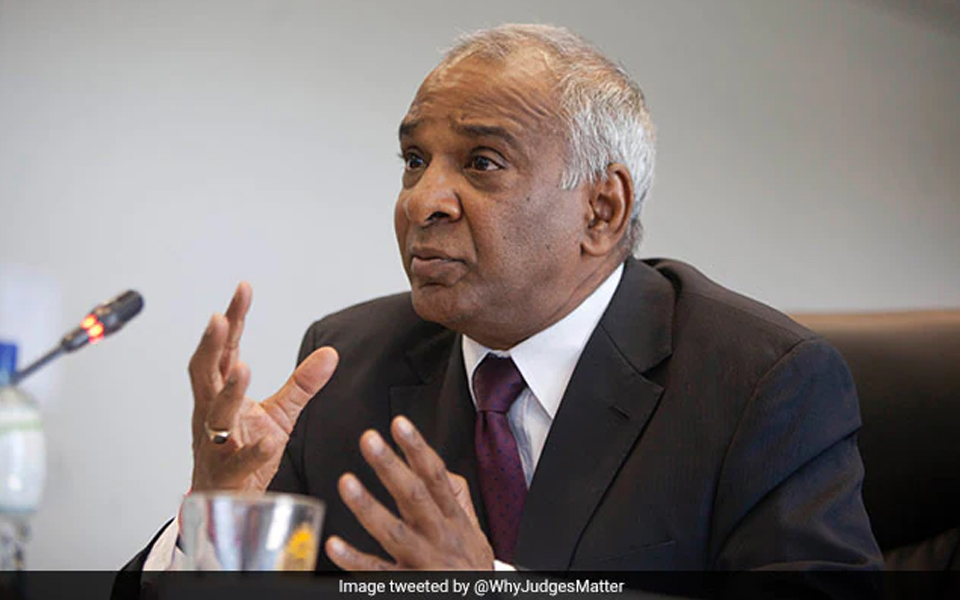
Johannesburg (PTI): Narandran 'Jody' Kollapen, who is Indian origin, has been appointed to South Africa's highest judicial bench, the Constitutional Court.
President Cyril Ramaphosa on Friday announced the appointment of 64-year-old Kollapen and Rammaka Steven Mathopo as the latest additions to the Constitutional Court after a lengthy process of public interviews.
Kollapen and Mathopo were among the five candidates recommended to Ramaphosa in October this year for the two vacancies.
Both will take office from January 1, 2022.
Kollapen was interviewed twice before for appointment to the Constitutional Court but was unsuccessful then despite having served two terms as an acting judge of the same institution.
The Presidency said Kollapen and Mathopo have illustrious careers in the legal profession and the judiciary.
Kollapen, who has now been elevated from his position as a judge of the high court, started legal practice in 1982, focussing largely on public interest work. He joined Lawyers for Human Rights in 1993 and went on to become its national director in 1995, serving in that position until the end of 1996.
In 1997, he took up a post as commissioner of the South African Human Rights Commission and went on to serve as chair of the commission for seven years from 2002 until 2009. He was appointed as chair of the South African Law Reform Commission in April, 2016.
Kollapen serves on the structures of numerous NGOs and community-based organisations, including the Legal Resources Centre, the Foundation for Human Rights and Laudium Care Services for the Aged.
He has also been invited to speak on human rights issues across the world, including at the United Nations and Harvard University.
He was awarded an honorary doctorate by the Durban University of Technology; the Turquoise Harmony Institute's award for his contribution to society in the area of law and human rights; and a Lifetime Achievement Award by the Congress of Business and Economics, which was born out of the erstwhile Transvaal Indian Congress from the days when Mahatma Gandhi was in South Africa.
In 2010, while in the position of acting Constitutional Court judge, Kollapen made a strong statement about cultural and national identity as the keynote speaker at the 50th anniversary celebrations of the religious organisation Siva Gnana Sabhay in Lenasia.
Kollapen said there was no need to shy away from the unique Indian identity, culture and religion brought to South Africa by the first indentured labourers 150 years earlier, but that South Africans of Indian-origin should use this to help build the rainbow nation as citizens of the country.
Kollapen's mother was among the women in the historic protest march to the Union Buildings in Pretoria, the seat of the apartheid-era government, in 1956 to protest discriminatory laws. She was arrested and jailed twice for her participation in passive resistance protests.
Kollapen often recalled how his mother had told him that she was pregnant with him at the time.
Let the Truth be known. If you read VB and like VB, please be a VB Supporter and Help us deliver the Truth to one and all.
Vartha Bharati–Sankalp predictions align closely with Karnataka bypoll results

Bengaluru: The Vartha Bharati–Sankalp election analysis has shown a high level of accuracy in predicting the outcome of the recent Karnataka Assembly by-elections held in May 2026, correctly calling winners in both constituencies and closely estimating vote share trends.
The by-elections were held in Bagalkot and Davanagere South, drawing significant political attention as both seats were seen as key tests for the ruling Congress and opposition BJP.
According to the analysis, Vartha Bharati–Sankalp had made three major projections ahead of the results the winning party, vote share percentages, and margin of victory.
In both constituencies, the platform accurately predicted that the Congress would emerge victorious. The outcome matched the projections, with Congress candidates winning in Bagalkot and Davanagere South.
In terms of vote share, the predictions were largely in line with the final results. In Bagalkot, the BJP’s vote share was forecast in the range of 40 to 46 per cent, while the actual figure stood at 42.9 per cent. The Congress vote share, however, exceeded expectations, with the party securing 55.4 per cent against a projected range of 43 to 48 per cent.
The margin of victory in Bagalkot turned out to be significantly higher than anticipated. While the projection had placed the margin between 2,000 and 3,500 votes, the final margin was around 22,332 votes.
In Davanagere South, the predictions also remained largely accurate. The Congress vote share was projected between 43 and 51 per cent, and the final figure stood at 43.9 per cent. The BJP was expected to secure between 42 and 50 per cent but ended with 40.3 per cent.
The analysis had also identified the role of SDPI as a potential spoiler in the constituency. While its vote share was estimated around 6 per cent, the party eventually secured around 12 per cent of the vote.
The margin of victory in Davanagere South was predicted to be between 1,500 and 2,600 votes. The actual margin was higher at around 5,708 votes, though the contest remained relatively close as anticipated.
Overall, the performance of Vartha Bharati–Sankalp stood out for correctly identifying the winning parties in both seats and maintaining close accuracy in vote share estimates, with only limited deviations in specific cases.