Indian-origin Justice becomes first person of colour to be nominated to Supreme Court of Canada
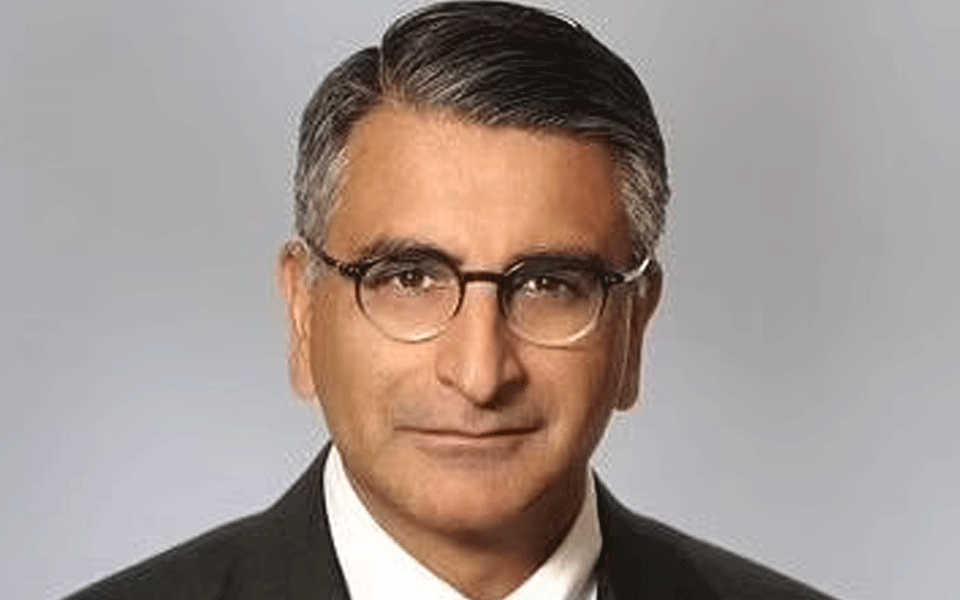
Toronto: Prime Minister Justin Trudeau has nominated Indian-origin Justice Mahmud Jamal to the Supreme Court of Canada, becoming the first person of colour to be named to the apex court of the country.
Trudeau announced Jamal's nomination on Thursday to replace the retiring Rosalie Silberman Abella, the first refugee and first Jewish woman to sit on the top court.
I am pleased to announce the nomination of Justice Mahmud Jamal to the Supreme Court of Canada. I know that Justice Jamal, with his exceptional legal and academic experience and dedication to serving others, will be a valuable asset to our country's highest court," Trudeau said in a statement .
Justice Jamal, who is in his mid-fifties, had a distinguished career as a litigator with a deep commitment to pro bono work prior to his appointment to the Court of Appeal for Ontario in 2019, the Prime Minister's office said.
He appeared in 35 appeals before the Supreme Court of Canada on civil, constitutional, criminal, and regulatory issues. He also taught constitutional law at McGill University and administrative law at Osgoode Hall Law School, it said.
The Minister of Justice and Attorney General of Canada and the Chairperson of the Independent Advisory Board for Supreme Court of Canada Judicial Appointments will soon appear before a special hearing of the House of Commons Standing Committee on Justice and Human Rights to discuss the selection process and the reasons for the nomination.
Members of the House of Commons Standing Committee will then take part in a question and answer period with the nominee, joined by the Standing Senate Committee on Legal and Constitutional Affairs and a member of the Green Party of Canada.
It represents the fourth nomination under the Supreme Court appointment process launched by the Government of Canada in 2016 to promote greater openness, transparency, and accountability, the statement said.
In a questionnaire submitted as part of his application to the Supreme Court, Jamal said: "I was raised at school as a Christian, reciting the Lord's Prayer and absorbing the values of the Church of England, and at home as a Muslim, memorising Arabic prayers from the Quran and living as part of the Ismaili community."
Justice Jamal was born in Kenya to a family originally from India. The family moved two years later to Britain. In 1981, Jamal's family moved to Canada, settling in Edmonton where he completed high school, CTV News said.
He received a Bachelor of Arts from the University of Toronto, Bachelor of Laws and Bachelor of Civil Law degrees from the Faculty of Law, McGill University, and a Master of Laws from Yale Law School, which he attended on a Fulbright Scholarship.
He served as a law clerk to Justice Melvin Rothman of the Quebec Court of Appeal and Justice Charles Gonthier of the Supreme Court of Canada.
Let the Truth be known. If you read VB and like VB, please be a VB Supporter and Help us deliver the Truth to one and all.
Two injuries, one DNF, a DQ as India end messy World Relays campaign
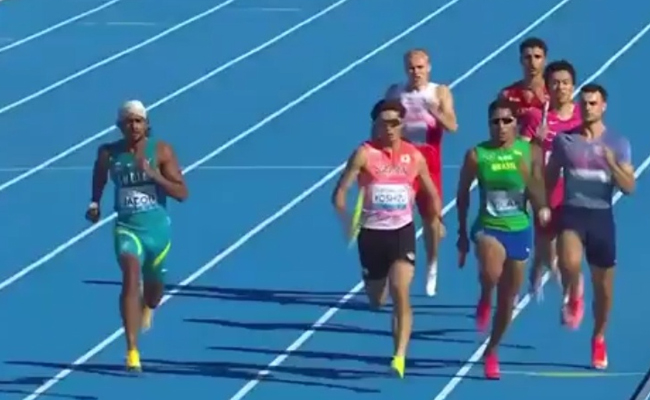
Gaborone (Botswana) (PTI): Amoj Jacob and Ragul Kumar got injured during the men's 4x400m and 4x100 races respectively as India ended their World Athletics Relays campaign in disappointment on the second day of competitions here on Sunday.
The Indian camp had high hopes of making the 2027 World Championships in the men's 4x400m relay but the team did not finish (DNF) the race as Jacob suffered cramps and pulled out of the race after taking the baton from the first leg runner Dharamveer Choudhary. Rajesh Ramesh and Vishal TK were to run in the third and fourth legs.
Those teams which could not qualify for the 2027 Beijing World Championships by reaching the final round of each of the six relay events on Saturday were given another chance in the second qualification round on Sunday.
The top two teams in each of the two heats (in all six relay events) booked the Beijing ticket on Sunday.
India will now have to try and qualify for the World Championships through the Top Lists of the World Athletics, which is a long and tedious process.
In the men's 4x100m race, third leg runner Ragul Kumar fell down the track after failing to hand over the baton inside the exchange zone to fourth leg runner Gurindervir Singh, which clearly showed the lack of coordination among the runners.
Harsh Santosh Raut and Animesh Kujur ran the first two legs.
The Indian quartet was disqualified and Kumar was seen being taken away from the Field of Play with the help of the volunteers.
It was a comedy of errors in the case of the women's 4x100m race, which saw the baton being dropped during an exchange between first leg runner Tamanna and second runner Nithya Gandhe, though the Indians finished the race in 53.09 seconds.
Gandhe started running quite a distance, but after realising that the baton was not in her hand, she turned and ran back to pick it up.
The only silver-lining for the Indian contingent was the national record time in the mixed 4x100m relay race, though the quartet of Ragul Kumar, Nithya Gandhe, Animesh Kujur and Sneha SS finished sixth in heat number two with a time of 41.35 seconds, bettering the previous national mark of 42.30 seconds set in March in Chandigarh.
The mixed 4x400m relay quartet of Theerthesh P Shetty, Kumari Saloni, Nihal William and Rashdeep Kaur ended at fifth in heat number one with a time of 3 minutes and 19.40 seconds.
On Saturday, all the five Indian relay teams had failed to make it to the respective final rounds and thus missed out on the 2027 World Championships berths.