Indians in Wuhan say strict lockdown, social distancing only ways to contain COVID-19
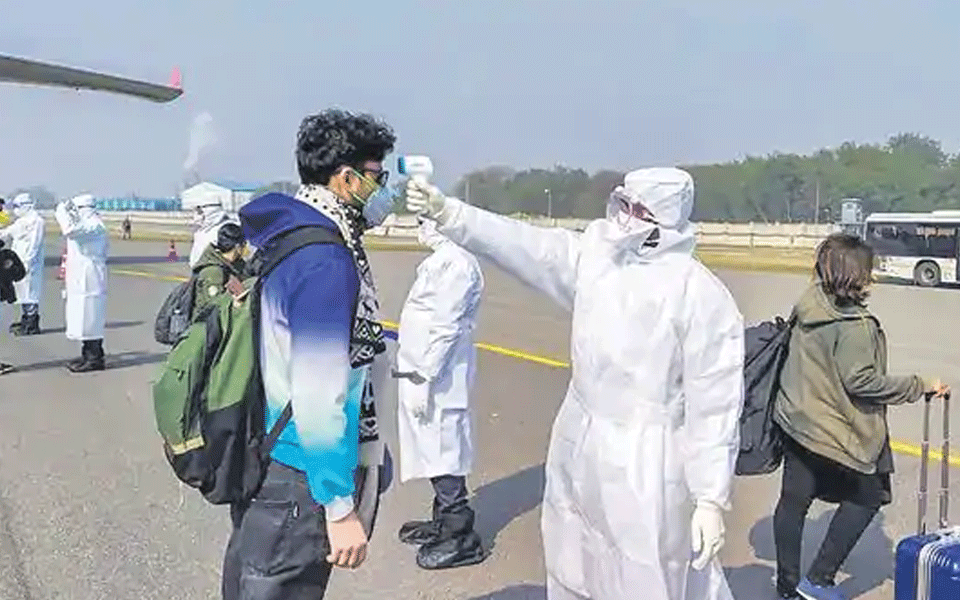
Beijing/Wuhan: A few daring Indians, who remained in Wuhan where the novel coronavirus first emerged and then became a global pandemic, have a word of advice for their compatriots back home: follow the strict lockdown and self-isolation measures to arrest the spread of the deadly disease.
Speaking to PTI, the Indian nationals in Wuhan said they were very happy that their 76-day suffering due to the strict lockdown came to an end on Wednesday when the authorities lifted the restrictions in the central Chinese city of 11 million people.
"For over 73 days, I stayed put in my room, stepped out to my lab close by with permission. Today I struggle to speak properly because I have not spoken much all these weeks as there is no one to speak because everyone stayed indoors," said Arunjith T Sathrajith, a hydrobiolgist working in Wuhan.
India evacuated about 700 Indians and foreigners through two special Air India flights, but Arunjith, who is from Kerala, decided to stay in Wuhan and brave it all because he felt "escaping" from a troubled place was not the ideal thing for "Indians to do".
He is one of the few Indians who chose to stay back in Wuhan, a city of 11 million people and the epicentre of the pandemic. He also thought his return to Kerala could endanger his parents and in-laws, all over 50 years, besides his wife and child.
A microbiologist-turned-hydrobiologist who is taking part in a research project in the central Chinese city, he said India had done the right thing to go for a nationwide lockdown, but the major problem for the country could surface when the monsoon season arises as people's immunity levels go down.
That is the time virus could turn virulent, Arunjith said. If there is any lesson Wuhan offers, it is the strict lockdown and people's participation in self-isolation campaign, he said.
Another Indian scientist who also stayed put in Wuhan fully agreed with Arunjith.
"For about 72 days I have shut myself in my room. My neighbour has three very young children. I have not seen them coming out of their flat even once.
"Today I am happy and relieved I survived but still not willing to venture out because I could run into virus carriers," the scientist, who preferred to remain anonymous, told PTI over phone.
He advising Indians to strictly follow the lockdown. The scientist said a lockdown of Wuhan a few days before could have helped prevent the virus from spreading like wildfire.
He preferred to remain in Wuhan and declined the Indian embassy's offer because he was concerned about his family back home.
"Considering the hospitality I enjoyed, I was confident I would be taken care of by my employer and local friends and they did," he said.
Arunjith said he and his fellow researchers began hearing about the spread of a vicious virus in Wuhan from the second week of December and things progressively began deteriorating with fear spreading among people as they began wearing masks.
But even after the lifting of the lockdown in Wuhan, still not many people are stepping out as there is lingering fear about the asymptomatic cases.
Asymptomatic coronavirus cases are those who test positive but do not show any symptoms and have the potential to cause sporadic clusters of infections.
Both agreed that it is very difficult for detecting the virus and its virulence in December and early January until many people started contracting it.
"It is not easy to understand this virus. And it is not going to be easy to understand it until they trace the zero case which is extremely difficult. Chinese took time to act because they had no idea about it early and when they learnt about it, they acted swiftly," the scientist said.
Arunjith, who travelled in China extensively especially in rural areas pursuing his research, said he suspects that the virus was passed from animal to human considering the habits among some of the communities in rural areas to eat wild animal delicacies.
Wild animals sold in the Huanan Seafood Market are believed to be the source of the novel coronavirus pandemic that has claimed more than 88,500 lives worldwide so far and infected nearly 1.5 million people. The Huanan market was closed after the virus outbreak in China in December last year.
Hubei has so far reported 67,803 confirmed COVID-19 cases in total, including 50,008 in Wuhan. The death toll due to the coronavirus in China has risen to 3,335 and the overall cases have reached 81,865 in the country.
In India, 166 people have died and the number of cases has gone up to 5,734 till Thursday, according to the Union Health Ministry.
Globally, over 88,500 have died and there are nearly 1.5 million cases of COVID-19 infections.
Let the Truth be known. If you read VB and like VB, please be a VB Supporter and Help us deliver the Truth to one and all.
Man arrested with Rs 2.54-crore heroin in Mumbai

Mumbai (PTI): Police have arrested a man and seized over 500 grams of heroin worth Rs 2.54 crore in the illicit market from him in Mumbai, officials said on Friday.
The police's Anti-Narcotics Cell (ANC) made the drug seizure in Santacruz in the western suburbs. The operation was conducted by the Kandivali unit of the ANC on Thursday as part of a special crackdown against drug trafficking in the area, they said.
Acting on specific inputs, an ANC team conducted a raid in Santacruz (East) and intercepted a man. During a search, the team recovered 508 grams of high-grade heroin from his possession, an official said.
The seized contraband, a highly addictive, opioid drug derived from morphine, is estimated to be worth Rs 2.54 crore in the international market, he informed.
Following the seizure, a case was registered against the man under relevant sections of the Narcotic Drugs and Psychotropic Substances (NDPS) Act, 1985, and he was formally placed under arrest in the early hours of Friday.
The police are currently investigating the source of the drug and trying to identify the intended recipients of the consignment, he said.