India's deployment of cash transfer scheme is a 'logistical marvel': IMF
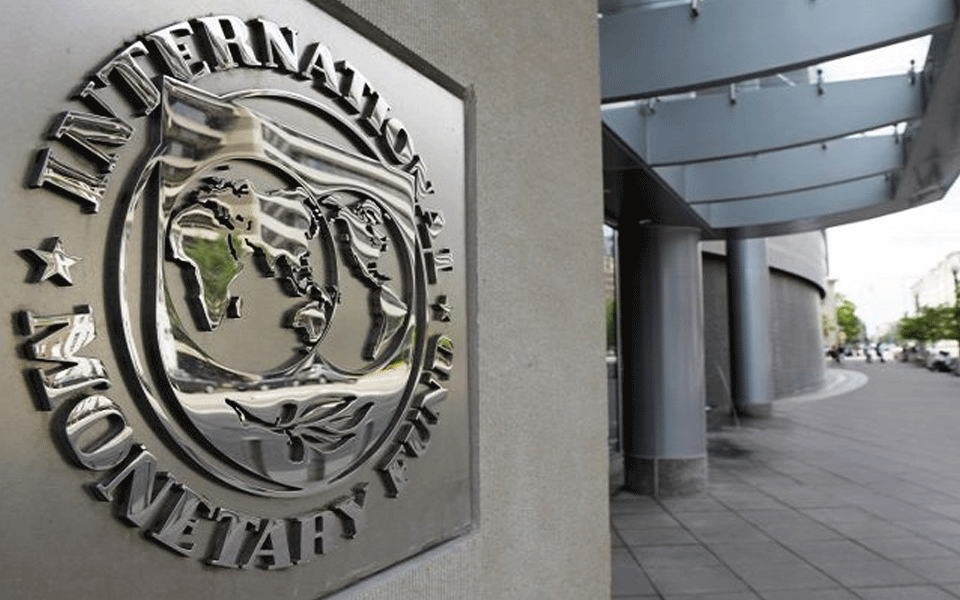
Washington (PTI): The IMF has described India's deployment of a direct cash transfer scheme and other similar social welfare programmes as a "logistical marvel", saying there is a lot to learn from the country which is one of the most inspiring examples of the application of technology to solve complicated issues.
The aim of DBT (Direct Benefit Transfer) is to transfer the benefits and subsidies of various social welfare schemes directly in the bank account of the beneficiary on time by bringing efficiency, effectiveness, transparency and also to eliminate the intermediary body.
According to the government data, more than Rs 24.8 lakh crore has been transferred through Direct Benefit Transfer (DBT) mode since 2013, Rs 6.3 lakh crore in the financial year 2021-22 alone; on an average over 90 lakh DBT payments are processed daily as per data of FY22.
"From India, there is a lot to learn. There is a lot to learn from some other examples around the world. We have examples from pretty much every continent and every level of income. If I look at the case of India, it is actually quite impressive, Paolo Mauro, Deputy Director of the Fiscal Affairs Department at the IMF, told reporters here on Wednesday.
"In fact, just because of the sheer size of the country, it is a logistical marvel how these programmes that seek to help people who are at low-income levels reach literally hundreds of millions of people, he said in response to a question on the impressive direct cash transfer programme being successfully implemented by the Indian government.
There are programmes that target specifically women. There are programmes that target the elderly and farmers. Perhaps the interesting part is that in these examples, there is a lot of technological innovation, he said.
"In the case of India, one thing that is striking is the use of the unique identification system, the Aadhaar, Mauro said.
"But in other countries, also, there is greater use of sending money through mobile banking to people who actually do not have a whole lot of money, but they have a cell phone, Mauro said.
"So being somewhat innovative in identifying people, in processing their applications for transfers through digital means, deploying funds through, again, mobile banking. This is something that countries can learn from each other. We also try here to be a little bit of a convening place where people can compare these types of experiences, he said.
Observing that the IMF is collaborating with India on the application of new technologies, Vitor Gaspar, Director of the Fiscal Affairs Department, said that India is one of the most inspiring examples of the application of technology to solve very complicated issues of targeting support to the people who need it most .
The IMF has also been working with many African countries in the area of government technology.
"And also in Africa, there are very many examples of innovation, which is relevant and inspiring as well. So, the exchange of experiences that Paolo was talking about is something that we are trying to organise, and the amount of learning that can take place is actually quite surprising. There is a lot going on in India, in Africa, and in other parts of the world, Gaspar said.
Let the Truth be known. If you read VB and like VB, please be a VB Supporter and Help us deliver the Truth to one and all.
Cong claims TVK chief Vijay has sought its support for govt formation in Tamil Nadu
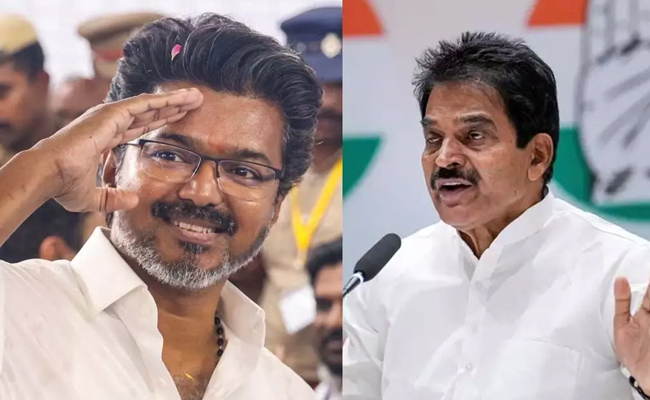
New Delhi (PTI): The Congress on Tuesday claimed that TVK chief Vijay has sought its support for government formation in Tamil Nadu and its leadership has directed the state unit to take a final decision on the matter, keeping in view the state's sentiments.
The party, which fought the assembly election in alliance with the DMK, asserted that the mandate in Tamil Nadu is for a secular government and that it is determined "not to have the BJP and its proxies run the government of Tamil Nadu in any manner".
Top Congress leaders held a meeting at party chief Mallikarjun Kharge's residence on Tuesday evening that was attended by Leader of Opposition in Lok Sabha Rahul Gandhi and Tamil Nadu in-charge Girish Chodankar, among others.
Addressing the media after the meeting, Congress general secretary, Organisation, K C Venugopal said the Congress leadership discussed the post-election scenario in Tamil Nadu.
"TVK President Thiru Vijay has requested the Indian National Congress for support to form a Government in Tamil Nadu. He has spoken about drawing inspiration from Perumthalaivar Kamaraj as well, in his political mission.
"The INC is clear that the mandate in Tamil Nadu is for a secular government that is committed to protecting the Constitution in letter and spirit. The INC is determined not to have the BJP and its proxies run the Government of Tamil Nadu in any manner," he said.
"Accordingly, the Congress leadership has directed the TNCC to take a final decision on Thiru Vijay's request, keeping in view the sentiments of the state reflected in the electoral verdict," Venugopal told reporters.
Vijay's TVK won 108 seats in the 234-member Tamil Nadu Assembly, falling short of the halfway mark. He needs the support of 10 MLAs to form a government with a simple majority. The results were declared only on Monday.
The Congress has won five seats, while the Pattali Makkal Katchi (PMK) has bagged four seats. The CPI and CPI-M have two seats each.
On the other hand, the Dravida Munnetra Kazhagam (DMK) has won 59 seats while the All India Anna Dravida Munnetra Kazhagam (AIADMK) has won 47 seats.
The Bharatiya Janata Party (BJP) has won only one seat and so have the Desiya Murpokku Dravida Kazhagam (DMDK) and the Amma Makkal Munnettra Kazagam (AMMK), while the VCK has won two seats.
The Congress had fought the assembly polls in a pre-poll alliance with the DMK, while the BJP had a tie-up with the AIADMK.