India's stand clear on Kashmir, won't accept third party mediation: Jaishankar
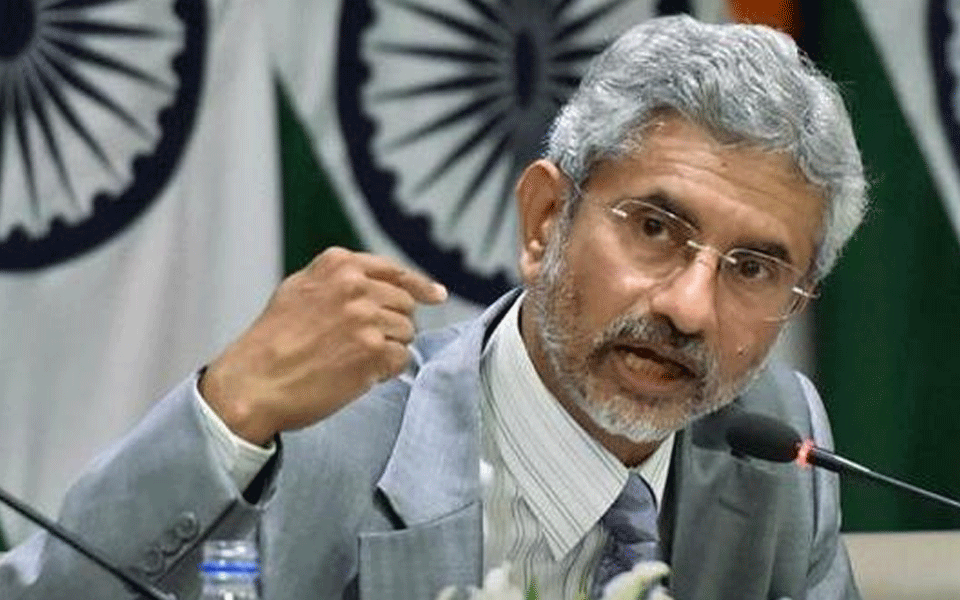
Washington: Categorically rejecting any scope for third party mediation between India and Pakistan on Kashmir, External Affairs Minister S Jaishankar has said India's stand has been clear for decades and the two countries can discuss the issue bilaterally.
Jaishankar arrived here on Sunday night from New York after attending the annual General Assembly session of the United Nations along with Prime Minister Narendra Modi.
On the sidelines of the UN General Assembly session, the two leaders held bilateral meetings with dozens of world leaders.
"India has been clear for 40 odd years that we would not accept mediation... and that whatever has to be discussed has to be discussed bilaterally," Jaishankar told a group of Indian reporters on Wednesday when asked about US President Donald Trump's mediation remarks on Kashmir.
Trump in the recent past has offered mediation between India and Pakistan on the Kashmir issue.
"I'm clearing in my mind as far as I'm concerned. That's what it's about. My point is very simple. Whose issue (is this?). Mine. Who has to take the call? Me. If it is my issue and I have to take the call; I will decide whether I want somebody's mediation or not. You can offer anything you like, but if I decide it is not relevant to me then it does not happen," Jaishankar said.
"I am very clear in my mind. When people speak of it has gone up and down, where has it gone up and down? India has been very clear about it," he said when asked about the frequent offer of mediation by President Trump.
The External Affairs Minister said in half of his meetings on the sidelines of the UN General Assembly session, the issue of recent developments in Jammu and Kashmir popped up.
"In terms of (issue of) Article 370, I would find it hard to quantify, but I would say may be in about half my meetings it came up and may be in half of my meetings it didn't come up. It wasn't that every guy who came to me came with that burning question," he said.
Frankly, most of them were focused on the bilateral relations, he said, adding that even those who raised it, it was not necessarily the first issue of interest to them.
"I think in the case of people who showed interest, it was more like, we have read about developments on Kashmir and it would be useful for us to hear from you," he said.
Jaishankar said he apprised the leaders about what was happening and why it was happening in Kashmir. The External Affairs Minister said that in many cases a lot of what he said was new to them.
"When you explain to them that Article 370 was temporary, when you tell them that it was part of the Constitution of India in which delegates from Jammu and Kashmir also took part, when you tell them that there was a provision within the Article for the modification which took place, and you explain to them that today major source of concern was the fact that Jammu and Kashmir is really not aligned with the rest of India on a whole set of issues and so therefore, how do you really run a country where one large state is misaligned with rest of the country.
"It's a very basic governance issue which people have ducked in the past. But because they ducked in the past doesn't mean that everybody keeps ducking in the future. I think, once you walked them (world leaders) through this, most of them understood it and got it," he said.
When specifically asked about the position of two countries Malaysia and Turkey on Kashmir, the minister said "obviously they have been given an understanding which clearly is very different from the facts on the ground".
Prime Minister Modi and Jaishankar's meeting came against the backdrop of the Indian government revoking the special status to Jammu and Kashmir and bifurcating the state into two Union Territories on August 5.
Tensions between India and Pakistan spiked after India abrogated provisions of Article 370 of the Constitution, evoking strong reactions from Pakistan.
India has categorically told the international community that the scrapping of Article 370 was an internal matter and also advised Pakistan to accept the reality.
Let the Truth be known. If you read VB and like VB, please be a VB Supporter and Help us deliver the Truth to one and all.
AIITA welcomes Karnataka’s ban on obscene songs in school events
Bhatkal: The Karnataka unit of the All India Ideal Teachers Association (AIITA) has welcomed the Karnataka government’s decision to strictly ban school children from dancing to obscene songs during educational and cultural programmes in government, aided, and private schools across the state.
AIITA Karnataka State President M. R. Manvi congratulated the government for taking what he termed an important step to preserve the sanctity of education.
“Such decisions to safeguard the dignity of school children and uphold the values of education are the need of the hour. This rule should not be limited to government schools alone but must be strictly implemented in all private educational institutions as well,” he said.
He further urged the government to address other concerns within school programmes.
“The government should not only prohibit obscene dances in the name of school anniversaries, but also ensure that plays and dialogues that incite religious hatred are avoided. Schools should be centres of harmony, not platforms for spreading hatred,” he added.
According to a recent circular issued by the Department of School Education and Literacy, obscene dances are adversely affecting the mental health and moral values of students.
In this regard, schools have been advised to use songs that promote nationalism, positive thinking, the greatness of Kannada culture, and value-based traditions instead of inappropriate content during programmes.
The circular also emphasises that students should be dressed in decent attire.
AIITA also backed the department’s warning that disciplinary action would be taken against head teachers if such guidelines are violated. The association has further demanded that district Deputy Directors of Public Instruction strictly monitor the implementation of these rules.