Indonesia asks people to avoid coast near erupting volcano
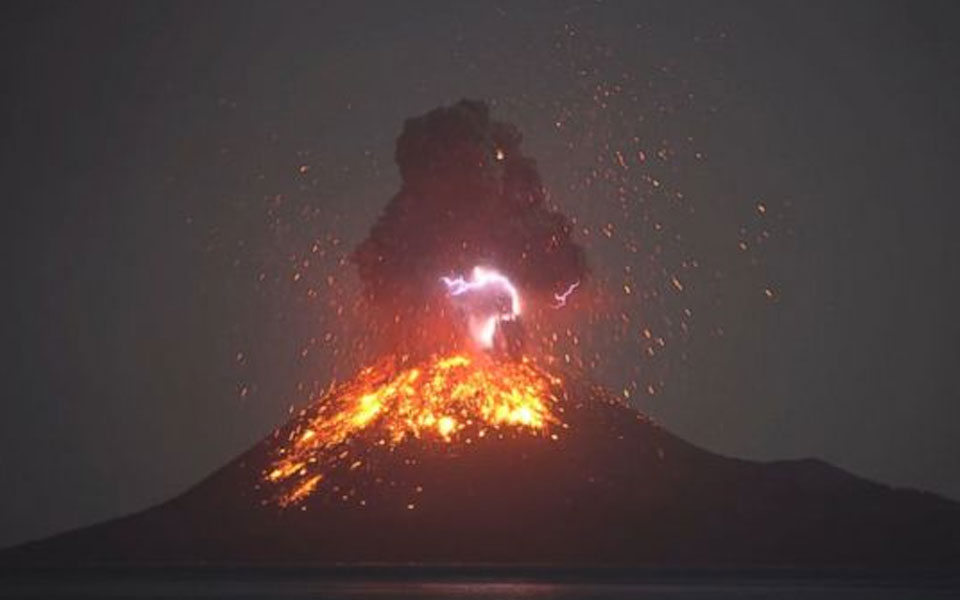
Sumur (Indonesia), Dec 26 : Indonesian authorities asked people to avoid the coast in areas where a tsunami killed more than 420 people last weekend in a fresh warning issued on the anniversary of the catastrophic 2004 Asian earthquake and tsunami.
The big waves that followed the eruption of Anak Krakatoa, or "Child of Krakatoa" island volcano, hit communities along the Sunda Strait on Saturday night. The eruption is believed to have set off a landslide on the volcano, displacing the water that slammed into Java and Sumatra islands.
Indonesia's Meteorology, Geophysics and Climatology Agency asked people late Tuesday to stay at least 500 meters (1,640 feet) and up to 1 kilometer (less than a mile) from the coastline along the strait, which lies between the two main islands.
Government workers were monitoring Anak Krakatoa's eruptions and high waves and heavy rain were possible Wednesday, said agency head Dwikorita Karnawati.
"All these conditions could potentially cause landslides at the cliffs of the crater into the sea, and we fear that that could trigger a tsunami," she said at a news conference. She asked that communities remain vigilant but not panic.
The tsunami struck without warning, taking people by surprise even in a country familiar with seismic disaster. No big earthquake shook the ground beforehand, and it hit at night on a holiday weekend while people were enjoying concerts and other beach and resort activities.
It was a sharp contrast to the disaster that struck 14 years ago off the western coast of Indonesia's Sumatra island. An enormous 9.1 magnitude earthquake rocked the area the day after Christmas, creating gigantic waves that surged far inland swallowing everything in their path. The wall of water killed some 230,000 people in a dozen countries, most of them in Indonesia.
The devastation was vast, and the disaster was among the worst witnessed by the world in recent history. Recovery was slow, but some victims of the latest tsunami said Wednesday they remember the resilience of the people in hard-hit Banda Aceh, which is giving them hope that they too can rebuild their homes and their lives.
Beaches were largely empty in the hard-hit area of Carita, and police patrolled the area on motorbikes warning people to stay away from the coast. Some people defied the order, returning to what was left of their homes to begin cleaning up as heavy rain fell and waves pounded the shore.
Meanwhile, residents of Sumur village, which has been slow to receive aid due to roads being cut off, remained stunned by how quickly the tsunami hit. The beach, located just a few kilometers (miles) from the tourist island of Umang near Java's western tip, is popular for snorkeling and other water activities. The tsunami decimated the area, ripping houses from their foundations and bulldozing concrete buildings.
Scientists have said the tsunami's waves were recorded in several places at about 1 meter (3.3 feet) high, but residents of Sumur insisted they towered more than 3 meters (10 feet) there, possibly as high as 5 meters (16.4 feet). They said a soaring white wall of water roared toward them at high speeds, ripping trees out of the ground by their roots.
"There was no sign of a tsunami when we were at the beach. The sea didn't recede," said Tati Hayati, a housewife, who was enjoying a pleasant evening with 10 other people when the disaster hit. "It was calm and bright with the full moon." When she spotted high, fast-moving waves launching toward the shore, she ran to her car and managed to get inside. But she couldn't outrun it. She said the car was struck by three waves, breaking out the back window and filling the vehicle with gushing water.
"We were locked inside. The car was swaying in the waves and we thought we would all die," Hayati said.
"We almost could not breathe and I almost gave up when I groped the key in the water and managed to open the door, and the water began to recede. We got out of the car and ran to safety."
More than 16,000 people were displaced from their homes and heavy equipment was urgently needed in the Sumur subdistrict near Ujung Kulon National Park to help get aid flowing and reach people who may be injured or trapped, said Sutopo Purwo Nugroho, spokesman for Indonesia's Disaster Mitigation Agency.
The death toll was 429, with more than 1,400 people injured and at least 128 missing, he said.
Anak Krakatau formed in the early 20th century near the site of the cataclysmic 1883 eruption of Krakatoa, which killed more than 30,000 people and hurled so much ash that it turned day to night in the area and reduced global temperatures.
Anak Krakatau has been erupting since June and did so again 24 minutes before the tsunami, according to the geophysics agency.
Let the Truth be known. If you read VB and like VB, please be a VB Supporter and Help us deliver the Truth to one and all.
No date fixed yet for leadership change in Karnataka: Cong chief Kharge
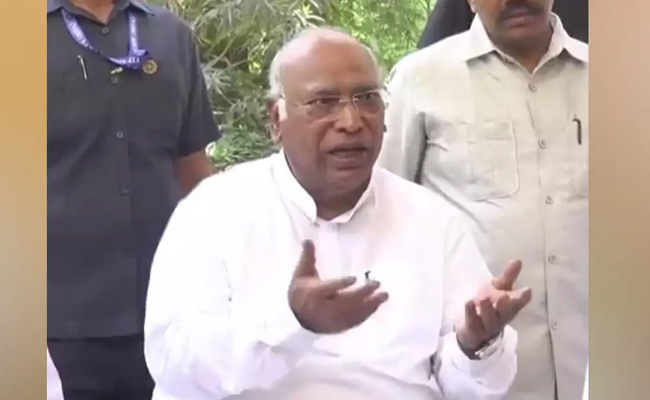
Kalaburagi (Karnataka) (PTI): Congress chief Mallikarjun Kharge on Friday said that no date has been fixed yet to discuss possible leadership change in Karnataka.
His statement came amid intensifying speculation over a power tussle between Chief Minister Siddaramaiah and his deputy D K Shivakumar.
Addressing a press conference here, Kharge maintained that any decision regarding leadership would be taken collectively by the party's high command after due consultation.
He also cautioned against misinterpretation of his remarks.
"See, we will take a decision together, the three of us: I as the AICC president, Sonia Gandhi as the Congress Parliamentary Party president, and Rahul Gandhi as the Leader of the Opposition in the Lok Sabha. That is why we always act together," he explained.
Kharge further said, "When the three of us fix a date together, we will take a decision. Since no date has been fixed yet, how can I say whether a change is happening or not?"
He asserted that the Congress leadership follows a consultative process before arriving at any conclusion.
"In the high command, we have extensive discussions among ourselves and also consult other senior leaders. We consider what the outcome would be and then take steps accordingly," the Congress chief said.
Stressing that no timeline had been finalised, he said, "When it happens, I will definitely inform you. Please do not misinterpret this."
He noted that he often avoids commenting publicly to prevent misrepresentation.
Emphasising party discipline, Kharge said any eventual decision would be binding on all.
"Whatever decision is taken, it will be in the interest of the state, and everyone will have to support whatever decision the high command takes," he said.
On Thursday, Kharge said there was no change of CM in Karnataka "for now" and that the leadership issue in the state would be resolved soon.
The remarks come amid ongoing speculation over an alleged understanding for a power transfer to Shivakumar when the Congress government completes its halfway mark in November 2025.
While Siddaramaiah has asserted that he intends to complete a full five-year term, he has also said he would abide by any decision taken by the party leadership.
Recently, Shivakumar and his brother D K Suresh's Delhi visit triggered speculation of a leadership change. His supporters are also charged up.