Indonesia finds Sriwijaya Air jet's cockpit voice recorder
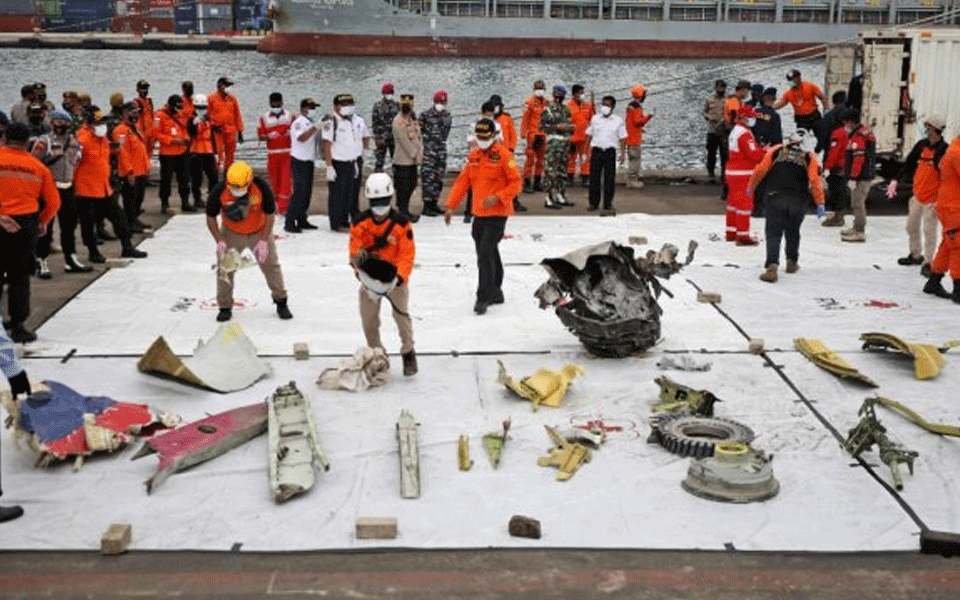
Jakarta: Indonesian navy divers have recovered the cockpit voice recorder of a Sriwijaya Air jet that crashed into the Java Sea in January, killing all 62 people on board, officials said Wednesday.
Transportation Minister Budi Karya Sumadi said divers retrieved the cockpit recorder at about 08.00 pm. Tuesday local time, near where the flight data recorder was recovered three days after the accident.
The contents of the recorder were not immediately available. However, the device could help investigators determine what caused the Boeing 737-500 to nosedive into the ocean in heavy rain shortly after it took off from Jakarta on January 9.
If the voice recorder is undamaged, it might tell investigators what the pilots were doing or failing to do to regain control of the plane during its brief, erratic flight.
Searchers have recovered plane parts and human remains from an area between Lancang and Laki islands in the Thousand Island chain, just north of Jakarta. The flight data recorder tracked hundreds of parameters showing how the plane was being operated.
Most retrieval efforts ended about two weeks after the crash, but a limited search is continuing for the missing memory unit of the cockpit voice recorder, which apparently broke away from other parts of the device during the crash.
The bright orange voice recorder was taken to Jakarta and given to the National Transportation Safety Committee, which is overseeing the accident investigation.
We hope the KNKT could share information about what is contained in this VCR to improve our aviation safety, Sumadi said, referring to Indonesian acronym for the transportation committee.
The KNKT chairman, Soerjanto Tjahjono, said the device will be taken to the investigators' black box facility. It will take five to seven days to dry and clean the device and to download its data, he said.
Without the CVR...it would be difficult to determine the cause of the plane crash, Tjahjono said, We would disclose it transparently to avoid similar accidents in the future.
Rear Adm. Abdul Rasyid Kacong, the navy's western region fleet commander, said the voice recorder was buried under 1 metre (3 feet) of seabed mud at a depth of 23 metres (75 feet). Divers removed debris and carried out desludging operations to reach the voice recorder, he said.
Data from a preliminary investigation report, which didn't state any conclusions, showed that the plane's left engine's throttle lever moved backward on its own while the autopilot was engaged, reducing the power output of that engine before the jet plunged into the sea.
That report provided new details on persistent problems with an autothrottle on the 737-500 Sriwijaya Air jet and the airline's efforts to fix them. An autothrottle can be used by pilots to set the speed automatically, thereby reducing workload and wear on the engines.
The 26-year-old jet had been out of service for almost nine months because of flight cutbacks due to the pandemic before resuming commercial flights in December.
The disaster has reignited concerns about safety in the aviation industry, which has grown quickly along with the economy since the fall of dictator Suharto in the late 1990s. The US banned Indonesian carriers from operating in the country in 2007 but lifted that restriction in 2016, citing improved compliance with international aviation standards. The European Union lifted a similar ban in 2018.
Sriwijaya Air had had only minor safety incidents in the past, though a farmer was killed in 2008 when a plane went off the runway while landing due to a hydraulic issue.
In 2018, a Boeing 737 MAX 8 jet operated by Lion Air crashed shortly after taking off from the airport in Jakarta, killing 189 people. An automated flight-control system played a role in that crash, but the Sriwijaya Air jet did not have that system. (AP)
Let the Truth be known. If you read VB and like VB, please be a VB Supporter and Help us deliver the Truth to one and all.
Allahabad HC orders probe into 'reinstatement' of teacher in UP's Barabanki
Lucknow (PTI): The Lucknow Bench of the Allahabad High Court on Friday ordered a probe by the special task force (STF) into alleged irregularities in the rejoining of a teacher at City Intermediate College in Barabanki, observing that the reinstatement appeared to be prima facie illegal.
The court also directed the recovery of the salary paid to the teacher during the disputed period.
A bench of Justice Rajeev Singh passed the order on a petition filed by the college management committee. The court expressed doubts over the roles of the District Inspector of Schools (DIOS), Barabanki, the college principal and the teacher concerned and hence, directed a detailed inquiry into the matter.
Taking note of alleged manipulation of records and misleading submissions, the court ordered the immediate transfer of the Barabanki DIOS to ensure a fair probe. It also directed the initiation of disciplinary proceedings against the then joint director of education of the Ayodhya division.
In its order, the court found that the teacher, Abhay Kumar, was initially appointed as an assistant teacher in 2018 but joined an Eklavya Model Residential School in Chhattisgarh as a lecturer in June 2024 without obtaining permission from the management. His subsequent request to retain the lien was rejected.
Despite this, he was allowed to rejoin the Barabanki College in September 2025 on the directions of the joint director of education and the DIOS, and was even paid the salary for October 2025. The court termed the rejoining "wholly illegal" and lacking any legal basis.
The bench also expressed concern over lapses in communication within the education department and directed the Uttar Pradesh chief secretary to ensure that official orders are communicated through email and WhatsApp as well, to prevent disputes.
The matter is next listed for hearing on May 28 when a compliance report is sought.