Indonesia's popular president Joko Widodo sworn in for 2nd term
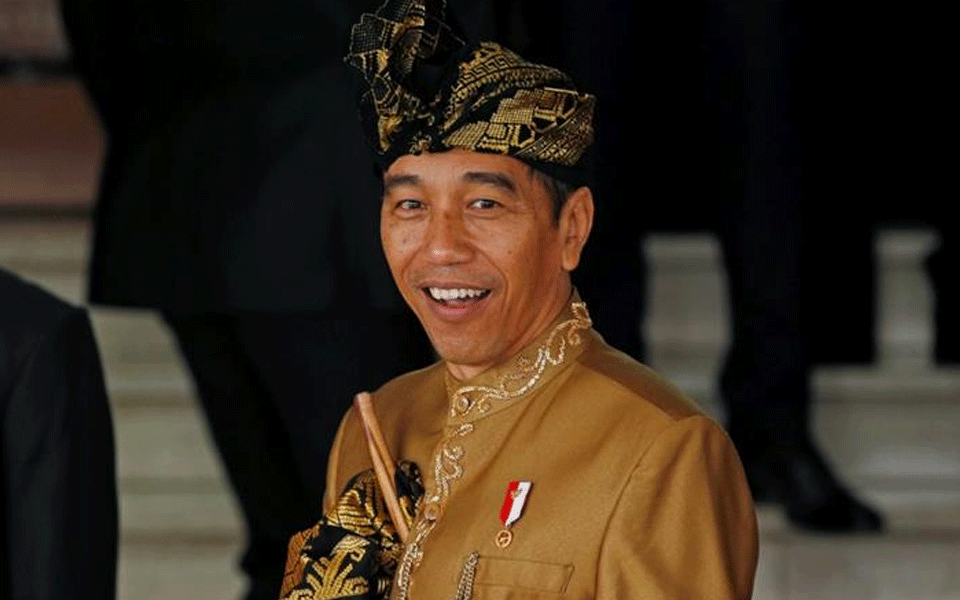
Jakarta: Indonesian President Joko Widodo, who rose from poverty and pledged to champion democracy, fight entrenched corruption and modernize the world's most populous Muslim-majority nation, was sworn in Sunday for his second and final five-year term with a pledge to take bolder actions.
Army troops and police, along with armored vehicles, firetrucks and ambulances, were deployed across the vast capital, Jakarta, and major roads were closed in a departure from the more relaxed atmosphere of the popular Widodo's 2014 inauguration.
Known for his down-to-earth style, Widodo, 58, opted for an austere ceremony at the heavily guarded Parliament without the festive parade that transported him after his inauguration five years ago on a horse-drawn carriage in downtown Jakarta, where he was then cheered on by thousands of waving supporters.
On his way to the ceremony Sunday, Widodo got out of his convoy with some of his security escorts and shook the hands of supporters, who yelled his name, waved Indonesia's red-and-white flag and called him "bapak," or father.
"This is the second time ... most importantly, we must work together immediately to bring Indonesia to prosperity," Widodo told reporters before leaving for Parliament, adding that he had completed picking all members of his Cabinet.
Western and Asian leaders and special envoys flew in for the event, including Australian Prime Minister Scott Morrison and Chinese Vice President Wang Qishan. President Donald Trump sent Secretary of Transportation Elaine Chao for the ceremony in Indonesia, Southeast Asia's largest economy and a member of the G-20 bloc of nations.
Indonesia is a bastion of democracy in Southeast Asia, a diverse and economically bustling region of authoritarian regimes, police states and nascent democracies.
After decades of dictatorship under President Suharto, the country was convulsed by political, ethnic and religious unrest in the late 1990s and early 2000s. Since then, it has consolidated its democratic transition. While most of the country remains poor and inequality is rising, it is home to a rapidly expanding middle class.
Popularly known as Jokowi, Widodo is the son of a furniture maker who grew up with his family in a rented bamboo shack on the banks of a flood-prone river in Solo city on Java island. He is the first Indonesian president from outside the country's super rich, and often corrupt, political, business and military elite.
Widodo presents himself as a man of the people, often emphasizing his humble roots. His popular appeal, including his pioneering use of social media, helped him win elections for mayor of Solo, governor of Jakarta and twice for president over the past 14 years.
In a reflection of his popularity as he begins his second term, he has nearly 26 million followers on Instagram and more than 12 million on Twitter.
He has been likened to Barack Obama, but since taking office he has been perceived as unwilling to press for accountability that threatens powerful institutions such as the military. Instead he has emphasized nationalism while also fending off attacks that he is not devout enough as a Muslim.
Widodo was sworn in with his vice president, Ma'ruf Amin, one of the most important religious figures in Indonesia, who he chose as his running mate to shore up his support among pious Muslims. Amin was chairman of Majelis Ulama Indonesia, the country's council of Islamic leaders, and supreme leader of Nahdlatul Ulama, the world's largest Muslim organization.
Widodo has been widely praised for his efforts to improve Indonesia's inadequate infrastructure and reduce poverty, which afflicts close to one-10th of the sprawling country's 270 million people.
He inaugurated the nation's first subway system, which was financed by Japan, in chronically congested Jakarta in March after years of delay under past leaders.
Pressing on is the biggest challenge, however, in his final years in office given the global economic slowdown, major trade conflicts, falling exports and other hurdles that impede funding.
In an interview with The Associated Press in July, Widodo said he would push ahead with sweeping and potentially unpopular economic reforms, including a more business-friendly labor law, because he is no longer constrained by politics in his final term.
"Things that were impossible before, I will make a lot of decisions on that in the next five years," he told the AP then.
Let the Truth be known. If you read VB and like VB, please be a VB Supporter and Help us deliver the Truth to one and all.
AIITA welcomes Karnataka’s ban on obscene songs in school events
Bhatkal: The Karnataka unit of the All India Ideal Teachers Association (AIITA) has welcomed the Karnataka government’s decision to strictly ban school children from dancing to obscene songs during educational and cultural programmes in government, aided, and private schools across the state.
AIITA Karnataka State President M. R. Manvi congratulated the government for taking what he termed an important step to preserve the sanctity of education.
“Such decisions to safeguard the dignity of school children and uphold the values of education are the need of the hour. This rule should not be limited to government schools alone but must be strictly implemented in all private educational institutions as well,” he said.
He further urged the government to address other concerns within school programmes.
“The government should not only prohibit obscene dances in the name of school anniversaries, but also ensure that plays and dialogues that incite religious hatred are avoided. Schools should be centres of harmony, not platforms for spreading hatred,” he added.
According to a recent circular issued by the Department of School Education and Literacy, obscene dances are adversely affecting the mental health and moral values of students.
In this regard, schools have been advised to use songs that promote nationalism, positive thinking, the greatness of Kannada culture, and value-based traditions instead of inappropriate content during programmes.
The circular also emphasises that students should be dressed in decent attire.
AIITA also backed the department’s warning that disciplinary action would be taken against head teachers if such guidelines are violated. The association has further demanded that district Deputy Directors of Public Instruction strictly monitor the implementation of these rules.