International Criminal Court issues arrest warrant for Putin over Ukraine war crimes
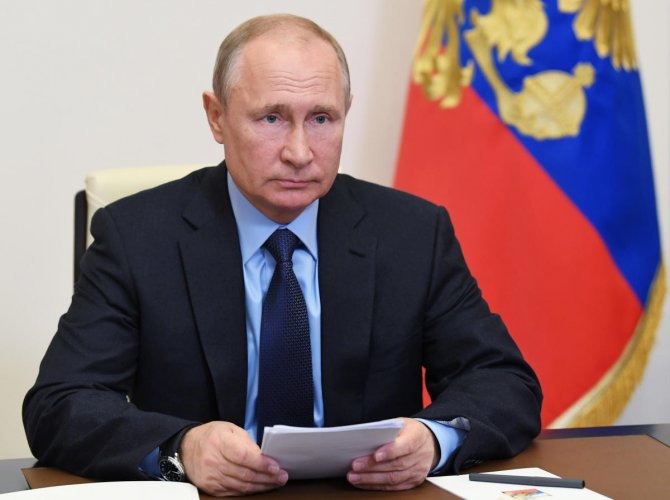
The Hague, Mar 17: The International Criminal Court said Friday it has issued an arrest warrant for Russian President Vladimir Putin for war crimes because of his alleged involvement in abductions of children from Ukraine.
The court said in a statement that Putin "is allegedly responsible for the war crime of unlawful deportation of population (children) and that of unlawful transfer of population (children) from occupied areas of Ukraine to the Russian Federation."
It also issued a warrant Friday for the arrest of Maria Alekseyevna Lvova-Belova, the Commissioner for Children's Rights in the Office of the President of the Russian Federation, on similar allegations.
The court's president, Piotr Hofmanski, said in a video statement that while the ICC's judges have issued the warrants, it will be up to the international community to enforce them.
The court has no police force of its own to enforce warrants.
"The ICC is doing its part of work as a court of law," he said.
"The judges issued arrest warrants. The execution depends on international cooperation."
A possible trial of any Russians at the ICC remains a long way off, as Moscow does not recognise the court's jurisdiction a position reaffirmed on Friday by Russian Foreign Ministry spokeswoman Maria Zakharova in a first reaction to the warrants.
"The decisions of the International Criminal Court have no meaning for our country, including from a legal point of view," she said.
Ukraine also is not a member of the court, but it has granted the ICC jurisdiction over its territory and ICC prosecutor Karim Khan has visited four times since opening an investigation a year ago.
The ICC said that its pre-trial chamber found there were "reasonable grounds to believe that each suspect bears responsibility for the war crime of unlawful deportation of population and that of unlawful transfer of population from occupied areas of Ukraine to the Russian Federation, in prejudice of Ukrainian children."
The court statement said that "there are reasonable grounds to believe that Mr Putin bears individual criminal responsibility" for the child abductions "for having committed the acts directly, jointly with others and/or through others (and) for his failure to exercise control properly over civilian and military subordinates who committed the acts.
After his most recent visit, in early March, ICC prosecutor Khan said he visited a care home for children two kilometers from frontlines in southern Ukraine.
"The drawings pinned on the wall ... spoke to a context of love and support that was once there. But this home was empty, a result of alleged deportation of children from Ukraine to the Russian Federation or their unlawful transfer to other parts of the temporarily occupied territories," he said in a statement.
"As I noted to the United Nations Security Council last September, these alleged acts are being investigated by my Office as a priority. Children cannot be treated as the spoils of war."
And while Russia rejected the allegations and warrants of the court as null and void, others said the ICC action will have an important impact.
"The ICC has made Putin a wanted man and taken its first step to end the impunity that has emboldened perpetrators in Russia's war against Ukraine for far too long," said Balkees Jarrah, associate international justice director at Human Rights Watch.
"The warrants send a clear message that giving orders to commit, or tolerating, serious crimes against civilians may lead to a prison cell in The Hague."
Prof. David Crane, who indicted Liberian President Charles Taylor 20 years ago for crimes in Sierra Leone, said dictators and tyrants around the world "are now on notice that those who commit international crimes will be held accountable to include heads of state."
Taylor was eventually detained and put on trial at a special court in the Netherlands.
He was convicted and sentenced to 50 years' imprisonment.
"This is an important day for justice and for the citizens of Ukraine," Crane said in a written comment to the Associated Press Friday.
On Thursday, a U.N.-backed inquiry cited Russian attacks against civilians in Ukraine, including systematic torture and killing in occupied regions, among potential issues that amount to war crimes and possibly crimes against humanity.
The sweeping investigation also found crimes committed against Ukrainians on Russian territory, including deported Ukrainian children who were prevented from reuniting with their families, a "filtration" system aimed at singling out Ukrainians for detention, and torture and inhumane detention conditions.
But on Friday, the ICC put the face of Putin on the child abduction allegations.
Let the Truth be known. If you read VB and like VB, please be a VB Supporter and Help us deliver the Truth to one and all.
T'gana RTC strike: Talks between govt, employees successful

Hyderabad (PTI): Talks between employees of Telangana State Road Transport Corporation (RTC) who were on strike and the state government concluded successfully on Friday as the government agreed to the key demands of the workmen.
Following a day-long marathon of talks between the leaders of the employees' Joint Action Committee (JAC) and the cabinet sub-committee, the government announced after midnight that it acceded to the demands, including a merger of RTC with the government, 11 per cent pay revision and elections to the employees' unions.
A committee comprising officials and employee leaders would be appointed over the merger of RTC with the government, it said.
The RTC management has also agreed to address the remaining issues as well, an official release said.
The employees would call off their strike and the RTC buses would hit the roads shortly, it said.
The employees had been on an indefinite strike since April 22 over a series of demands, including the merger of RTC with the government.
Earlier in the day, a driver of the RTC, who attempted suicide on April 23 during the strike, died at a hospital here in the early hours of Friday.
Shankar Goud, a 55-year-old driver, set himself ablaze by pouring petrol at Narsampet in Warangal district when the employees were staging a protest on Thursday in support of their demands.
Goud suffered serious burns, was initially admitted to a state-run hospital in Warangal, and later shifted to a super-speciality hospital in Hyderabad for advanced treatment.
"He succumbed (to injuries) at about 1.30 am on Friday," a senior official said.
The driver’s body was taken to his relative’s village, Muttojipet in Warangal district, for funeral rites.
Tension prevailed in Muttojipet as his family members and RTC employees attempted to take the body to the Narsampet bus station, where he worked, to enable his colleagues to pay their last respects. However, police did not permit this, citing law-and-order concerns.
This led to a deadlock before the funeral could proceed.
Union Minister Bandi Sanjay Kumar criticised the Telangana government for not allowing the body to be taken to the Narsampet bus station.
Kumar, Minister of State (Home), visited Muttojipet village in Warangal district, where the funeral was held, and paid homage to Goud.
“They (family members) want to take the body to the bus depot for five minutes. Is the RTC bus depot in Pakistan or Bangladesh? They are emotionally attached to taking the body there. The government is hurting sentiments and creating fear among RTC employees,” Kumar told reporters.
He also expressed anger at the police for not allowing the body to be taken to the bus station and staged a protest, according to a release from his office.
RTC employees and BJP workers attempted to take the mortal remains in an ambulance to Narsampet, but were stopped by the police.
Later, after discussions with the police, the family members and RTC employees agreed to conduct the funeral in the village.
Sanjay Kumar, stating he would abide by the family’s decision, left the village after the funeral was conducted there.
Transport Minister Ponnam Prabhakar said an ex gratia of Rs 10 lakh, a house, and a government job would be provided to the kin of Goud.
Chief Minister A Revanth Reddy expressed shock over the employee’s death and conveyed deep condolences to the grieving family, according to the release.
The RTC employees’ JAC had earlier announced an agitation programme from April 24 to 29, including silent marches and submission of memorandums to MLAs and other leaders.