International journalists visit Gaza City under supervision of Israel's army
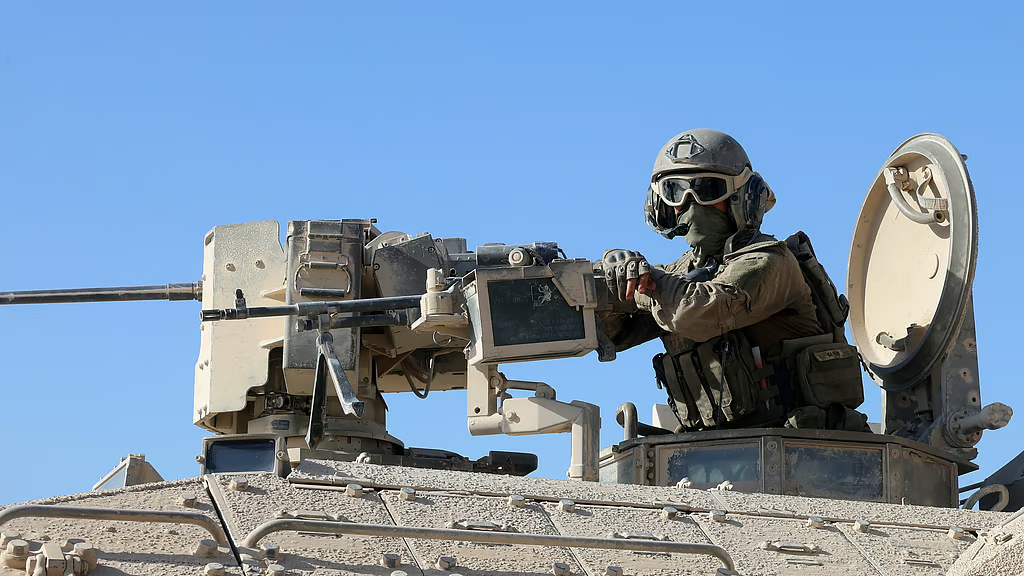
Gaza City (AP): An Israeli army vehicle rumbles through the empty streets of a shattered neighbourhood in Gaza City, and with help from a video camera, a soldier spots people standing inside a blasted out nearby building. The armoured personal carrier revs its engine and moves on.
A little further along, the vehicle stops near an empty hospital formerly overseen by the Jordanian government. A senior official speaking on condition of anonymity in line with military rules says soldiers recently found a tunnel used by Hamas adjacent to the hospital.
On Friday, the Israeli military escorted international journalists through Gaza City, the focus of a new offensive to root out Hamas, offering a rare – and limited -- glimpse into the territory devastated by nearly two years of war and where tens of thousands of Palestinians have been killed.
In August, international experts said the city was in a famine and warned that Israel's offensive and mass displacement of people would exacerbate the humanitarian crisis.
The soldiers escorting the journalists through Gaza City portrayed their military operations as deliberate, to minimize harm to civilians – yet justified, to eliminate a militant group that has been severely weakened but remains dug in, capable of carrying out attacks and still in possession of 48 hostages.
Israel has for two years banned international journalists from entering Gaza, except for rare, brief visits supervised by the military, such as this one.
A city under siege
The drive into and out of Gaza City was through the Netzarim corridor, which separates northern and southern Gaza and is used as a military zone. The route was littered with destroyed buildings and mounds of concrete. Few signs of life were seen during the tour, which lasted several hours.
Once in Gaza City's Sabra neighbourhood, the army took journalists to a lookout point several hundred metres away from the deserted Jordanian hospital. The army said Hamas had been making weapons in a room beneath the hospital while the Jordanians were aboveground, in control of the health care facility — one of many struggling to operate in recent weeks as Israeli attacks intensified.
Surrounded by destruction and collapsed buildings, the hospital shut down about two weeks ago. What appeared to be a tube extended from one of its buildings into a mound of dirt in front of it, which soldiers said was where the tunnel was located. A few hundred feet away, excavators moved piles of sand, as the sound of gunfire and artillery reverberated in the background.
Of Gaza's 36 hospitals, 22 are no longer operational and the remaining 14 are only partially functional, according to the World Health Organisation.
Israel accuses Hamas of using health facilities as command centres and for military purposes, putting civilians in harm's way, though it has presented little evidence. Hamas security personnel have been seen in hospitals and have kept some areas inaccessible.
A soldier showed journalists videos taken from a drone that flew through the 1.5 km long tunnel. The video showed narrow tunnels that led to rooms, one which showed explosives lined against the wall.
A Jordanian official speaking on condition of anonymity due to the sensitivity of the matter denied that its hospital was being used by Hamas. The AP could not independently verify the Israeli army's claims.
A few hundred metres from the Jordanian hospital, soldiers with the 36th division were positioned in a house they say had previously been used by Hamas. Shards of glass and concrete blanketed the floor, wires hung from the ceiling and on the walls were handwritten instructions in Hebrew about being on duty.
Soldiers warned journalists not to stand too close to the windows because of snipers. A day earlier, the building beside the house was hit by sniper fire, one soldier said.
The fate of Gaza City
On the eve of the war, Gaza City was home to roughly 1 million people. Throughout the conflict, it has been the focus of regular Israeli bombardment and ground operations.
Several neighbourhoods have been almost completely destroyed. Hundreds of thousands fled under Israeli evacuation orders at the start of the war but many returned during a ceasefire earlier this year.
Before their latest campaign in Gaza City began last month, Israel warned Palestinians to evacuate south. Earlier this week, Israel's Defence Minister Israel Katz said people had one last chance to go, and that anyone left behind would be considered a Hamas supporter.
The senior army official leading the journalists' through Gaza City on Friday was more measured, however.
“We're trying every day to explain how much safer it is to go down to the south,” the senior official said. “And when we get closer to areas with a lot of population, we stop and we try with other means to get them out of this area.”
While hundreds of thousands have left, many have remained, some unable to afford to move, others too weak to leave or not wanting to be displaced once again.
Let the Truth be known. If you read VB and like VB, please be a VB Supporter and Help us deliver the Truth to one and all.
Brothers awaiting board exam results drown in canal

Erode (Tamil Nadu) (PTI): Minor brothers who were awaiting their board exam results have drowned in a canal in this district while spending their Summer holidays at their aunt's place, police said.
According to Arachalure Police, Santhosh, aged 17, and his younger brother Sanjai, aged 15, natives of Musiri village in Tiruchirapalli district, came to Gopaliparai hamlet near Arachalure to their Aunt's house a couple of days ago after writing their annual 12th and 10th examinations, respectively.
The police said on Friday that both boys went to the nearby Lower Bhavani Project canal to take a bath. It was alleged that while taking a bath, both boys went to a deeper area of the canal and went missing.
As they didn't return home, even two hours after they left, their aunt grew suspicious and informed the Fire and Rescue Services, Chennimalai. A rescue team from the department rushed to the spot. After a few minutes of searching, they located the dead bodies of the brothers and sent them to the hospital. Arachalure police registered a case of death due to drowning and are investigating.