iPhone longtime supplier accused of using forced Uighur Muslim labor in China

Beijing: Documents uncovered by a human rights group has revealed and accused one of the oldest and reputed suppliers of Apple’s iPhones of using forced Muslim labor in its factories.
The document discovered by the Tech Transparency Project and shared exclusively with The Washington Post reveals thousands of Uighur workers mostly hailing from the Muslim region of Xinjiang were forced to work for Lens Technology.
Lens Technology is one of at least five companies connected to Apple's supply chain that has now been linked to alleged forced labor from the Xinjiang region, according to human rights groups. Lens Technology stands out from other Apple component suppliers because of its high-profile founder and long, well-documented history going back to the early days of the iPhone.
Lens also supplies Amazon and Tesla, according to its annual report.
"Our research shows that Apple's use of forced labor in its supply chain goes far beyond what the company has acknowledged," said Katie Paul, director of the Tech Transparency Project.
Apple, however, categorically rejected the claims and said that Lens Technology has not received any labor transfers of Uighur workers from Xinjiang. Josh Rosenstock, Apple spokesman added that Apple has ensured that none of its other suppliers are using Uighur labor transferred from Xinjiang.
Looking for the presence of forced labor is part of every supplier assessment we conduct, including surprise audits. These protections apply across the supply chain, regardless of a person's job or location. Any violation of our policies has immediate consequences, including possible business termination. As always, our focus is on making sure everyone is treated with dignity and respect, and we will continue doing all we can to protect workers in our supply chain" Rosenstock said.
Lens Technology however did not respond to requests for comment according to The Washington Post.
In response to faxed questions from The Post, the Foreign Ministry in Beijing called forced labor in China "nonexistent" and accused people with "ulterior motives" of fabricating it. It said a number of companies had hired auditors to conduct investigations, which "confirmed the nonexistence of 'forced labor.'" It did not name the companies.
"Apple claims to take extraordinary measures to monitor its supply chain for such problems, but the evidence we found was openly available on the Internet," said Paul of the Tech Transparency Project.
Xinjiang, in the far reaches of Western China bordering Afghanistan, Pakistan, and other Muslim-majority countries, is facing a brutal crackdown by China's government, which has placed more than a million Muslims in concentration camps or forced them to work in factories making everything from cotton to soft drinks to electronics.
Some Uighur workers have told human rights groups that they were given a choice between taking a job in a far-flung factory and being sent to a detention center. In some cases, workers have said that when they "accept" the job, they live in heavily guarded campuses and are rarely allowed to leave. In the evenings, when their shifts end, the Uighur workers say they are forced to take lessons in communist propaganda. Whether the Uighurs are paid, and exactly how much, is unclear.
Some of these labor transfers sent workers to Lens Technology campuses in Hunan, according to an August 2019 article in the Global Times of China.
In a previous report, the Tech Transparency Project alleged the cotton T-shirts worn by Apple Store employees were also sourced from forced labor in Xinjiang. Rosenstock has said Apple doesn't receive shirts from Xinjiang, but would not say whether the company ever did in the past.
Let the Truth be known. If you read VB and like VB, please be a VB Supporter and Help us deliver the Truth to one and all.
MP boat tragedy: Death toll climbs to 13; body of last missing person recovered
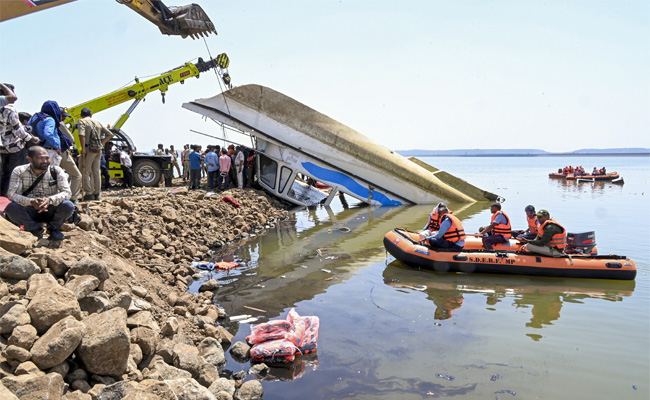
Jabalpur (PTI): The bodies of a five-year-old boy and his uncle were recovered from Bargi Dam in Madhya Pradesh's Jabalpur district on Sunday morning, raising the death toll in the cruise boat tragedy to 13, police said.
The boat, around 20 years old and operated by the state tourism department, capsized during a storm on Thursday evening.
"The bodies of Mayuram (5) and his uncle Kamraj (around 50), an employee of the Ordnance Factory in Khamaria, were found floating and were fished out of the dam," Bargi Sub Divisional Officer of Police Anjul Ayank Mishra told PTI over the phone.
ALSO READ: Passenger held after opening emergency exit on taxiing flight at Chennai airport
All 13 missing persons identified have now been accounted for, he said, adding the bodies were sent to a government hospital for postmortem.
Teams comprising around 20 Army divers airlifted from Agra, along with personnel from the National Disaster Response Force, State Disaster Response Force and local divers, were involved in the search operation, the police said.
Of the 41 identified passengers on board the vessel, 28 were rescued after the incident, according to the police.
The CCTV footage near the boarding point showed 43 people heading towards the boat, though the identities of 41 passengers have been confirmed so far, they said.
The state government on Friday ordered a probe into the incident and dismissed three crew members. It also banned the operation of similar vessels in the state.