Iran launches missile attacks on US bases in Qatar, Iraq
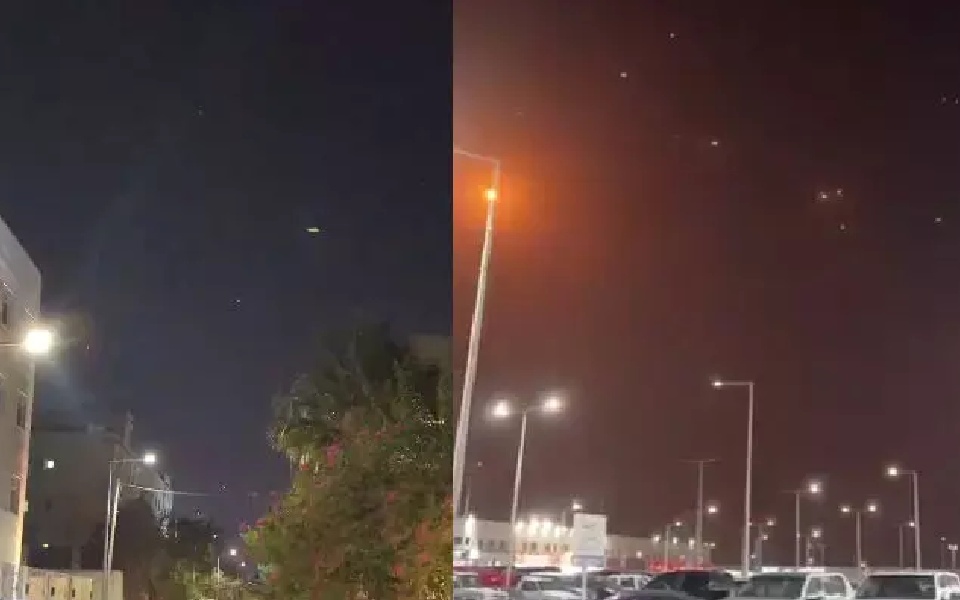
Dubai, Jun 23 (AP): Iran launched missile attacks Monday on US military bases in Qatar and Iraq, retaliating for the American bombing of its nuclear sites and escalating tensions in the volatile region.
Qatar condemned the attack on Al Udeid Air Base attack, but said it successfully intercepted the missiles and no casualties were reported. It said its airspace was now safe.
Iran said the attack in Qatar matched the number of bombs dropped by the United States on its nuclear sites this weekend, signalling its likely desire to de-escalate.
Iran also said it targeted the base because it was outside of populated areas.
Iran announced the attack on state television as martial music played. A caption on screen called it “a mighty and successful response" to "America's aggression.”
The Ain al-Assad base housing US troops in western Iraq was also targeted, an Iraqi security official who was not authorised to comment publicly told The Associated Press on condition of anonymity.
It wasn't immediately clear if there was damage to the Iraq base or any injuries.
Qatar's Foreign Ministry said the attack by Iran's Revolutionary Guards was “a flagrant violation of Qatar's sovereignty, its airspace, and international law.”
Al Udeid is also home to the Combined Air Operations Center, which provides command and control of air power across the region as well as the 379th Air Expeditionary Wing, the largest expeditionary wing in the world.
The retaliation came a day after the US launched a surprise attack Sunday morning on three of Iran's nuclear sites.
Just before the explosions, Iranian President Masoud Pezeshkian wrote on the social platform X: “We neither initiated the war nor seeking it. But we will not leave invasion to the great Iran without answer.”
Earlier in the day, Israel expanded its war against Iran to include targets associated with the country's struggling theocracy, striking the gate of a Tehran prison notorious for holding political activists and hitting the headquarters of the military force that suppressed recent protests.
As plumes of thick smoke rose over Tehran, Israel was attacked with yet another barrage of Iranian missiles and drones. The persistent fire has become a reality for civilians in both countries since Israel started the war to target Tehran's rapidly advancing nuclear programme.
On the 11th day of the conflict, Israel said it attacked “regime targets and government repression bodies in the heart of Tehran,” but Israeli officials insisted they did not seek the overthrow of Iran's government, their archenemy since the country's 1979 Islamic Revolution.
The Israeli military warned Iranians that it would continue to attack military sites around Tehran over “the coming days” as its focuses has shifted to symbolic targets as well. The military issued the warning on the social platform X, though Iranians are struggling to access the outside world as an internet shutdown has crippled the country.
The latest strikes unfolded only hours after President Donald Trump openly raised the possibility himself after just a day earlier inserting America into the war with its unprecedented stealth-bomber strike on three Iranian nuclear sites.
“If the current Iranian Regime is unable to MAKE IRAN GREAT AGAIN, why wouldn't there be a Regime change???” he asked on his Truth Social website.
White House press secretary Karoline Leavitt later described Trump as “simply raising a question.” However, suggestions of overthrowing the Iranian government drew new anger from Tehran, which insists it will not negotiate at this time and is threatening to retaliate directly against either American troops or interests in a Mideast already inflamed by the still-raging Israel-Hamas war in the Gaza Strip.
Tehran strikes open new chapter of war
In the Tehran strikes, Israel blew open a gate at Evin prison. Iranian state television shared black-and-white surveillance footage of the strike at the facility known for holding dual nationals and Westerners often used by Iran as bargaining chips in negotiations with the West.
Evin also has specialised units for political prisoners run by the paramilitary, all-volunteer Revolutionary Guard, which answers only to Supreme Leader Ayatollah Ali Khamenei. The facility is the target of both US and European Union sanctions.
There were no immediate reports of casualties in Iran or significant damage, though the semiofficial Tasnim news agency said there had been a power cut reported outside of Tehran following the Israeli strikes.
Iranian state television also aired footage it described as being shot inside Evin, with prisoners under control inside the facility. However, the Washington-based Abdorrahman Boroumand Center for Human Rights in Iran expressed worry about the condition of prisoners there.
“Many families of current detainees have expressed deep concern about the safety and condition of their loved ones held inside the prison,” it said.
Earlier Monday, Iranian Gen. Abdolrahim Mousavi, the chief of joint staff of armed forces, warned Washington that its strikes had given Iranian forces a “free hand “ to “act against US interests and its army.”
Tens of thousands of American troops are based in the Middle East, many in locations within range of short-range Iranian missiles.
The Israeli military also confirmed it struck roads around Iran's Fordo enrichment facility to obstruct access to the site. The underground site was one of those hit in Sunday's attack by the United States on three nuclear facilities. The Israeli military did not elaborate.
“The Iranian dictator will be punished with full force for attacking the Israeli home front,” Israel's Defense Ministry said.
According to an Israeli official familiar with the government's strategy, Israel is targeting these sites to put pressure on the Iranian administration but is not actively seeking to topple it. The official spoke on condition of anonymity to discuss internal government deliberations.
Nuclear fears mount after US strikes
In Vienna, the head of the United Nations nuclear watchdog said he expected there to be heavy damage at the Fordo facility following Sunday's US airstrike there with sophisticated bunker-buster bombs.
With the strikes Sunday on Iranian nuclear sites, the United States inserted itself into Israel's war, prompting fears of a wider regional conflict. Iran said the US had crossed “a very big red line” with its risky gambit to strike the three sites with missiles and 30,000-pound bunker-buster bombs.
Several Iranian officials, including Atomic Energy Organization of Iran spokesman Behrouz Kamalvandi, have claimed Iran removed nuclear material from targeted sites ahead of time.
Rafael Grossi, the head of the International Atomic Energy Agency, told the agency's board of governors Monday that Iranian Foreign Minister Abbas Araghchi informed him on June 13 that Iran would “adopt special measures to protect nuclear equipment and materials.”
“I indicated that any transfer of nuclear material from a safeguarded facility to another location in Iran must be declared,” Grossi said, without saying whether Iran had responded.
Iran presses on attacking Israel
Iran described its Monday attack on Israel as a new wave of its “Operation True Promise 3,” saying it was targeting the Israeli cities of Haifa and Tel Aviv, according to Iranian state television.
Explosions were also heard in Jerusalem, possibly from air defence systems in action, and Israel's Magen David Adom emergency rescue service said there had been no reports of injuries.
In Israel, at least 24 people have been killed and more than 1,000 wounded in the war. Israeli strikes on Iran have killed at least 950 people and wounded 3,450 others, according to the Washington-based group Human Rights Activists.
The group, which has provided detailed casualty figures from Iranian unrest such as the protests surrounding the death of Masha Amini in 2022, said of those killed, it identified 380 civilians and 253 security force personnel.
Calls for de-escalation
The US described its attack on the Fordo and Natanz enrichment facilities, as well as the Isfahan nuclear site, as a one-off to take out Iran's nuclear program, but Trump has warned of additional strikes if Tehran retaliates.
Mousavi described the American attacks as violating Iran's sovereignty and being tantamount to invading the country, the state-run IRNA news agency reported.
Russia is one of Iran's closest allies and on Monday, President Vladimir Putin said after meeting in Moscow with Araghchi, the Iranian foreign minister, that they had explored “how we can get out of today's situation.”
Putin called the Israeli and American attacks on Iran an “absolutely unprovoked aggression.”
Iran, which insists its nuclear program is for civilian purposes only, previously agreed to limit its uranium enrichment and allow international inspectors access to its nuclear sites under a 2015 deal with the U.S., France, China, Russia, Britain and Germany in exchange for sanctions relief.
But after Trump pulled the US unilaterally out of the deal during his first term, Iran began enriching uranium up to 60 per cent — a short, technical step away from weapons-grade levels of 90 per cent — and restricting access to its nuclear facilities.
Let the Truth be known. If you read VB and like VB, please be a VB Supporter and Help us deliver the Truth to one and all.
Two injuries, one DNF, a DQ as India end messy World Relays campaign

Gaborone (Botswana) (PTI): Amoj Jacob and Ragul Kumar got injured during the men's 4x400m and 4x100 races respectively as India ended their World Athletics Relays campaign in disappointment on the second day of competitions here on Sunday.
The Indian camp had high hopes of making the 2027 World Championships in the men's 4x400m relay but the team did not finish (DNF) the race as Jacob suffered cramps and pulled out of the race after taking the baton from the first leg runner Dharamveer Choudhary. Rajesh Ramesh and Vishal TK were to run in the third and fourth legs.
Those teams which could not qualify for the 2027 Beijing World Championships by reaching the final round of each of the six relay events on Saturday were given another chance in the second qualification round on Sunday.
The top two teams in each of the two heats (in all six relay events) booked the Beijing ticket on Sunday.
India will now have to try and qualify for the World Championships through the Top Lists of the World Athletics, which is a long and tedious process.
In the men's 4x100m race, third leg runner Ragul Kumar fell down the track after failing to hand over the baton inside the exchange zone to fourth leg runner Gurindervir Singh, which clearly showed the lack of coordination among the runners.
Harsh Santosh Raut and Animesh Kujur ran the first two legs.
The Indian quartet was disqualified and Kumar was seen being taken away from the Field of Play with the help of the volunteers.
It was a comedy of errors in the case of the women's 4x100m race, which saw the baton being dropped during an exchange between first leg runner Tamanna and second runner Nithya Gandhe, though the Indians finished the race in 53.09 seconds.
Gandhe started running quite a distance, but after realising that the baton was not in her hand, she turned and ran back to pick it up.
The only silver-lining for the Indian contingent was the national record time in the mixed 4x100m relay race, though the quartet of Ragul Kumar, Nithya Gandhe, Animesh Kujur and Sneha SS finished sixth in heat number two with a time of 41.35 seconds, bettering the previous national mark of 42.30 seconds set in March in Chandigarh.
The mixed 4x400m relay quartet of Theerthesh P Shetty, Kumari Saloni, Nihal William and Rashdeep Kaur ended at fifth in heat number one with a time of 3 minutes and 19.40 seconds.
On Saturday, all the five Indian relay teams had failed to make it to the respective final rounds and thus missed out on the 2027 World Championships berths.