Iran hails nuclear talks in Europe 'constructive'
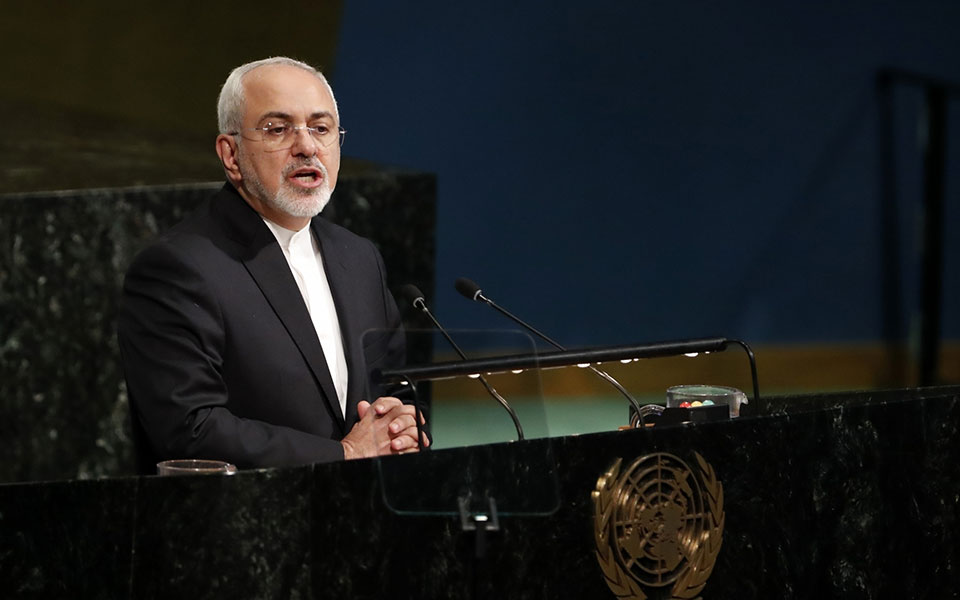
Tehran, July 7 : Iranian Foreign Minister Mohammad Javad Zarif has said the ministerial meeting of the remaining parties to the international 2015 nuclear deal was "constructive".
"I believe that there is a political will to continue work and save this agreement but we must see what will happen to this issue in practice," he was quoted as saying by Press TV on Friday.
On Friday, a ministerial meeting on the Iran nuclear deal, also known as the Joint Commission of the Joint Comprehensive Plan of Action (JCPOA), was held in Vienna, capital of Austria, Xinhua news agency reported.
The meeting was chaired by EU High Representative Federica Mogherini and attended at the ministerial level by China, France, Germany, Russia, Britain and Iran.
Zarif said Iran received an economic package from the European countries two days ago but Iranian President Hassan Rouhani said it is not enough.
On Thursday, Rouhani said the proposal package offered by the EU does not secure Iran's interests in the 2015 deal.
"Unfortunately, in the proposed package, there is no practical measure and specific strategy for cooperation," Rouhani said in a telephone conversation with German Chancellor Angela Merkel, according to IRNA news agency.
The package encompasses "a number of generalities about EU commitments which have also been issued before," he said.
"We expected a vivid plan from the three European countries" of Germany, France and Britain, two months after the US pullout of the JCPOA, the Iranian president noted.
Merkel confirmed that the EU package contains some principles and generalities, stressing that the talks should continue over the details.
"We all know that we want to stay in the nuclear deal, and we believe that we should keep talks in a quite atmosphere," she said.
In another telephone conversation with his French counterpart Emmanuel Macron on Thursday, Rouhani also underlined the need to meet the demands of the Islamic republic by the parties to JCOPA.
The Iranian President highlighted the problems that Washington's unilateral withdrawal from the JCPOA has created for the European companies involved in Iranian projects.
"We expect Europe to offer a clear operational programme with a specific timeframe in order to be able to compensate for the US pullout from the Iran nuclear deal," Rouhani said.
Rouhani has urged the European signatories to the JCPOA to take "practical and tangible measures" to protect Iranian interests after the US pullout.
On Friday, Zarif told reporters in Vienna that Europe must translate its commitment into action before the re-imposition of the US sanctions on Tehran.
Let the Truth be known. If you read VB and like VB, please be a VB Supporter and Help us deliver the Truth to one and all.
Two injuries, one DNF, a DQ as India end messy World Relays campaign
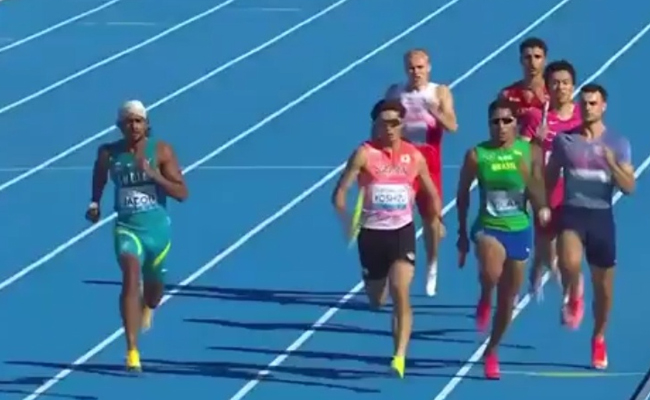
Gaborone (Botswana) (PTI): Amoj Jacob and Ragul Kumar got injured during the men's 4x400m and 4x100 races respectively as India ended their World Athletics Relays campaign in disappointment on the second day of competitions here on Sunday.
The Indian camp had high hopes of making the 2027 World Championships in the men's 4x400m relay but the team did not finish (DNF) the race as Jacob suffered cramps and pulled out of the race after taking the baton from the first leg runner Dharamveer Choudhary. Rajesh Ramesh and Vishal TK were to run in the third and fourth legs.
Those teams which could not qualify for the 2027 Beijing World Championships by reaching the final round of each of the six relay events on Saturday were given another chance in the second qualification round on Sunday.
The top two teams in each of the two heats (in all six relay events) booked the Beijing ticket on Sunday.
India will now have to try and qualify for the World Championships through the Top Lists of the World Athletics, which is a long and tedious process.
In the men's 4x100m race, third leg runner Ragul Kumar fell down the track after failing to hand over the baton inside the exchange zone to fourth leg runner Gurindervir Singh, which clearly showed the lack of coordination among the runners.
Harsh Santosh Raut and Animesh Kujur ran the first two legs.
The Indian quartet was disqualified and Kumar was seen being taken away from the Field of Play with the help of the volunteers.
It was a comedy of errors in the case of the women's 4x100m race, which saw the baton being dropped during an exchange between first leg runner Tamanna and second runner Nithya Gandhe, though the Indians finished the race in 53.09 seconds.
Gandhe started running quite a distance, but after realising that the baton was not in her hand, she turned and ran back to pick it up.
The only silver-lining for the Indian contingent was the national record time in the mixed 4x100m relay race, though the quartet of Ragul Kumar, Nithya Gandhe, Animesh Kujur and Sneha SS finished sixth in heat number two with a time of 41.35 seconds, bettering the previous national mark of 42.30 seconds set in March in Chandigarh.
The mixed 4x400m relay quartet of Theerthesh P Shetty, Kumari Saloni, Nihal William and Rashdeep Kaur ended at fifth in heat number one with a time of 3 minutes and 19.40 seconds.
On Saturday, all the five Indian relay teams had failed to make it to the respective final rounds and thus missed out on the 2027 World Championships berths.