Iran novel coronavirus toll jumps to 145
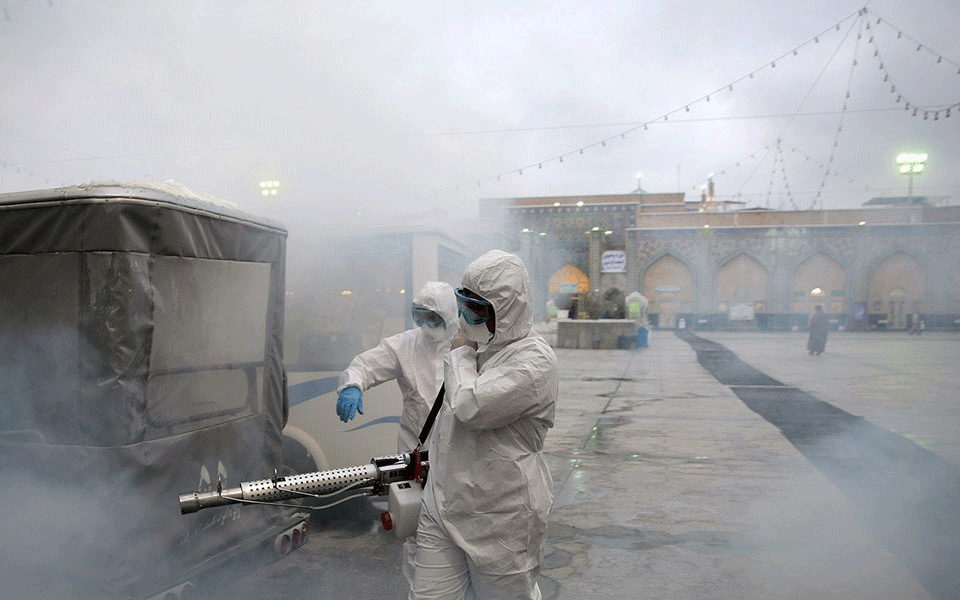
Tehran: The death toll from the novel coronavirus in Iran continued to rise on Saturday with 21 more people killed, including a politician who became the eighth official to succumb to the disease.
Health ministry spokesman Kianoush Jahanpour announced 1,076 additional cases had been confirmed in the past 24 hours, bringing the overall tolls to 145 dead and 5,823 infected.
"More than 16,000 people are currently hospitalised as suspect cases," Jahanpour said during a televised news conference.
He added that 1,669 people who were sick with the COVID-19 illness have recovered.
The Islamic republic is battling one of the world's deadliest outbreaks of the disease outside China, where it originated.
The capital Tehran remains the worst-hit province in the country, with 1,539 confirmed cases.
On Saturday, a newly elected conservative MP for the city was the second Iranian lawmaker killed by the virus, state news agency IRNA reported.
Fatemeh Rahbar, 55, served as MP from 2004 to 2016 and was among the top candidates in Tehran for the conservatives, who overwhelmingly won February's general election marked by the lowest turnout in the Islamic republic's history.
Seven other politicians and government officials have died in the outbreak since the country reported its first cases in mid-February.
Iran has closed schools and universities until early April, as well as suspended major cultural and sporting events and reduced working hours across the country to slow the contagion, which has spread to all of its 31 provinces.
The number of infections is climbing in northern provinces in particular, Jahanpour said.
More than 300 of the new cases reported on Saturday were in Mazandaran province, a popular tourist destination north of Tehran on the Caspian sea.
"Mazandaran is at the top of the list because the necessary limitations (on domestic travelling) were not imposed," Jahanpour added.
"Considering that a minority are not taking the situation seriously and risk their own and others' health, imposing limitations is now on the agenda." Several provinces, including in northern and central Iran, have said they will not provide lodging to tourists in an effort to dissuade people from travelling.
Gilan and Mazandaran police from Friday started preventing cars without local license plates from entering the provinces.
But according to an adviser to the health minister Alireza Vahabzadeh, some locals were bypassing the restrictions by giving non-residents lifts across province borders.
In a tweet, he urged people to "cooperate" with the authorities.
Let the Truth be known. If you read VB and like VB, please be a VB Supporter and Help us deliver the Truth to one and all.
Man arrested with Rs 2.54-crore heroin in Mumbai
Mumbai (PTI): Police have arrested a man and seized over 500 grams of heroin worth Rs 2.54 crore in the illicit market from him in Mumbai, officials said on Friday.
The police's Anti-Narcotics Cell (ANC) made the drug seizure in Santacruz in the western suburbs. The operation was conducted by the Kandivali unit of the ANC on Thursday as part of a special crackdown against drug trafficking in the area, they said.
Acting on specific inputs, an ANC team conducted a raid in Santacruz (East) and intercepted a man. During a search, the team recovered 508 grams of high-grade heroin from his possession, an official said.
The seized contraband, a highly addictive, opioid drug derived from morphine, is estimated to be worth Rs 2.54 crore in the international market, he informed.
Following the seizure, a case was registered against the man under relevant sections of the Narcotic Drugs and Psychotropic Substances (NDPS) Act, 1985, and he was formally placed under arrest in the early hours of Friday.
The police are currently investigating the source of the drug and trying to identify the intended recipients of the consignment, he said.