Iran says downed US drone recovered in its territorial waters
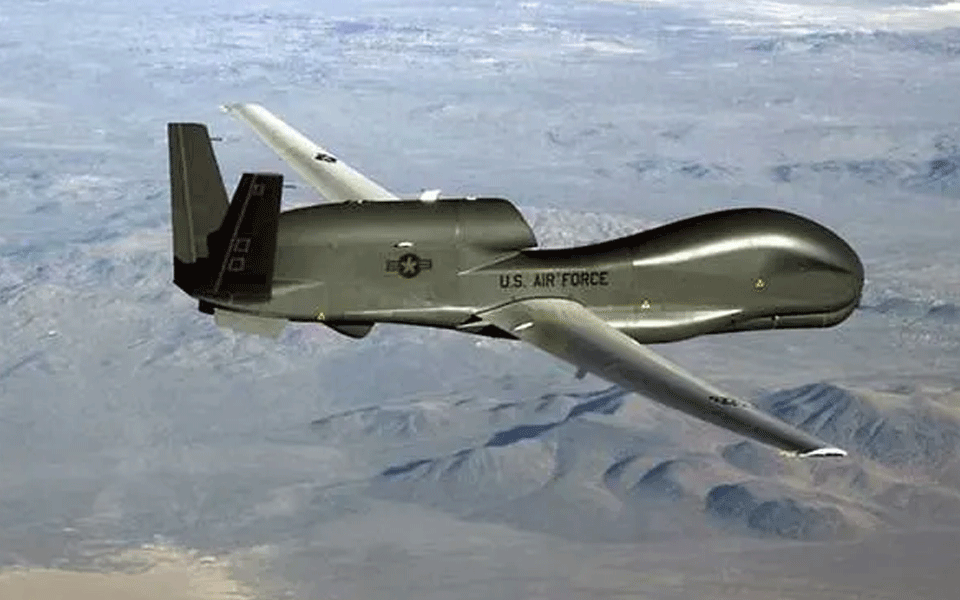
Washington: Iran said Thursday it had recovered parts of a US spy drone in its territorial waters, after downing the aircraft in a missile strike slammed by President Donald Trump as a "big mistake."
Under pressure to respond to the high-stakes incident in the strategic Strait of Hormuz, where a series of tanker attacks have sent tensions soaring with Iran, Trump initially struck a combative tone.
"Iran made a very big mistake!" he tweeted in response to news Iran had shot down the Global Hawk surveillance aircraft -- which the Pentagon says was above international waters at the time.
"This country will not stand for it, that I can tell you," he said later at the White House.
But as the overnight incident whipped up fears of open conflict between the United States and its declared foe Iran -- sending crude oil prices up more than six percent -- Trump moved swiftly to dial back tensions.
"I find it hard to believe it was intentional, if you want to know the truth," Trump said. "I think that it could have been somebody who was loose and stupid that did it." The president's mixed message left the world unsure what Washington's next move would be.
"You will find out," Trump said, when asked about possible retaliation. In Tehran, however, the message came loud and clear.
Foreign Minister Mohammad Javad Zarif announced late Thursday that parts of the drone had been recovered in Iranian territorial waters, as Tehran moved to bring the incident before the United Nations.
"We don't seek war, but will zealously defend our skies, land & waters," Zarif said.
The Pentagon denounced the "unprovoked attack," claiming the navy drone was 34 kilometers (21 miles) from Iran when destroyed by a surface-to-air missile.
But the Islamic Revolutionary Guard Corps said it brought the drone down as it was "violating Iranian air space" over the waters of Hormozgan province.
Zarif provided coordinates to back the claim."At 00:14 US drone took off from UAE in stealth mode & violated Iranian airspace," Zarif tweeted.
"It was targeted at 04:05 at the coordinates (25?59'43"N 57?02'25"E) near Kouh-e Mobarak." "We've retrieved sections of the US military drone in OUR territorial waters where it was shot down."
But the Pentagon published a map showing the flight path of the drone, which indicated it traveled outside of Iranian waters and included a photograph showing it was at the coordinates (25?57'42"N 56?50'22"E) when it was downed.
In a letter to the UN Security Council and UN Secretary-General Antonio Guterres, Iran protested against a "dangerous and provocative act by the U.S. military forces against the territorial integrity of the Islamic Republic of Iran."
The drone downing came as Iran was already accused by Washington of carrying out attacks on oil tankers in the congested Hormuz area.
Tehran denies involvement but has frequently threatened to block the sea lanes used to ship much of the world's oil exports.
The commander of the US Naval Forces Central Command, Sean Kido, said a mine allegedly used in one of the attacks matched Iranian weaponry and that incriminating fingerprints had also been collected.
Trump has repeatedly said he does not favor war with Iran unless it is to stop the country getting a nuclear weapon -- something Iranian leaders insist they are not pursuing.
But Trump critics say his policy of "maximum pressure" -- including crippling economic sanctions, abandonment of an international deal to regulate Iran's nuclear activities, and deployment of extra troops to the region -- make war ever more likely.
A key Republican ally of Trump, Senator Lindsey Graham, said the president's "options are running out." Asked if he believed the countries were nearing conflict, he replied: "I think anybody would believe that we're one step closer."
"They shot down an American asset well within international waters trying to assess the situation. What are you supposed to do?" One of Trump's biggest opponents, the Democratic speaker of the House of Representatives, Nancy Pelosi, warned that "there's no appetite for wanting to go to war in our country."
Israeli Prime Minister Benjamin Netanayahu blasted "Iranian aggression" and said "Israel stands by the United States." But Russian President Vladimir Putin, who has close relations with Iran's leadership, said US military retaliation "would be a disaster for the region."
Trump's arrival in the White House, alongside veteran Mideast hawks like national security adviser John Bolton, has seen sharp deterioration in relations with Tehran.
Trump began last May by abandoning -- and effectively wrecking -- the 2015 international agreement on bringing Iran in from the diplomatic cold in exchange for verified controls on its nuclear industry.
That has prompted Iran to threaten it will stop observing restrictions agreed to under the deal on enrichment of uranium.
The threat has been seen as an effort to pressure European governments that want to save the nuclear deal to push back against Washington. The US State Department called that "extortion."
Let the Truth be known. If you read VB and like VB, please be a VB Supporter and Help us deliver the Truth to one and all.
Online fraud: Hotel chef from Udupi cheated of over Rs 1 lakh by WhatsApp contact
Udupi: Udupi City Police have registered a case of online fraud after a 62-year-old hotel chef was allegedly cheated of Rs 1.13 lakh by a woman who befriended him on WhatsApp, claiming to be based in London.
The victim, identified as Pandu Kariappa Poojary, a resident of Kuthpadi in Udupi, was working at a hotel in Mangaluru.
He reportedly came into contact with a woman identifying herself as Emilda William on WhatsApp. During their interactions, she told Poojary that she planned to start a cosmetics and hotel business in India and would meet him during a visit to Mangaluru.
On April 7, Emilda sent Poojary a flight ticket from London to Delhi via WhatsApp. The following day, Poojary received a phone call from a woman who informed him that Emilda had arrived at Delhi airport carrying a demand draft worth Rs 5 crore along with other items. The caller allegedly asked him to pay Rs 70,000.
Subsequently, Poojary also received a call from Emilda, who was reportedly crying and spoke about the situation. Believing the claims, he transferred a total of Rs 1,13,300 in phases using a scanner. He later realised that he had been cheated.