Ukrainian airplane crashes near Iran's capital, killing 176
Tehran, Jan 8: A Ukrainian airplane carrying 176 people crashed on Wednesday shortly after takeoff from Tehran's main airport, killing all onboard, state TV reported.
The plane had taken off from Imam Khomeini International Airport in the Iranian capital when a fire struck one of its engines, said Qassem Biniaz, a spokesman for Iran's Road and Transportation authority. The pilot of the aircraft then lost control of the plane, sending it crashing into the ground, Biniaz said, according to the state-run IRNA news agency.
The plane carried 167 passengers and nine crew members from different nations on its flight to the Ukrainian capital, Kyiv, Biniaz said. The crash killed all on board, Iranian emergency officials and Ukraine's Foreign Ministry said.
Flight data from the airport showed a Ukrainian 737-800 flown by Ukraine International Airlines took off Wednesday morning, then stopped sending data almost immediately afterward, according to website FlightRadar24. The airline did not immediately respond to a request for comment.
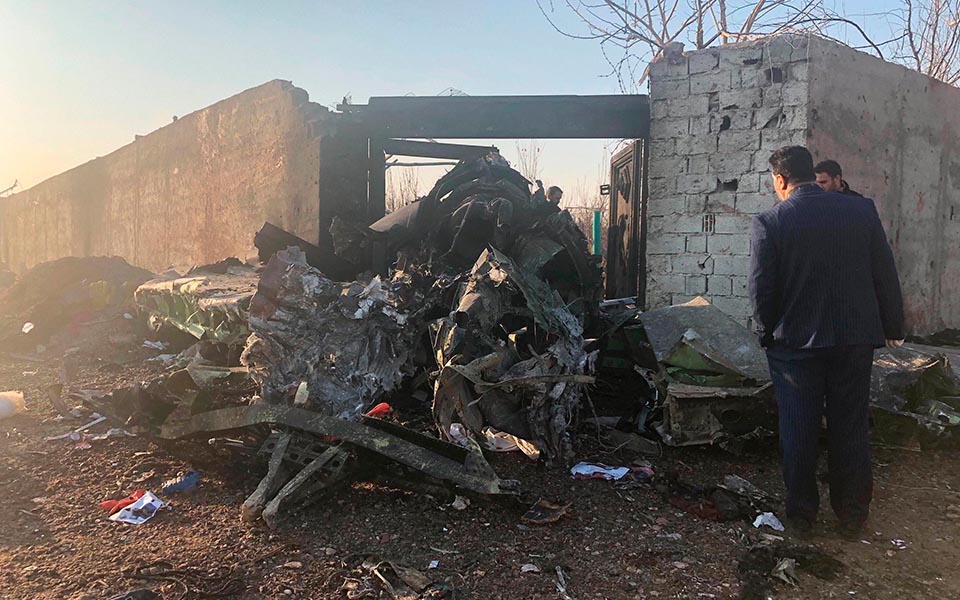
Associated Press journalists who reached the crash site saw a wide field of field of debris scattered across farmland. The dead lay among shattered pieces of the aircraft.
Rescuers in masks shouted over the noise of hovering helicopters as they worked.
The crash came hours after Iran launched a ballistic missile attack targeting two bases in Iraq housing US forces in retaliation for the killing of Revolutionary Guard General Qassem Soleimani.
The Boeing 737-800 is a very common single-aisle, twin-engine jetliner used for short to medium-range flights. Thousands of planes are used by airlines around the world.
Introduced in the late 1990s, it is an older model than the Boeing 737 MAX, which has been grounded for nearly 10 months following two deadly crashes.
A number of 737-800 aircraft have been involved in deadly accidents over the years.
In March 2016, a FlyDubai 737-800 from Dubai crashed while trying to land at Rostov-on-Don airport in Russia, killing 62 onboard. Another 737-800 flight from Dubai, operated by Air India Express, crashed in May 2010 while trying to land in Mangalore, India, killing more than 150 onboard.
Chicago-based Boeing Co was "aware of the media reports out of Iran and we are gathering more information,'' spokesman Michael Friedman told The Associated Press.
Boeing, like other airline manufacturers, typically assists in crash investigations.
However, that effort in this case could be affected by the US sanctions campaign in place on Iran since President Donald Trump unilaterally withdrew from Tehran's nuclear deal with world powers in May 2018.
Both Airbus and Boeing had been in line to sell billions of dollars of aircraft to Iran over the deal, which saw Tehran limit its enrichment of uranium in exchange for the lifting of economic sanctions. But Trump's decision halted the sales.
Under decades of international sanctions, Iran's commercial passenger aircraft fleet has aged, with air accidents occurring regularly for domestic carriers in recent years, resulting in hundreds of casualties.
Let the Truth be known. If you read VB and like VB, please be a VB Supporter and Help us deliver the Truth to one and all.
Mamata visits Bhabanipur EVM strong room, warns against counting irregularities

Kolkata (PTI): West Bengal Chief Minister and TMC supremo Mamata Banerjee early Friday warned against any attempt to tamper with the counting process, hours after she visited an EVM strong room in Bhabanipur, alleging possible malpractice.
Banerjee, who emerged around 12:07 am after spending nearly four hours at the counting centre for her Bhabanipur constituency housed in Sakhawat Memorial School in south Kolkata, said only one person would be allowed inside the designated counting area.
"Either the candidate or one agent can stay upstairs. I have also suggested installation of a CCTV camera for the media," she told reporters.
Stressing the need for transparency, she said, "It is essential to maintain transparency. People’s votes must be protected. I rushed here after receiving complaints. The central forces initially did not allow me to enter."
Sounding a stern note ahead of the May 4 counting, she added, "If there is any plan to tamper with the counting process, it will not be tolerated."
On Thursday evening, Banerjee had reached the Bhabanipur Assembly segment counting centre, which houses the strong room for EVMs used in the April 29 polling, citing suspicion of tampering with the machines.
She entered the premises along with her election agent and remained inside for hours, even as Kolkata Mayor and TMC candidate from the Kolkata Port segment Firhad Hakim reached the spot but could not meet her.
"I reached here upon learning that the chief minister has arrived. But I couldn’t meet her since she was already inside the premises, exercising her right as a candidate to visit strong rooms. I wasn’t allowed there. I will not be able to confirm what exactly is transpiring inside," Hakim said.
The development coincided with protests by TMC candidates Kunal Ghosh and Shashi Panja outside the Khudiram Anushilan Kendra in north Kolkata, where they staged a sit-in alleging irregularities and possible tampering of EVMs stored in strong rooms, leading to face-offs between TMC and BJP supporters.
Earlier in a video message, Banerjee had urged party leaders, workers and polling agents to maintain a 24-hour vigil on EVM strong rooms, alleging that the BJP could attempt to tamper with the machines before counting begins.
Her remarks come amid heightened political tension in the state following a fiercely contested Assembly election, with parties closely monitoring arrangements and raising concerns over transparency.