Iran vows revenge for US attack that killed powerful general
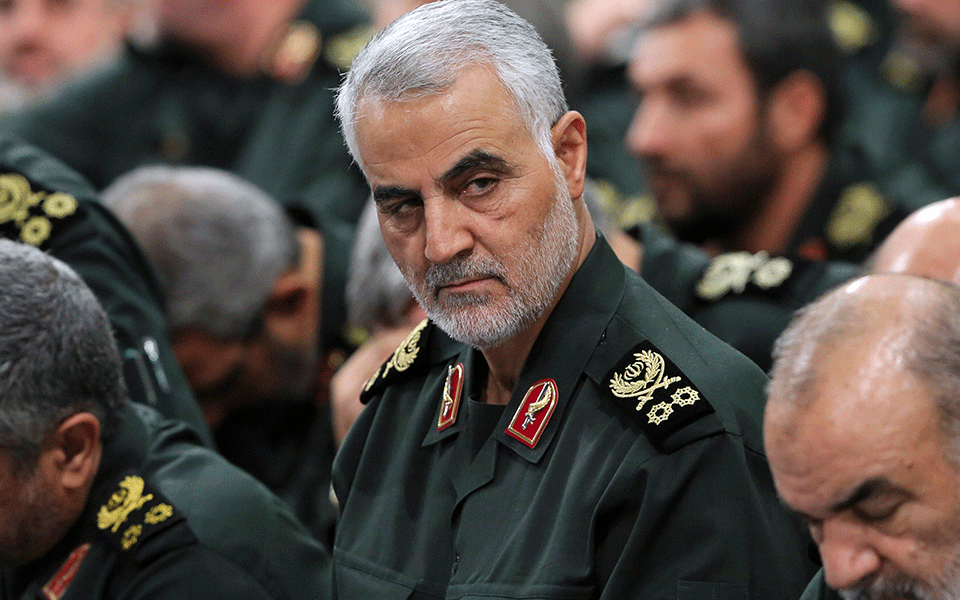
Baghdad: Iran promised to seek revenge for a US airstrike near Baghdad's airport that killed the mastermind of its interventions across the Middle East, and the U.S. said Friday that it was sending thousands more troops to the region as tensions soared in the wake of the targeted killing.
The death of Gen. Qassem Soleimani, head of Iran's elite Quds Force, marks a major escalation in the standoff between Washington and Tehran, which has careened from one crisis to another since U.S. President Donald Trump withdrew from the 2015 nuclear deal and imposed crippling sanctions.
Almost 24 hours after the attack on Soleimani, Iraqi officials and Iranian-backed militias in Iraq reported another deadly airstrike.
An Iraqi government official reported a strike on two vehicles north of Baghdad but had no information on casualties. Another security official who witnessed the aftermath described charred vehicles and said five people were killed. Both officials spoke on condition of anonymity because they were not authorized to speak to the media.
Iraqi state television and the media arm of the Iran-backed militias known as the Popular Mobilization Forces also reported the strike. The group said its medics were targeted.
An American official who spoke on the condition on anonymity denied the U.S. was behind the reported attack.
The targeted strike against Soleimani and any retaliation by Iran could ignite a conflict that engulfs the whole region, endangering U.S. troops in Iraq, Syria and beyond. Over the last two decades, Soleimani had assembled a network of heavily armed allies stretching all the way to southern Lebanon, on Israel's doorstep.
We take comfort in knowing that his reign of terror is over, Trump said of Soleimani.
The United States said it was sending nearly 3,000 more troops to the Middle East, reflecting concern about potential Iranian retaliation. The U.S. also urged Americans to leave Iraq immediately following the airstrike at Baghdad's international airport that Iran's state TV said killed Soleimani and nine others.
The State Department said the embassy in Baghdad, which was attacked by Iran-backed militiamen and their supporters earlier this week, is closed and all consular services have been suspended.
Around 5,200 American troops are based in Iraq to train Iraqi forces and help in the fight against Islamic State militants. Defense officials who discussed the new troop movements spoke on condition of anonymity to discuss a decision not yet announced by the Pentagon.
A Pentagon official who was not authorized to speak publicly said the U.S. also had placed an Army brigade on alert to fly into Lebanon to protect the American Embassy. U.S. embassies also issued a security alert for Americans in Bahrain, Kuwait and Nigeria.
The announcement about sending more troops came as Trump said Soleimani's killing was not an effort to begin a conflict with Iran.
We took action last night to stop a war. We did not take action to start a war, Trump said, adding that he does not seek regime change in Iran.
Iran's supreme leader, Ayatollah Ali Khamenei, vowed harsh retaliation" after the airstrike, calling Soleimani the international face of resistance. Khamenei declared three days of public mourning and appointed Maj. Gen. Esmail Ghaani, Soleimani's deputy, to replace him as head of the Quds Force.
Iranian President Hassan Rouhani called the killing a heinous crime" and said his country would take revenge. Iran twice summoned the Swiss envoy, the first time delivering a letter to pass to Washington.
Iranian Foreign Minister Mohammad Javad Zarif called the U.S. attack a cowardly terrorist action and said Iran has the right to respond in any method and any time.
Thousands of worshipers in Tehran took to the streets after Friday prayers to condemn the killing, waving posters of Soleimani and chanting Death to deceitful America. However, the attack could act as a deterrent for Iran and its allies to delay or restrain any potential response. Trump said possible targets had been identified and the U.S. was prepared. Oil prices surged on news of the airstrike, and markets were mixed.
The killing promised to further strain relations with Iraq's government, which is allied with both Washington and Tehran and has been deeply worried about becoming a battleground in their rivalry. Iraqi politicians close to Iran called for the country to order U.S. forces out.
The U.S. Defense Department said it killed the 62-year-old Soleimani because he was actively developing plans to attack American diplomats and service members in Iraq and throughout the region." It also accused Soleimani of approving orchestrated violent protests at the U.S. Embassy in Baghdad.
The strike, on an access road near Baghdad's airport, was carried out early Friday by an American drone, according to a U.S. official.
Soleimani had just disembarked from a plane arriving from either Syria or Lebanon, a senior Iraqi security official said. The blast tore apart his body and that of Abu Mahdi al-Muhandis, deputy commander of the Iran-backed Popular Mobilization Forces. A senior politician said Soleimani's body was identified by the ring he wore.
Others killed include five members of Iran's elite Revolutionary Guard and Soleimani's son-in-law, Iranian state TV said.
The officials spoke on condition of anonymity because they were not authorized to talk to reporters.
Let the Truth be known. If you read VB and like VB, please be a VB Supporter and Help us deliver the Truth to one and all.
Mamata visits Bhabanipur EVM strong room, warns against counting irregularities
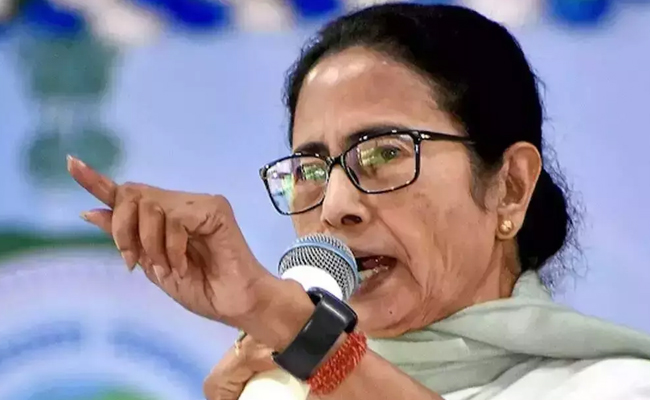
Kolkata (PTI): West Bengal Chief Minister and TMC supremo Mamata Banerjee early Friday warned against any attempt to tamper with the counting process, hours after she visited an EVM strong room in Bhabanipur, alleging possible malpractice.
Banerjee, who emerged around 12:07 am after spending nearly four hours at the counting centre for her Bhabanipur constituency housed in Sakhawat Memorial School in south Kolkata, said only one person would be allowed inside the designated counting area.
"Either the candidate or one agent can stay upstairs. I have also suggested installation of a CCTV camera for the media," she told reporters.
Stressing the need for transparency, she said, "It is essential to maintain transparency. People’s votes must be protected. I rushed here after receiving complaints. The central forces initially did not allow me to enter."
Sounding a stern note ahead of the May 4 counting, she added, "If there is any plan to tamper with the counting process, it will not be tolerated."
On Thursday evening, Banerjee had reached the Bhabanipur Assembly segment counting centre, which houses the strong room for EVMs used in the April 29 polling, citing suspicion of tampering with the machines.
She entered the premises along with her election agent and remained inside for hours, even as Kolkata Mayor and TMC candidate from the Kolkata Port segment Firhad Hakim reached the spot but could not meet her.
"I reached here upon learning that the chief minister has arrived. But I couldn’t meet her since she was already inside the premises, exercising her right as a candidate to visit strong rooms. I wasn’t allowed there. I will not be able to confirm what exactly is transpiring inside," Hakim said.
The development coincided with protests by TMC candidates Kunal Ghosh and Shashi Panja outside the Khudiram Anushilan Kendra in north Kolkata, where they staged a sit-in alleging irregularities and possible tampering of EVMs stored in strong rooms, leading to face-offs between TMC and BJP supporters.
Earlier in a video message, Banerjee had urged party leaders, workers and polling agents to maintain a 24-hour vigil on EVM strong rooms, alleging that the BJP could attempt to tamper with the machines before counting begins.
Her remarks come amid heightened political tension in the state following a fiercely contested Assembly election, with parties closely monitoring arrangements and raising concerns over transparency.