Iranian military mocks Trump's claim of US-Iran negotiations
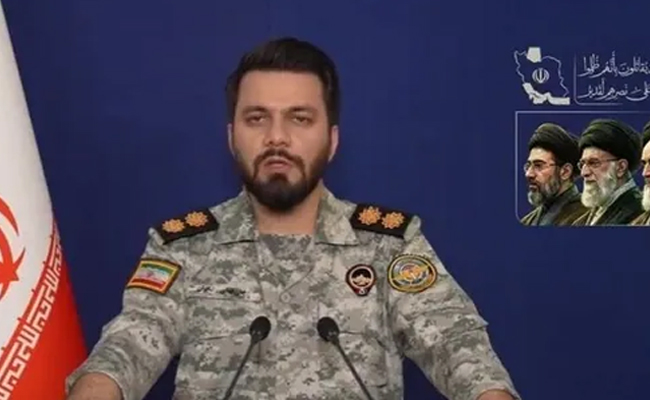
Dubai (AP): An Iranian military spokesperson mocked US attempts at a ceasefire deal Wednesday, raising questions about whether a 15-point plan proposed by Washington has a chance to succeed.
The comments from Lt. Col. Ebrahim Zolfaghari, a spokesperson for the Iranian military's Khatam Al-Anbiya Central Headquarters, which jointly commands Iran's regular military and paramilitary Revolutionary Guard, came after the plan was submitted to Iran by intermediaries.
US President Donald Trump has said that American officials are negotiating with Iran on the plan, but Zolfaghari, in a recorded video statement that aired on state television, suggested there were no talks.
“Have your internal conflicts reached the point where you are negotiating with yourselves?” he said.
“Our first and last word has been the same from day one, and it will stay that way: Someone like us will never come to terms with someone like you,” Zolfaghari said. “Not now, not ever.”
The 15-point plan was submitted to Iran by intermediaries from Pakistan, who have offered to host renewed negotiations between Washington and Tehran, according to the person, who spoke on condition of anonymity because they were not authorised to speak publicly.
The New York Times was the first to report that the plan had been delivered to Iranian officials.
The Pentagon is also in the process of deploying two Marine units that will add about 5,000 Marines and thousands of sailors to the region.
The moves are being framed as Trump maneuvering to give himself “max flexibility” on what he will do next, the person added.
Israeli officials, who have been advocating for Trump to continue the war against Iran, were surprised by the submission of a ceasefire plan, the person said.
The White House did not respond to requests for comment.
Meanwhile, airstrikes battered the Islamic Republic while Iranian missiles and drones targeted Israel and sites across the region.
With oil prices rising and consumers feeling the pain at the pump, Trump has been under increasing pressure at home to bring the war to an end.
Tehran's chokehold on the crucial Strait of Hormuz has snarled international shipping, sent fuel prices skyrocketing and threatened the world economy.
“The strategic power you used to talk about has turned into a strategic failure,” said Zolfaghari, the Iranian military spokesman.
“The one claiming to be a global superpower would have already gotten out of this mess if it could. Don't dress up your defeat as an agreement. Your era of empty promises has come to an end.”
Let the Truth be known. If you read VB and like VB, please be a VB Supporter and Help us deliver the Truth to one and all.
Women’s Reservation Bill: K'taka CM accuses PM Modi of adopting 'double standard'
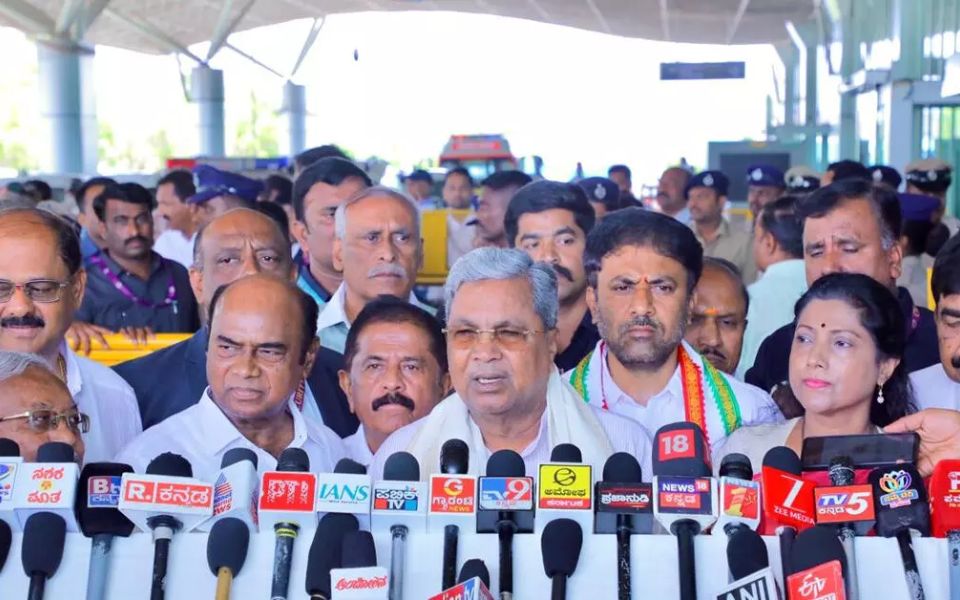
Mysuru (Karnataka) (PTI): Karnataka Chief Minister Siddaramaiah on Monday accused Prime Minister Narendra Modi of adopting a “double standard” on women’s reservation, alleging that the Centre had delayed implementation despite having the opportunity to act earlier.
Addressing reporters here, Siddaramaiah said the BJP and Modi had earlier opposed welfare guarantees and were now replicating them, while also questioning the timing and intent behind the women’s reservation move.
“That’s what I call double standards. Narendra Modi is not for social justice. If he was, this would have been done long ago. How many years has he been in power? It’s been 12 years. Why hasn’t it been done so far?” he asked.
The Chief Minister reiterated that the Congress had consistently supported women’s reservation and accused the Centre of "politicising" the issue.
“We spoke about women’s reservation. The Prime Minister asked me what our stand was. I said we are in favour of women’s reservation,” he said, referring to recent discussions with the PM.
He maintained that delimitation should only be carried out after a fresh Census to ensure equitable representation among states.
“In my view, delimitation should be done after a new census. That is why we opposed it. We have not opposed women’s reservation. We have always supported it,” he said.
Highlighting Congress’ past role, he said, “Who brought the 73rd and 74th amendments? Rajiv Gandhi and the Congress party. Those amendments ensured 50 per cent reservation for women in local bodies. Why would we oppose it?”
Siddaramaiah further questioned the union government’s delay in implementation. “Narendra Modi indulged in politics and got it passed in 2023. Why didn’t he implement it immediately? Then why did he wait so long? He could have implemented it immediately. If he is committed to women’s reservation, he should have implemented it,” he said.
On the linkage between delimitation and reservation, he asked, “Why did the Centre link it with delimitation? Why did it go for a constitutional amendment?” adding that such a move could disadvantage southern states that have successfully controlled population growth.
“Southern states have controlled population well, but northern states haven’t. Naturally, it benefits them and disadvantages us,” he said.
Responding to BJP’s criticism that women would “teach Congress a lesson,” Siddaramaiah said, “They are doing politics. If Modi had brought this earlier, who would have opposed women’s reservation?”
On electoral prospects elsewhere, he said he had no direct information on Tamil Nadu but was optimistic about ruling DMK's victory.
"According to the information I have, DMK and its alliance are likely to win,” while asserting that Kerala would also be won by the opposition.
In a major setback to the BJP-led Central government, a Constitution Amendment Bill to implement 33 per cent reservation for women in legislatures in 2029 and increase the number of Lok Sabha seats to 816 was defeated on Friday, with the ruling dispensation asserting that the struggle to give the rights to women will continue.
While 298 members voted in support of the bill in Lok Sabha, 230 MPs voted against it. Out of 528 members who voted, the bill required 352 votes for a two-third majority.
According to the Constitution (131st Amendment) Bill, Lok Sabha seats were to be increased to 816 from the current 543 to "operationalise" the women's reservation law before the 2029 parliamentary polls, following a delimitation exercise based on the 2011 Census.
Seats were also to be increased in state and Union territory assemblies to accommodate 33 per cent reservation for women.